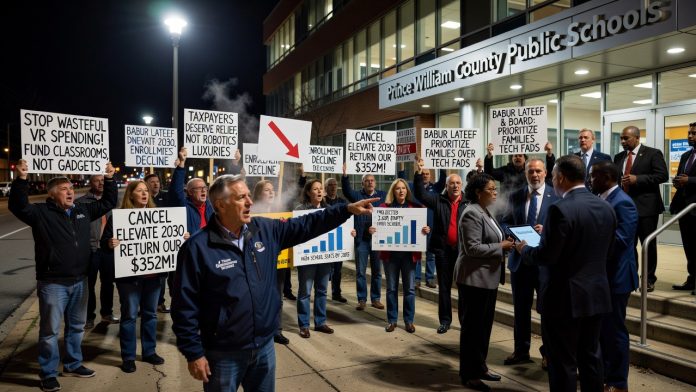
Prince William County taxpayers are facing another massive financial burden as the local school district pushes forward with a staggering 2.9 billion dollar budget for the 2027 fiscal year. This newly proposed financial plan heavily prioritizes controversial spending on augmented reality and virtual reality technologies instead of focusing on core educational needs. Fiscal conservatives are raising alarms over these expensive initiatives, arguing that the district should focus on returning surplus funds to hardworking families. Ultimately, this budget represents a missed opportunity to implement true fiscal restraint during a time of widespread economic uncertainty.
The Prince William County School Board, which includes Babur Lateef, Adele Jackson, Loree Williams, Tracy Jenkins, Richard Jessie, Diane Raulston, Justin Wilk, and Lisa Zargarpur, is overseeing this massive spending transition. Officials are currently shifting from the previous Vision 2025 agenda to the newly adopted Elevate 2030 strategic plan. This transition includes heavily funded projects that reallocate millions of dollars instead of reducing the overall financial burden on local residents. Taxpayers are increasingly frustrated by a board that seemingly views every canceled project as an excuse to fund new bureaucratic programs.
Questionable Spending Priorities
A primary point of contention among conservative watchdogs is the allocation of 17 million dollars for two new robotics centers. Gar-Field High School in the eastern part of the county and Unity Reed High School in the west are each slated to receive 8.5 million dollars for these specialized facilities. While STEM education holds undeniable value, critics question the necessity of such exorbitant price tags for localized centers during a time of economic strain. Hardworking citizens want to know why basic classroom instruction is being overshadowed by multimillion-dollar building projects that only serve a fraction of the student body.
Adding to these budgetary concerns, the school district is planning significant investments in augmented and virtual reality technologies for daily classroom use. Superintendent LaTanya McDade has publicly praised these initiatives, claiming they will expand personalized and adaptive learning environments across the county. However, taxpayers are left wondering if purchasing expensive virtual reality headsets is a prudent use of public funds when traditional educational fundamentals often require more attention. Investing heavily in fleeting technological trends is a classic example of wasteful government spending that fails to guarantee improved student outcomes.
Reallocation Instead of Relief
The funding for these modernization projects was made possible by the abrupt cancellation of a previously planned fourteenth high school in the county. District officials noted that the estimated cost for this new facility skyrocketed from 223.8 million dollars to approximately 352 million dollars in just one year. This staggering increase of over 128 million dollars forced the district to abandon the project entirely, revealing severe flaws in their initial financial projections. Rather than returning these unexpected savings to the taxpayers, officials immediately funneled the money into alternative spending avenues.
Ignoring Demographic Realities
The justification for canceling the new school also highlights a troubling demographic trend that local leaders seem hesitant to address directly. Student enrollment is projected to decline significantly over the coming years due to lower birth rates, an aging population, and an alarming rate of outmigration from the area. In fact, current projections indicate a massive surplus of 3,601 high school seats by the year 2035. Families are clearly leaving the county, yet the government continues to tax and spend as if the region is experiencing unprecedented growth.
Despite this projected surplus of space and fleeing populations, school leadership remains stubbornly committed to finding new ways to spend taxpayer money. Chairman Babur Lateef expressed his full support for the budget, specifically highlighting the initial funding for universal preschool programs. Fiscal conservatives argue that expanding government-funded preschool is an overreach that artificially inflates the budget and places unnecessary long-term financial burdens on local property owners. Expanding the size and scope of the public school system while enrollment drops is a contradictory policy that defies basic economic logic.
As the district implements the Capital Improvement Program for the coming years, local taxpayers must demand greater accountability and strict fiscal restraint. Instead of redirecting canceled construction funds into expensive virtual reality gadgets and expanding government programs, the board should prioritize substantial tax relief. True fiscal responsibility requires cutting wasteful spending, eliminating unnecessary programs, and respecting the financial limits of the hardworking citizens of Prince William County. Moving forward, the community must hold these elected officials accountable for their reckless spending habits and demand a budget that respects the taxpayer.