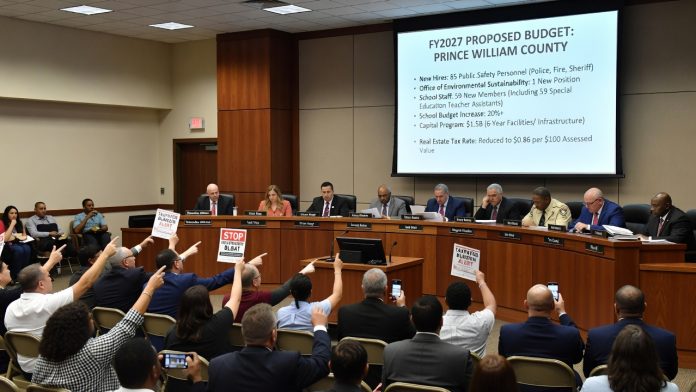
Prince William County taxpayers are facing another year of massive government expansion as the proposed FY2027 budget introduces sweeping spending increases across multiple departments. Despite a modest reduction in the real estate tax rate, the overall county government budget is slated to grow by an alarming ten percent compared to the previous year. Fiscal conservatives are raising red flags over this aggressive growth, warning that unchecked spending on new administrative positions and expanding programs will ultimately burden hardworking families. The sheer volume of newly hired staff points to a growing bureaucracy that prioritizes government bloat over meaningful taxpayer savings.
The spending plan must be reviewed by the Prince William County Board of Supervisors, which currently includes Deshundra Jefferson, Yesli Vega, Victor Angry, Andrea Bailey, Kenny Boddye, Margaret Franklin, Bob Weir, and Tom Gordy. These elected officials are tasked with navigating a budget that includes a staggering billion-dollar transfer to the school system. Furthermore, the Prince William County School Board, consisting of Babur Lateef, Adele Jackson, Lisa Zargarpur, Tracy Meadows, Isis Otero, Richard Jessie, Justin Wilk, and Loree Williams, is overseeing a separate budget that balloons by over twenty percent. Taxpayer advocates are urging both boards to heavily scrutinize these financial documents to eliminate waste, fraud, and unnecessary expenditures.
Questionable Spending on Environmental Bureaucracy
One of the most glaring examples of unnecessary government expansion in the FY2027 budget is the continued funding of environmental initiatives that do little to improve core county services. The budget includes funding for a brand new position within the Office of Environmental Sustainability, adding permanent payroll obligations for taxpayers to shoulder. Additionally, the school budget carves out an extra three hundred and thirty-three thousand dollars specifically for environmental sustainability programs. Critics argue that these funds would be better spent on direct educational materials or returned to the taxpayers entirely, rather than funding niche ideological projects.
Every new administrative position created by the local government represents a permanent drain on public resources, complete with salaries, benefits, and eventual pension payouts. Fiscal watchdogs consistently warn that creating specialized offices for environmental sustainability distracts from essential municipal duties like road maintenance and public safety. When local governments prioritize trendy environmental initiatives over basic fiscal restraint, the financial burden inevitably falls on residential property owners. Trimming these newly proposed administrative roles would be a simple and effective first step toward reining in runaway county spending.
School Budget Explosion and Massive Hiring
The financial demands of Prince William County Public Schools represent the largest driver of overspending in the FY2027 proposal. The county is planning a massive transfer of over one billion dollars to the school system, which constitutes a twelve and a half percent increase from the previous fiscal year. This massive influx of cash is fueling an aggressive hiring spree, including the addition of fifty-nine new full-time special education teacher assistants at a cost of nearly three million dollars. While supporting vulnerable students is a priority, adding dozens of permanent staff members requires a long-term financial commitment that taxpayers will be forced to fund for decades.
In addition to the new hires, the school budget includes an across-the-board average pay increase of over six percent for all school employees, with certified teachers receiving a six and a half percent bump. School Board Chairman Babur Lateef praised the spending plan, stating he was excited that the budget would begin funding universal pre-kindergarten and other strategic initiatives. Superintendent LaTanya McDade also championed the financial blueprint, calling it a pivotal moment that bridges the transition between two massive strategic plans. However, fiscal conservatives point out that the school system’s total budget is growing by over twenty percent, largely driven by a massive hundred and sixty-eight million dollar increase in the construction fund.
Balancing Public Safety Needs with Fiscal Restraint
Public safety remains a core function of local government, and the FY2027 budget does include significant investments in this critical area. The proposal adds eighty-five new public safety positions across the police, fire, and sheriff departments, along with one million dollars designated for expanded firefighter physicals. Furthermore, the county is committing to a massive six-year capital program for facilities and infrastructure that totals over one and a half billion dollars. While keeping the community safe is non-negotiable, conservatives emphasize that such massive capital expenditures must be strictly audited to prevent contractor fraud and cost overruns.
County executives have defended the spending spree by pointing to a slight reduction in the real estate tax rate, which was lowered from ninety cents to eighty-six cents per hundred dollars of assessed value. Officials claim this will result in an average residential tax bill decrease of fifty-six dollars compared to the previous year. However, fiscal conservatives argue that a fifty-six dollar savings is entirely inadequate when the local government is simultaneously increasing overall spending by hundreds of millions of dollars. True fiscal responsibility requires actively shrinking the size of government and slashing bloated departmental budgets, rather than merely offering token tax reductions while expanding the bureaucracy.
Email the Board of Supervisors At:
Chair At-Large (Deshundra Jefferson) – djefferson@pwcgov.org,
Brentsville (Tom Gordy): tgordy@pwcgov.org,
Coles (Yesli Vega): yvega@pwcgov.org,
Occoquan (Kenny Boddye): kboddye@pwcgov.org,
Potomac (Andrea Bailey): abailey@pwcgov.org,
Woodbridge (Jeannie LaCroix): jlacroix@pwcgov.org,
General Board: bocs@pwcgov.org,