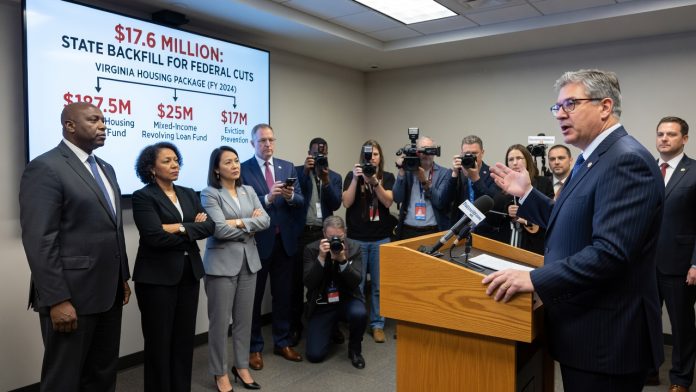
The Virginia General Assembly recently advanced a state budget that includes a controversial $17.6 million allocation to backfill federal funding cuts for rapid rehousing programs. This multi-million dollar expenditure represents a significant shift in financial responsibility, transferring the burden of federal shortfalls directly onto the shoulders of Virginia taxpayers. Fiscal conservatives are raising alarms over this aggressive expansion of state spending, arguing that bailing out Washington’s budget deficits sets a dangerous and unsustainable precedent.
The $17.6 million rapid rehousing bailout is merely one component of a massive state housing package pushed by Democratic lawmakers. This expansive legislative effort also funnels $187.5 million into the Virginia Housing Trust Fund, $25 million into a mixed-income housing revolving loan fund, and another $17 million toward eviction prevention assistance. Critics argue that this sprawling network of subsidies vastly inflates the state budget and creates long-term financial liabilities for the Commonwealth. By continuously pumping taxpayer dollars into these programs, the state risks fostering a cycle of dependency rather than encouraging true economic independence.
Shifting the Burden to State Taxpayers
Historically, the Continuum of Care program relied heavily on federal resources, which provided at least $42.5 million annually to support housing for over 2,000 households across Virginia. However, recent federal cuts have left a massive funding gap that state leaders are now rushing to fill with local tax revenues. House Appropriations Chair Luke Torian defended this maneuver by claiming that Virginians should not become collateral damage due to decisions made in Washington. He further characterized the budget maneuver as an act of prudence, though conservative watchdogs view it as a textbook example of unbridled government overreach.
Torian also argued that the budget is fundamentally about affordability and ensuring families can build stable and secure lives. However, fiscal conservatives maintain that true affordability is achieved by lowering taxes, cutting bureaucratic red tape, and allowing citizens to keep more of their hard-earned money. Funneling millions into the Department of Housing and Community Development only expands the administrative state while offering little guarantee of long-term programmatic success. Government-funded rapid rehousing often acts as a temporary bandage that fails to address the root causes of economic instability, potentially leading to widespread waste and fraud.
Questionable Claims of Fiscal Responsibility
Democratic leaders, including Speaker Don Scott, Leader Charniele Herring, and Chair Kathy Tran, recently released a joint statement praising the massive spending package. They boldly claimed that they delivered on their promise to build an affordable Virginia through what they described as a fiscally responsible budget. These lawmakers insisted that their financial blueprint prioritizes areas where families are hurting the most, specifically targeting housing, healthcare, and childcare costs. Yet, conservative analysts quickly pointed out that increasing state expenditures by tens of millions of dollars to cover federal shortfalls is the exact opposite of fiscal responsibility.
When state governments volunteer to backfill federal funding cuts, they essentially give Washington politicians a free pass to continue their reckless financial behavior. Virginia taxpayers are already stretched thin by inflation and high living costs, making this additional burden entirely unjustified and economically harmful. Instead of tightening the belt and finding ways to reduce government bloat, state officials are choosing to dramatically increase public spending. This approach completely ignores the fundamental conservative principles of limited government, strict budget management, and the protection of taxpayer assets.
Protecting the Taxpayer Moving Forward
In order to protect the financial future of the Commonwealth, lawmakers must strongly resist the urge to replace every lost federal dollar with state revenue. True fiscal prudence requires making tough choices, auditing existing programs for fraud, and eliminating wasteful spending across all government agencies. If Virginia wants to foster genuine economic growth, the focus must shift toward empowering the private sector rather than expanding public welfare initiatives. Ultimately, safeguarding taxpayer money should always remain the top priority for those entrusted with managing the state budget.
Moving forward, conservative leaders must demand rigorous audits of the Continuum of Care organizations and the broader rapid rehousing initiatives to ensure funds are not being mismanaged. Every single dollar allocated from the state treasury must be tracked with absolute transparency to prevent the kind of systemic fraud often seen in large-scale government housing programs. Taxpayers deserve to know exactly how their money is being spent and whether these programs are actually delivering measurable results. Without strict oversight and a commitment to reducing the overall budget, Virginia risks sliding further into a quagmire of endless public spending and higher taxation.