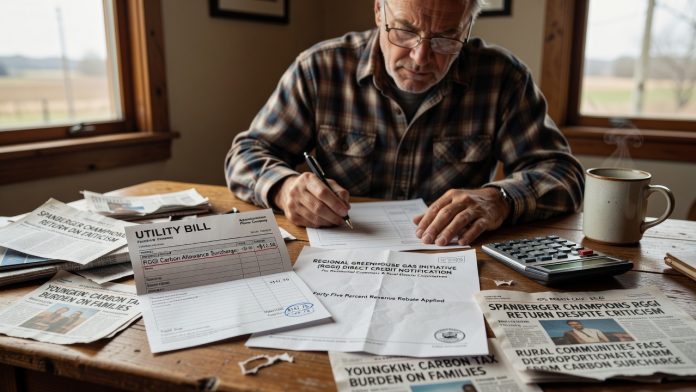
The recent passage of the Virginia state budget marks a controversial return to the Regional Greenhouse Gas Initiative, a move that critics argue will unnecessarily burden hardworking taxpayers. Governor Abigail Spanberger has championed this re-entry, despite clear evidence that the program functions as a hidden carbon tax on everyday utility consumers. To mitigate the self-inflicted financial damage, the new budget includes a provision returning forty-five percent of collected revenues as rebates to residential and small commercial customers. However, conservative watchdogs point out that taking money from citizens only to return a fraction of it is a textbook example of government inefficiency and overspending.
Virginia initially joined the Regional Greenhouse Gas Initiative under former Governor Ralph Northam before wisely withdrawing under Governor Glenn Youngkin. Youngkin correctly identified the initiative as a punitive tax on ratepayers that directly increased electricity bills for families already struggling with inflation. Now, the new budget for the upcoming biennium reverses that taxpayer protection and forces Virginia back into the multi-state carbon market. Projections indicate that the state could collect up to three times the two hundred fifty million dollars it took in during its previous participation, representing a massive extraction of wealth from the private sector.
The Hidden Cost of Carbon Taxation
The financial impact of re-entering this climate pact is expected to hit household budgets immediately and noticeably. The carbon allowance surcharge mandated by the program is projected to increase typical residential electricity bills by six to seven and a half percent. For the average Virginia family, this translates to an additional ten to thirteen dollars extracted from their wallets every single month. While this might seem insignificant to wealthy politicians, it represents a tangible hardship for rural communities, small businesses, and fixed-income seniors facing an ongoing affordability crisis.
In an attempt to pacify frustrated taxpayers, the state government has designed a convoluted rebate system managed by the State Corporation Commission. The budget mandates that forty-five percent of the tax revenue collected by utilities like Dominion Energy and Appalachian Power Company will be returned as direct credits. These rebates are specifically targeted toward residential consumers, small general service businesses, and church class customers. Nevertheless, fiscal conservatives argue that allowing the government to keep fifty-five percent of an unnecessary tax is a poor excuse for utility bill relief.
Rural Communities Bear the Burden
The negative consequences of this carbon tax policy are particularly threatening to the rural areas of the Commonwealth. Recognizing the disproportionate harm inflicted on these communities, the budget incorporates Governor amendments six and six point one to extend rebate eligibility to rural electric cooperatives. While these amendments offer slight relief to rural ratepayers, they primarily highlight the fundamental flaw of imposing metropolitan environmental policies on agricultural and rural regions. Critics maintain that true relief would come from entirely eliminating the surcharge rather than expanding a bureaucratic rebate structure.
Governor Abigail Spanberger recently praised the budget, claiming it invests in cleaner, more affordable, and reliable homegrown energy for the Commonwealth. She further stated that the budget addresses the affordability crisis created by reckless policies out of Washington, a remark that many find ironic given her own administration’s push for this costly carbon tax. By imposing a state-level surcharge that artificially inflates energy costs, the current administration is mirroring the exact type of reckless economic policies it claims to oppose. Taxpayers are left footing the bill for progressive environmental goals while receiving only a partial refund on their own money.
A Call for Fiscal Responsibility
The mechanics of the Regional Greenhouse Gas Initiative inherently promote government overspending and create massive potential for bureaucratic waste. Funneling hundreds of millions of taxpayer dollars through state agencies to administer partial rebates requires administrative overhead that produces absolutely no economic value. Every dollar spent managing this complex carbon credit exchange is a dollar stolen from potential tax cuts, infrastructure improvements, or direct debt reduction. Fiscal conservatives strongly advocate for keeping money in the pockets of Virginians in the first place, rather than cycling it through inefficient government channels.
Ultimately, the decision to force Virginia consumers to pay higher electricity rates to fund a massive state revenue pool contradicts basic conservative principles of limited government. While the promised utility bill credits offer a modest shield against the incoming rate hikes, they fail to address the root problem of unnecessary taxation. Lawmakers must prioritize genuine budget reduction and permanent taxpayer savings over complex wealth redistribution schemes. Protecting the financial well-being of Virginia families requires abandoning punitive environmental taxes and embracing free-market energy solutions that naturally drive down costs.