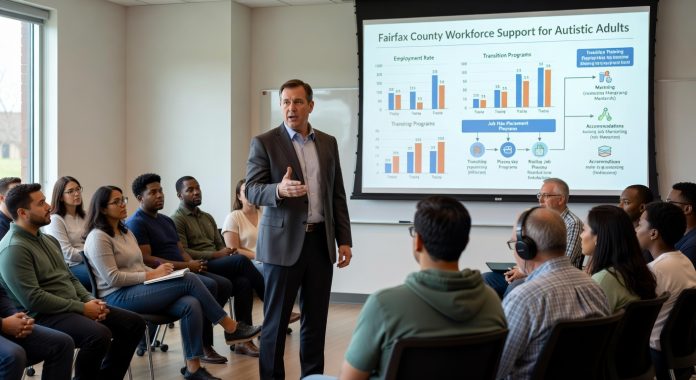
Harrity highlighted the need for programs and other resources that can help autistic individuals succeed in employment settings. He pointed to ongoing research that continues to shape better approaches to adult services across the community.
The discussion centered on the challenges that arise when young adults on the autism spectrum move beyond school-based supports. This period often creates a noticeable gap in available services, sometimes described as a services cliff, where individuals and families must navigate new systems without sufficient continuity.
Community leaders in Fairfax County recognize that autistic adults bring valuable skills and perspectives to the workplace. Harrity stressed that targeted support can help bridge the transition from education to employment, allowing more individuals to contribute meaningfully to the local economy.
Research plays a key role in identifying effective strategies for adult support services. Harrity noted that continued investment in studies helps refine programs that address specific needs related to job training, workplace accommodations, and long-term stability.
Autism Acceptance Month provides an annual opportunity to review progress and identify areas where additional attention is required. In Fairfax County, this includes examining how existing resources can be better aligned to serve adults who are entering or advancing in careers.
Families and advocates have long called for smoother pathways that prevent abrupt loss of support after high school or college. Harrity’s comments underscore the value of proactive planning to reduce disruptions during this critical life stage.
Workforce participation among autistic adults can improve with appropriate guidance on communication, social skills, and job matching. Harrity advocated for expanded options that connect individuals with employers who understand neurodiversity and are willing to implement practical accommodations.
The services cliff remains a significant concern because it can lead to setbacks in employment and independence. Harrity emphasized that addressing this gap requires coordinated efforts between schools, service providers, and local government to maintain continuity.
Research into adult outcomes continues to reveal opportunities for improvement in areas such as job retention and career growth. Harrity pointed out that Fairfax County benefits when more residents with autism are able to participate fully in the workforce.
Programs designed for transition-age youth often focus on building foundational skills that carry over into adult employment. Harrity highlighted the importance of sustaining these efforts through dedicated adult support services.
Autism Acceptance Month encourages broader community involvement in creating inclusive environments. In Fairfax County, this includes promoting awareness among employers about the benefits of hiring autistic individuals and providing necessary resources.
The call for enhanced support services reflects a recognition that many autistic adults face unique barriers when seeking or maintaining employment. Harrity advocated for solutions that prioritize practical assistance tailored to individual strengths and needs.
Continued research helps inform policy and program development aimed at closing service gaps. Harrity noted that Fairfax County remains committed to exploring evidence-based approaches that improve outcomes for autistic adults.
Workforce entry represents a pivotal moment that can shape long-term independence and quality of life. Harrity stressed the need for resources that help individuals navigate this transition successfully.
Community action during Autism Acceptance Month can lead to greater visibility for the challenges faced by autistic adults. Harrity’s remarks serve as a reminder that sustained attention to support services benefits the entire region.
Programs that focus on employment readiness often include training in areas such as interview skills, workplace etiquette, and self-advocacy. Harrity advocated for expanding access to these opportunities for autistic adults in Fairfax County.
The gap in services after adolescence can affect multiple aspects of daily living, including housing, transportation, and social connections. Harrity highlighted the importance of addressing these interconnected needs to support successful workforce participation.
Research continues to advance understanding of how best to assist autistic adults in achieving their employment goals. Harrity pointed to ongoing studies as a foundation for developing more effective local initiatives.
Autism Acceptance Month provides a platform for discussing both achievements and remaining challenges in adult services. In Fairfax County, this includes evaluating how current programs can better meet the needs of those entering the workforce.
Harrity’s advocacy underscores the value of inclusion and the role of targeted support in helping autistic adults thrive professionally. By focusing on resources, research, and coordinated services, Fairfax County aims to reduce barriers and promote greater opportunity.