by Ali Ahmad
A narrow majority of Virginians voted to disenfranchise rural Virginia between Friday, March 6th, and Tuesday, April 21st. This was part of an effort nationwide to elect Hakeem Jeffreys, the New York representative, as Speaker of the House in the coming year.
Without deceptive ballots and millions of dollars in outside funding, the vote could have easily gone the opposite way. It’s not over yet. The vote has to be certified. When, or if that happens, is still an open question.
Legal
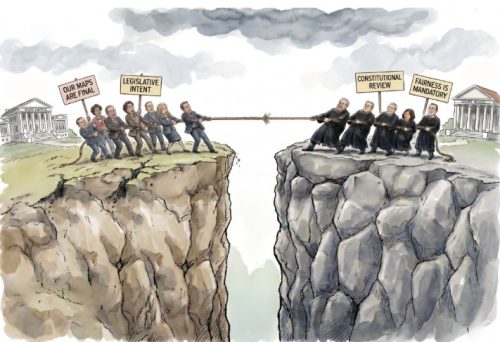
The Supreme Court of Virginia’s (SCOVA) heard the long-awaited oral arguments in Scott v. McDougle.
Zachary Werrell is an author and attorney who has a deep understanding of Virginia politics and law. Werrell said that both sides were asked tough questions, and warned against reading too much into the courtroom dynamics.
He did, however, note that both justices who asked questions were “locked on” to two key issues
First, can the General Assembly not adjourn its special session but then recall it and continue legitimate legislative activities during that recalled session after another regular session?
“Second,” said the General Assembly, “can the General Assembly adopt the proposed constitutional change for the first and only time in a few days after the constitutionally mandated ‘intervening elections’ and meet the procedural requirements and substantive requirements of a constitutional amendment?”
Werrell stated that “the questions themselves appeared to indicate [the Justices] had grave concern over the propriety this amendment.”
The purpose of two separate passages on a constitutional amendment proposed, separated by an election for the General Assembly, is to allow voters to provide indirect feedback by influencing their vote on legislators. This amendment was proposed in a way that is blatant, brazen, and intentional. Its purpose is to undermine the whole reason of having two amendments passed by the legislature separated by elections.
Werrell is not as confident that the Court will decide on the second key question, whether or not the General Assembly may continue its “special session” during regular sessions, and then return, taking legislative actions on issues unrelated to their initial call.
This is an important public policy issue, even if the court does not have a say. Virginia’s Constitution may be silent but it does not envisage a year-round legislative body.
Injunction Upheld
In a separate ruling, the Tazewell circuit court ( RNC V. Koski) has enjoined that the State Board of Elections not certify the results of the elections on April 21, 2026. This is the next important step in the implementation of the rigged map. On Tuesday, SCOVA refused a request by Attorney General Jay Jones for a stay of that injunction.
In a posting on X the former Attorney General Ken Cuccinelli cautions readers against reading tea leaves, but nonetheless notes that “this is a positive ‘tea-leaf’ as one could imagine! Cuccinelli noted also in a news conference following the oral arguments, a decision might not be made until the middle or May.
The move to the rigged map cannot begin if the election is not certified. The voters must be transferred from the existing (fair) district to the new (rigged). Early voting for primaries had been scheduled to begin June 18. For candidates in the Commonwealth, this timetable would become unworkable if certification slipped too far into May.
To get more in-depth analysis and coverage, I recommend that readers follow AG. Cuccinelli, Zachary Werrell as well as former delegate Tim Anderson.
What’s Next? What’s Next?
Lamont Bagby, Richmond Senator and Democrat Leader, has assured rural Virginians of his love for Opie Taylor and the Duke Boys.
Despite all the joking, rural Virginians are being disenfranchised from voting. The absurdity of the 7th district, or other district lines that are distorted has a real impact on Virginia’s delegation. It is the voice of the rural and exurban communities who have been displaced by the voices of those in more densely-populated areas.
It is not comforting to know that this is a temporary affront. Anyone who has observed past redistricting attempts knows the maps will have a significant impact on the next effort, especially if they are in place during the next few election cycles. The 2020 process was intended to be non-partisan and to favor neither political party.
The backlash against the amendment will also favor a single political party. Jeff Ryer’s rhetoric is a good indication that the Republican Party of Virginia has been energized by the redistricting battle.
If the referendum is thrown, this renewed energy will likely have an even bigger impact. They will have a map that is more favorable and a rallying call of “Democrat Overreach”. Democrats will be forced to explain to rural residents why they voted for their disenfranchisement. Democrats will need to explain to voters on the bipartisan maps of district boundaries why they planned to move to another, friendlier district. Last but not least, Democrats will need to explain to their donors why so much money was wasted on a process that is constitutionally dubious.
Ryer stated that “the actions of Governor Spanberger, and the Democrat majority in the General Assembly has united Republicans throughout Virginia.” Their attempts to transform us into “East California”, have united Republicans, and caused revulsion in the majority of Virginians. “We are prepared for the challenges that face us.”
Virginia Public Access Project reports that 11 localities who supported Governor Spanberger’s election in November 2025 voted ‘no’ this year. UVA political analyst J. Miles Coleman points out that nine of the thirteen seats that Democrats will flip in 2025 were voted “no.”
The Jefferson Forum actively opposed the redistricting process. This was not because we are partisans, but rather due to the unfairness and the way the map has been drafted. The only way to guarantee that our bipartisan maps will remain in place, regardless of which party holds the gavel in the General Assembly, is by punishing the party who pushed for this referendum.
Ali Ahmad is a Senior Visiting Fellow at the Jefferson Forum and served as the Deputy Chief of Staff for Governor Glenn Youngkin and may be reached at ali@jeffersonforum.org. This column has been republished with permission from The Jefferson Forum.