
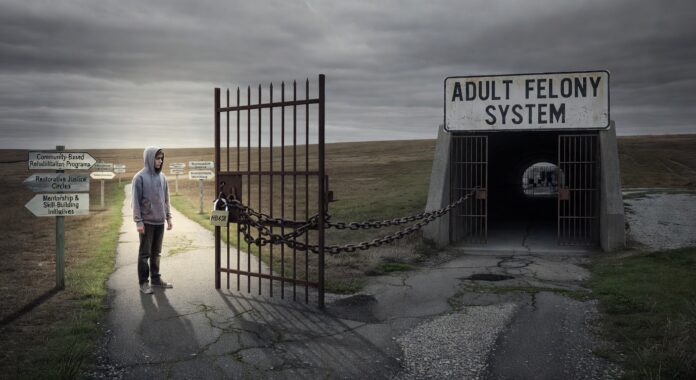
RICHMOND, Va. – The Virginia House of Delegates passed HB 438 on February 17, 2026, by a vote of 63-33, advancing a measure that broadens the ability of courts to divert juveniles accused of serious delinquent acts from formal adjudication proceedings. The bill, patroned by Delegate LeVere Bolling, amends sections of the Code of Virginia related to juvenile intake procedures and adds new provisions for handling delinquency petitions.
Under current law, intake officers are restricted from proceeding informally on complaints involving violent juvenile felonies or cases where the juvenile has prior informal handling or adjudication for adult-equivalent felony offenses. Such cases must proceed to the filing of a petition and formal court process. HB 438 changes this landscape significantly. The House substitute, HB438H1, proposed by the Courts of Justice Committee on February 11, 2026, empowers the court—either on its own initiative or upon motion from the Commonwealth’s Attorney or the juvenile’s counsel—to refer a delinquency petition back to the court service unit for intake at any point prior to the start of an adjudication hearing.
This referral applies even to juveniles charged with violent juvenile felonies or those delinquent for offenses that would constitute felonies if committed by adults, regardless of prior informal proceedings or adjudications for felony-level acts. The legislation amends § 16.1-260 to incorporate this flexibility into the intake process and revises § 16.1-306 on preliminary procedures. It further introduces a new § 16.1-277.3 in Article 8 of Chapter 11 of Title 16.1, outlining dispositions following such referrals.
Key language in the bill states that after referral, the court service unit conducts intake to determine if formal court intervention is necessary. If informal action is deemed appropriate, the unit develops a plan potentially including restitution, community service, or referral to youth justice diversion programs. The court then reviews the recommendation: it can approve the informal plan and continue the case without adjudication, pending successful completion, or dismiss the petition outright upon fulfillment of the plan’s terms.
The bill’s progression through the House underscores deep divisions. Referred to the Courts of Justice Committee upon introduction on January 14, 2026 (prefiled January 12), it received a favorable recommendation with substitute from the Criminal Subcommittee on February 6, 2026, by an 8-2 vote. The full committee endorsed the substitute, leading to second reading and engrossment on February 16. On third reading, the House approved it narrowly, with every one of the 33 nays coming from Republicans: Delegates Austin, Ballard, Bloxom, Cherry, Cornett, Davis, Fowler, Garrett, Griffin, Hamilton, Hodges, Kent, Kilgore, Leftwich, McLaughlin, McNamara, Morefield, Oates, O’Quinn, Pence, Phillips, Tata, Wachsmann, Walker, Ware, Webert, Whittle, Wiley, Williams, Wilt, Wright, Wyatt, and Zehr.
These Republican delegates, representing districts across Virginia from rural Southwest to suburban areas, stood united in opposition, prioritizing accountability for juvenile offenders whose actions mirror adult felonies. Their votes reflect a commitment to ensuring that serious juvenile crimes—such as those involving violence or repeat felony behaviors—face the full scrutiny of the court system rather than potential diversion through informal channels.
In the Senate, HB 438 moved to the Courts of Justice Committee, which reported it with amendments on March 2, 2026, by a unanimous 15-0 vote before rereferring it to Finance and Appropriations. As of March 6, 2026, the bill remains in committee, with its fiscal implications under review following a Fiscal Impact Statement issued by the Department of Planning and Budget on February 20.
Proponents of stricter juvenile justice measures argue that expanding diversion options risks undermining deterrence for young offenders engaged in felony-level conduct. By allowing courts to sidestep adjudication for even repeat or violent cases, the bill could lead to fewer formal records, reduced oversight, and heightened public safety concerns in Virginia communities already grappling with rising youth crime rates. The House Republicans’ bloc rejection highlights a steadfast defense of law enforcement priorities and victim protections.
The original introduced version of HB 438 focused more narrowly on amending § 16.1-260 to permit courts to continue proceedings for violent felonies or repeat felony delinquencies and direct informal intake. The committee substitute expanded the scope, incorporating additional code sections and the new disposition framework, reflecting iterative changes during legislative deliberations.
Virginia’s juvenile justice system has long balanced rehabilitation with accountability, but HB 438 tips further toward informality for high-stakes cases. With the Senate now holding the bill’s fate, attention turns to whether the upper chamber will endorse this shift or heed the House GOP’s call for maintaining rigorous standards for juvenile felons. The measure’s outcome could shape how the Commonwealth addresses youth delinquency in the years ahead, ensuring communities remain secure from unaddressed threats.
NEWSLETTER SIGNUP
Subscribe to our newsletter! Get updates on all the latest news in Virginia.