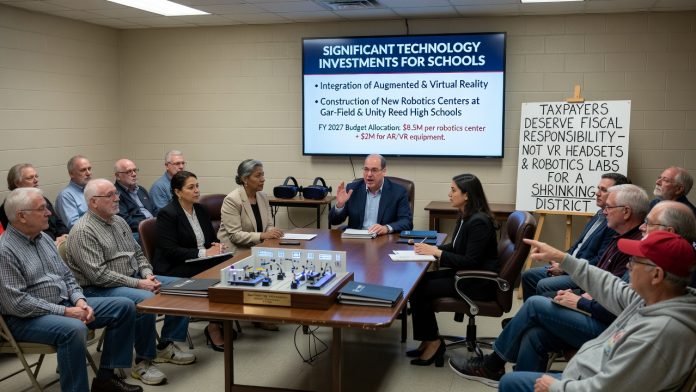
Prince William County taxpayers are facing a staggering financial burden as the local school system pushes forward with a massive fiscal plan. The newly proposed budget and Capital Improvement Program for fiscal year 2027 outline a total investment of nearly three billion dollars over the coming years. Despite this enormous and unprecedented price tag, the public school district is actually projecting a net decrease in student enrollment for the upcoming academic year. Fiscal conservatives are understandably raising alarms over these massive spending increases that seem entirely disconnected from the practical needs of a shrinking student population. Hardworking families are being asked to foot the bill for an expanding bureaucracy that refuses to tighten its own belt.
OVERSEEING THE BUDGET EXPANSION
The Prince William County School Board is ultimately responsible for overseeing this aggressive expansion of taxpayer-funded educational initiatives. Current board members include Babur Lateef, Adele Jackson, Lisa Zargarpur, Jennifer Wall, Diane Raulston, Lillie Jessie, Justin Wilk, and Loree Williams. These elected officials are presiding over a massive county tax transfer to the school system totaling roughly one billion dollars. This staggering sum represents an increase of more than one hundred twenty million dollars compared to the previous fiscal year. Such a dramatic escalation in local funding requirements leaves many residents questioning the fiscal responsibility and basic financial competence of their local government.
QUESTIONABLE TECHNOLOGY EXPENDITURES
A significant portion of this inflated school budget is being directed toward flashy technology projects rather than fundamental academic instruction. District leaders have allocated eight and a half million dollars each to construct new, specialized robotics centers at Gar-Field High School and Unity Reed High School. Furthermore, the budget includes a highly questionable two million dollar investment in augmented reality and virtual reality equipment for local classrooms. While school administrators describe these immersive tools as essential for personalized learning environments, conservative critics view them as expensive digital gimmicks. Spending millions on virtual reality headsets while basic educational benchmarks remain a challenge is a clear example of misplaced priorities and wasteful spending.
REDIRECTED FUNDS INSTEAD OF TAX RELIEF
The funding for these multi-million dollar robotics centers was made possible only by the cancellation of a previously planned high school facility. Scrapping the construction of the much-discussed fourteenth high school reportedly saved the district nearly two hundred million dollars in projected capital expenses. However, instead of returning these substantial savings to the taxpayers or paying down existing municipal debt, the district immediately redirected the funds into new, unnecessary spending projects. Fiscal watchdogs argue that this behavior perfectly illustrates a classic bureaucratic tendency to consume every available tax dollar rather than exercise prudent financial restraint.
DECLINING ENROLLMENT AND RISING COSTS
Perhaps the most troubling aspect of the new financial plan is the stark inverse relationship between student enrollment and district spending. The approved budget clearly accounts for a projected net decrease of more than six hundred enrolled students compared to the previous academic year. Despite educating significantly fewer children across the county, the district is demanding a massive twelve percent increase in local funding transfers. The budget also guarantees an average salary increase of over six percent for all school employees, further driving up the permanent operational costs for local taxpayers. Rewarding a shrinking system with an ever-expanding budget is a recipe for long-term economic disaster in the county.
MISGUIDED STRATEGIC PRIORITIES
School Board Chairman Babur Lateef publicly praised the aggressive spending package and commended the administrative staff who drafted the expensive proposal. He expressed great excitement that the budget begins funding new strategic plan initiatives, specifically highlighting the controversial rollout of universal pre-kindergarten programs. Conservative advocates have long argued that universal pre-kindergarten is an expensive government overreach that inappropriately shifts early childhood development away from families. Expanding the scope of public schooling into early childhood while struggling to efficiently manage the current system represents a deeply concerning departure from responsible governance. Taxpayers simply cannot afford to fund the endless expansion of the public education apparatus.
A CALL FOR FISCAL RESPONSIBILITY
Prince William County residents deserve a school board that genuinely respects the heavy financial burden placed on local taxpayers. Investing in core educational fundamentals should always take strict priority over purchasing virtual reality headsets or building extravagant, specialized robotics facilities. If the district is serving fewer students next year, the corresponding operating budget should reflect those savings rather than ballooning to nearly three billion dollars. True fiscal responsibility requires elected officials to make tough choices, reduce institutional waste, and eliminate unnecessary administrative programs. By reigning in this out-of-control spending, the county can finally protect the financial well-being of its hardworking community members.