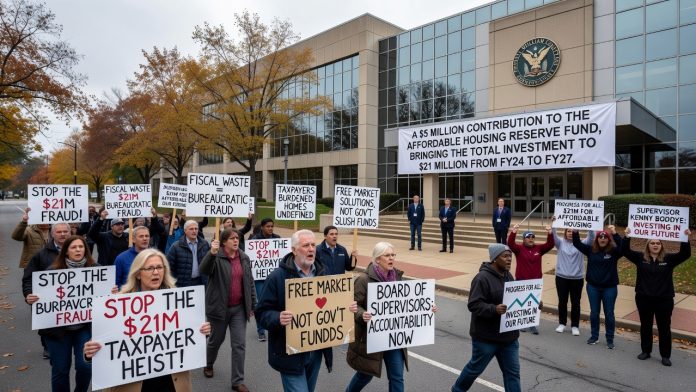
The Prince William County Board of County Supervisors is pushing forward with a massive expansion of government spending by funneling another five million dollars of taxpayer money into the Affordable Housing Reserve Fund for fiscal year 2027. This latest massive appropriation brings the total community investment in this specific fund to a staggering twenty-one million dollars over the four-year period spanning from 2024 to 2027. Fiscal conservatives are raising alarms about this aggressive accumulation of taxpayer wealth for government-subsidized housing initiatives. Taxpayers are left shouldering the burden of these exorbitant costs while inflation and rising living expenses already squeeze local families to their financial limits.
Undefined Projects and Fiscal Waste
Adding insult to injury for the hardworking taxpayer, the specific initiatives funded by this massive twenty-one million dollar pool remain entirely undefined at this stage of the budget process. Official budget documents clearly admit that the specific affordable housing projects are yet to be determined, meaning the government is stockpiling cash without a concrete plan. Future appropriations from this fund may only be authorized by the Board of County Supervisors, but the practice of hoarding millions before identifying a need is a classic hallmark of bureaucratic overspending. Conservative watchdogs argue that allocating funds for vague, future concepts is a direct pathway to government waste and potential fraud.
Accountability and the Board of Supervisors
The responsibility for this massive financial commitment rests squarely on the shoulders of the current Prince William County Board of County Supervisors. The board consists of Chair Deshundra Jefferson, Tom Gordy, Yesli Vega, Bob Weir, Victor Angry, Kenny Boddye, Andrea Bailey, and Margaret Franklin. Local taxpayers are looking to these elected officials to demonstrate fiscal restraint and protect the community from runaway government spending. When millions of dollars are tucked away into reserve funds for undefined housing projects, it signals a troubling departure from the core conservative principles of limited government and strict budgetary discipline.
Political Agendas Over Taxpayer Relief
Proponents of this aggressive spending strategy openly celebrate the diversion of taxpayer dollars into these specialized government accounts. Occoquan District Supervisor Kenny Boddye publicly stated that following days of deliberation, he helped craft a budget that supposedly delivers more for the people of the county. Boddye claimed the budget is not perfect but represents progress, highlighting his pride in targeted investments including five million dollars for the Affordable Housing Reserve Fund. However, fiscal watchdogs warn that this version of progress translates directly into bloated budgets, higher tax burdens, and an ever-expanding local government apparatus.
The Failure of Government Intervention
This massive reserve fund falls under the purview of the Department of Housing and Community Development and aligns with the county’s Quality of Life and Smart Growth strategic plan area. While the title of this strategic initiative sounds appealing to the general public, the reality is often a bureaucratic nightmare that stifles free-market solutions. Subsidizing housing through government intervention historically disrupts the local real estate market and creates long-term dependencies on taxpayer funding. True smart growth should rely on deregulation, lower taxes, and free-market incentives to spur private development rather than relying on a twenty-one million dollar government slush fund.
The Free Market Solution
Fiscal conservatives understand that the most effective way to lower housing costs is to reduce the heavy hand of government regulation and allow private developers to build without excessive red tape. Instead of hoarding twenty-one million dollars in a government reserve, Prince William County could easily return this money to the taxpayers or use it to pay down existing municipal debt. When local governments artificially manipulate the housing market with massive subsidies, they inevitably drive up the overall cost of living for everyone else in the community. Protecting the taxpayer means demanding absolute transparency and refusing to fund pet projects that lack a detailed, itemized justification.
Protecting the Future of Prince William County
As the fiscal year 2027 budget approaches implementation, local residents must remain vigilant and hold their elected officials accountable for every single dollar spent. The five million dollar contribution to the Affordable Housing Reserve Fund is just one symptom of a much larger problem regarding municipal overspending and fiscal irresponsibility. Taxpayers have a fundamental right to demand that their hard-earned money is treated with respect rather than being tossed into an undefined reserve account. Only through strict budgetary oversight and a return to conservative economic principles can Prince William County hope to achieve true financial stability.
Email the Board of Supervisors At:
Chair At-Large (Deshundra Jefferson) – djefferson@pwcgov.org,
Brentsville (Tom Gordy): tgordy@pwcgov.org,
Coles (Yesli Vega): yvega@pwcgov.org,
Occoquan (Kenny Boddye): kboddye@pwcgov.org,
Potomac (Andrea Bailey): abailey@pwcgov.org,
Woodbridge (Jeannie LaCroix): jlacroix@pwcgov.org,
General Board: bocs@pwcgov.org,