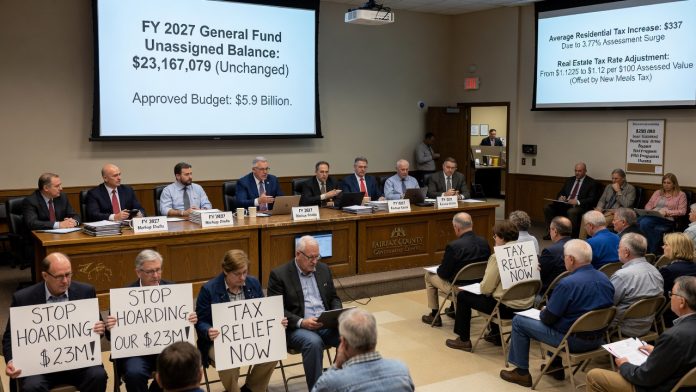
The Fairfax County Board of Supervisors recently concluded their fiscal year 2027 budget markup process, leaving a massive unassigned fund balance completely unchanged at just over $23 million. Despite this available pool of taxpayer money, the newly approved $5.9 billion budget still guarantees an increased financial burden for the average homeowner. Local taxpayers will see their average residential tax bill rise by $337 due to surging property assessments. Residents are questioning why the local government continues to hoard unassigned funds while families struggle to make ends meet under the weight of relentless taxation.
The current Fairfax County Board of Supervisors consists of Chairman Jeffrey McKay, Walter Alcorn, Jimmy Bierman, Pat Herrity, Andres Jimenez, Rodney Lusk, Dalia Palchik, Kathy Smith, and Daniel Storck. These elected officials recently navigated a complex markup process that ultimately maintained the available fiscal year 2027 General Fund unassigned balance at exactly $23,167,079. Throughout the entire add-on package review process initiated by County Executive Bryan Hill, no structural adjustments were made to return these specific unassigned funds to the taxpayers. Critics argue this represents a missed opportunity to significantly reduce the bloated local budget and provide meaningful relief to overburdened working families.
Token tax rate reductions in the new budget fail to provide meaningful relief for working families
The final budget does include a microscopic real estate tax rate reduction of one-quarter of a cent, dropping the rate from $1.1225 to $1.12 per $100 of assessed value. While officials claim this move costs the county nearly $8.8 million, the reduction is largely offset by alternative revenue streams rather than actual spending cuts. Chairman Jeffrey McKay justified the move by noting that people are suffering right now, yet he simultaneously acknowledged that a newly implemented county meals tax provided the revenue necessary to allow for this minor rate drop. Fiscal conservatives point out that substituting a property tax with a new consumption tax does nothing to curb overall government spending or shrink the massive budget footprint.
Furthermore, the slight adjustment to the base tax rate offers little comfort when average residential property assessments have increased by 3.77 percent. Because property values continue to artificially inflate the tax base, the fractional rate decrease is entirely swallowed by the higher assessed values of family homes. Consequently, the average homeowner will still pay exactly $337 more out of pocket this year to fund the county government operations. True fiscal responsibility would require the board to lower the rate below the equalized level, thereby preventing the government from automatically profiting off inflation and housing market volatility.
Questionable spending and administrative bloat continue unchecked despite economic uncertainties
Instead of utilizing the massive unassigned fund balance to offset these mandatory tax hikes, the board opted to restore and expand various social programs and administrative positions. Hundreds of thousands of taxpayer dollars were pumped back into initiatives like a $250,000 low-income home repair pilot program, a $200,000 part-time preschool program, and $310,000 for contracted peer support specialists. At the same time, the county added new full-time equivalent positions to the Department of Economic Initiatives and Land Development Services, further expanding the permanent bureaucratic payroll. While one vacant position was cut from the Office of the Commonwealth’s Attorney to save roughly $112,680, the overall trend reflects a government unwilling to make tough financial sacrifices.
The relentless expansion of the county budget is heavily driven by massive annual increases in educational transfers and specialized housing initiatives. The total financial transfer to Fairfax County Public Schools has increased by an average of nearly six percent annually over the past three years, consuming a massive portion of local tax revenues. Additionally, the board allocated almost $8.8 million toward affordable housing initiatives and set aside another $4.6 million for an economic uncertainty reserve. Taxpayer advocates argue that a government sitting on a $23 million unassigned surplus should be aggressively cutting waste rather than continuously expanding its financial demands on the public.
Commercial real estate struggles continue to shift the heavy tax burden onto residential homeowners
The heavy reliance on residential property taxes is further exacerbated by the ongoing struggles within the local commercial real estate sector. County Executive Bryan Hill recently expressed hope that the county has turned a corner and that a stronger commercial real estate market is beginning to emerge as they right-size office market inventory. However, until the commercial sector fully recovers, residential taxpayers are being forced to shoulder a disproportionate share of the nearly $5.9 billion operational budget. Reducing the size and scope of local government programs would provide a much-needed buffer against these commercial revenue shortfalls without punishing local homeowners.
Maintaining a massive unassigned fund balance while simultaneously raising the average tax bill highlights a fundamental disconnect between local government spending habits and conservative fiscal principles. If Fairfax County officials truly recognized the financial pressures facing their constituents, they would utilize unassigned surpluses to enact deep, meaningful tax cuts instead of hoarding taxpayer cash. Shrinking the overall budget and eliminating bureaucratic bloat are the only sustainable ways to protect taxpayers from endless revenue extraction. Until the board prioritizes aggressive spending reductions over program expansion, working families will continue to foot the bill for an ever-expanding local government apparatus.
Jeffrey McKay (chairman@fairfaxcounty.gov),
Kathy Smith (sully@fairfaxcounty.gov),
Rachna Sizemore Heizer (braddock@fairfaxcounty.gov),
James Bierman (dranesville@fairfaxcounty.gov),
Rodney Lusk (franconia@fairfaxcounty.gov),
Walter Alcorn (huntermill@fairfaxcounty.gov),
Andres Jimenez (mason@fairfaxcounty.gov),
Daniel Storck (mtvernon@fairfaxcounty.gov),
Dalia Palchik (provdist@fairfaxcounty.gov),
Pat Herrity (springfield@fairfaxcounty.gov),