In a stunning display of political theater that only Washington insiders and their coastal enablers could applaud, Virginia’s Democratic Governor Abigail Spanberger rolled out the red carpet—quite literally—for King Charles III and Queen Camilla during their April 30, 2026, visit to the small town of Front Royal. Smiling alongside the British monarch, Spanberger introduced the royal couple to local first responders, veterans, farmers, and even a Little League team as part of America’s 250th anniversary celebrations. Photos captured the governor in her signature blue power suit, clasping hands and posing for pictures with the very embodiment of hereditary rule that America’s Founding Fathers rejected in 1776.
This is the same Abigail Spanberger who just months earlier stood with “No Kings” protesters in Richmond, cheering on crowds railing against supposed authoritarianism in America. The contrast couldn’t be more glaring, and it reveals a deeper truth about modern Democratic politics in Virginia: principles are flexible when royalty wears a crown and waves from across the pond, but “kings” must be opposed when they represent conservative leadership at home.
Front Royal, the charming “Gateway to the Shenandoah,” hosted the royals for a block party and parade to cap their U.S. state visit. Spanberger’s office and local media described it as a “special day,” with the governor personally escorting King Charles and Camilla through interactions with everyday Virginians. One image even shows the group near a baby goat, evoking pastoral British charm amid Virginia’s Blue Ridge backdrop. Spanberger later posted on X about bidding the royals “farewell across the pond,” framing herself as gracious host and diplomat.
For conservatives who value the American Revolution’s core rejection of monarchy—“No taxation without representation,” after all—this fawning over actual crowned heads raises eyebrows. Virginia, the cradle of presidents like Washington, Jefferson, and Madison, fought a war to throw off King George III’s rule. Yet here was a sitting governor, elected in 2025, beaming next to King Charles as if the divine right of kings had suddenly become compatible with Democratic values.
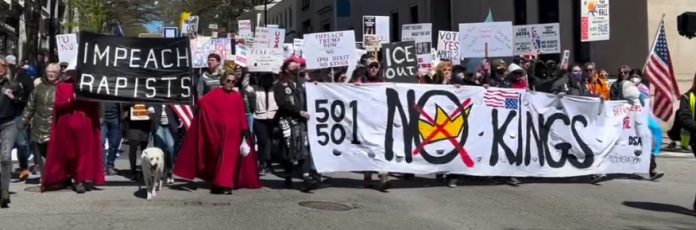
Now rewind to Richmond’s “No Kings” rallies. Throughout 2025 and into 2026, progressive organizers staged multiple large demonstrations across Virginia, including at the state Capitol in Richmond, protesting the Trump administration’s policies. These events, branded explicitly as “No Kings,” drew thousands in Richmond alone, with participants decrying everything from border enforcement to executive actions as tyrannical overreach. Spanberger publicly praised the movement, posting about the “beauty of America” in seeing “millions of people coming together in peaceful protest” and even attending or signaling strong support for the Richmond events.
The rhetoric was fiery: signs reading “No Kings,” costumes mocking authority, and speeches framing the moment as resistance to a new American monarchy under Republican leadership. Organizers tied the protests to opposition against Trump’s second term, portraying conservative governance as incompatible with democracy. Spanberger amplified these voices, positioning herself as a defender of republican principles against any hint of overweening executive power.
The hypocrisy writes itself. When it suits the narrative to attack a duly elected American president as a “king,” Democrats like Spanberger march in solidarity. But when a literal king—complete with titles, palaces, and taxpayer-funded lifestyle—visits Virginia soil, the same governor plays gracious courtier. This selective outrage exposes how “No Kings” was never about consistent anti-monarchical principle. It was a partisan cudgel aimed squarely at conservatives.
From a Republican perspective, this episode underscores the growing disconnect between Virginia Democrats and the Commonwealth’s founding ideals. Virginians cherish limited government, individual liberty, and skepticism of inherited power—values that propelled the Revolution. True conservatives don’t genuflect before foreign royals while demonizing domestic leaders who win fair elections. Spanberger’s actions suggest a worldview where foreign pomp is harmless pageantry, but American voters exercising their will through strong executive leadership is dangerous “authoritarianism.”
Critics on X were quick to pounce after Spanberger’s Front Royal post, with replies mocking the “No Kings” crowd suddenly cozying up to actual royalty. One user quipped about the governor following the king “like a little kid,” while others noted the absence of protesters during the royal visit. The irony resonates particularly in a state like Virginia, where suburban voters in Northern Virginia and Richmond suburbs helped elect Spanberger, yet rural and conservative strongholds remain skeptical of such performative politics.
Economically and culturally, the royal visit brought positive attention to Front Royal. Locals turned out in force, and the event highlighted Virginia’s tourism appeal. Yet conservatives argue this doesn’t excuse the double standard. Supporting “No Kings” rallies that painted half the country as threats to democracy while curtsying to King Charles sends a message that rules apply differently depending on political convenience.
Spanberger, a former CIA officer and moderate Democrat in branding, has governed with progressive priorities on issues like taxation, education, and regulation—policies many Virginia conservatives view as overreach closer to monarchical fiat than the restrained republicanism they prefer. Her enthusiastic participation in both the royal welcome and anti-“king” protests reveals a flexible ideology tailored for electoral success rather than philosophical consistency.
As Virginia heads into future elections, this episode serves as a potent reminder. Republicans should highlight such inconsistencies to remind voters what self-government truly means. America rejected kings in 1776 not just for a foreign monarch, but for the idea that any man—or woman—should rule without accountability to the people. True leaders honor that heritage by respecting voters’ choices, not by selectively cheering or jeering “kings” based on partisan scripts.
Governor Spanberger’s warm embrace of King Charles in Front Royal, juxtaposed against her support for Richmond’s “No Kings” fervor, isn’t mere optics. It’s emblematic of a political class that weaponizes revolutionary rhetoric against opponents while enjoying the trappings of elite globalism. Virginians deserve better: leaders who apply principles evenly, whether the crown is literal or metaphorical. In the battle for the Old Dominion’s soul, conservatives will continue fighting for the republic the Founders envisioned—one without kings of any stripe.
NEWSLETTER SIGNUP
Subscribe to our newsletter! Get updates on all the latest news in Virginia.