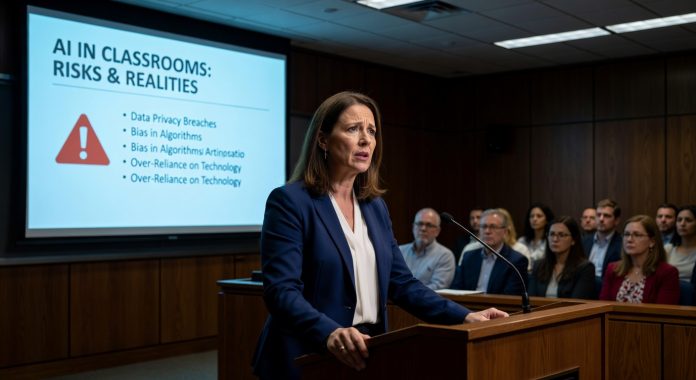
The parent, identifying herself as a concerned FCPS elementary school family member, emphasized that while school administrators are developing an AI policy, the process is steamrolling ahead before any meaningful public input. She contrasted this haste with the deliberate two-year process used for school boundary adjustments, questioning why such patience is absent when the stakes involve far greater consequences for children’s education and safety. ‘Let me be direct, as parents, we demand your attention,’ she stated, outlining three critical areas requiring immediate action.
First, she demanded concrete protocols in classrooms before any AI deployment, warning against placing weak measures first. The draft policy, she noted, lacks any mention of student data protection, a glaring omission especially given FCPS’s data privacy policy has not been updated since 2015, leaving it outdated amid rapid technological advancements. Second, she called for parents to deserve a seat at the table in policy development. Third, she insisted on no further AI rollouts until accountability measures are in place, including a regulatory framework and a dedicated tech and AI advisory committee.
This mother’s testimony underscores a broader pattern of parental frustration in Fairfax County, where community members have repeatedly urged Superintendent Michelle Reid to delay AI adoption. Recent discussions at School Board meetings have highlighted reports, such as one from Brookings, indicating that the risks of AI in schools currently outweigh the benefits. Parents have pointed to issues like potential inaccuracies in AI assessments, privacy breaches from voice recording and data collection, and the disruption of traditional human interaction essential for young learners.
The push for AI comes amid growing national concerns about untested educational technologies. In Fairfax County, with its diverse student body and high-stakes academic environment, introducing experimental AI without rigorous testing raises alarms about equity, accuracy for students with accents or speech issues, and the vulnerability of student data to external exploitation. The absence of parental consent mechanisms and opt-out options mirrors complaints from other districts, where AI tools have caused distress by repeatedly demanding responses or misinterpreting inputs.
From a parental rights standpoint, this situation exemplifies the need for transparency and local control in education. Fairfax County parents are demanding that school leaders commit to open public review of draft policies, ensuring that innovations serve students rather than subjecting them to unproven experiments. The call for a tech and AI advisory body with public participation aligns with principles of accountable governance, preventing top-down impositions that sideline families.
As AI integration accelerates nationwide, Fairfax County’s approach highlights the urgency for caution. Parents argue that true progress in education prioritizes safety, privacy, and proven methods over trendy technologies. When something goes wrong with AI in classrooms—whether algorithmic bias, data leaks, or diminished learning outcomes—accountability must be ironclad. Until these demands are met, vigilant parents will continue sounding the alarm, protecting the next generation from hasty bureaucratic decisions.
The Fairfax County School Board’s response to these pleas will test its commitment to families over administrative agendas. Parents deserve not just a voice, but veto power over risks to their children.
Source: Field reports and eyewitness accounts.