
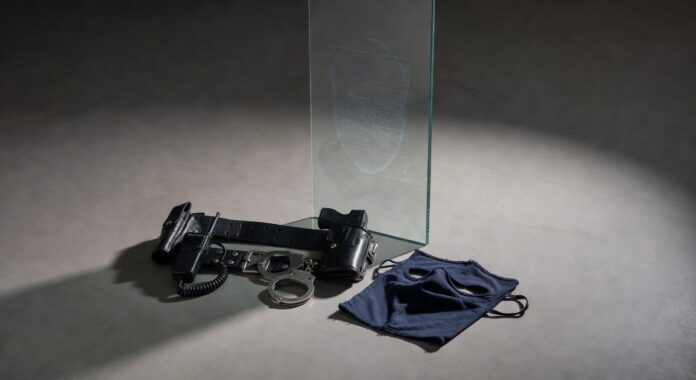
RICHMOND, Va. – In the 2026 Regular Session of the Virginia House of Delegates, House Bill 7 emerged as a targeted measure to enhance transparency and accountability among law enforcement officers by imposing restrictions on the wearing of facial coverings during official duties. Introduced by Delegate Michael Jones as the chief patron, the legislation addresses a critical aspect of public safety and trust in policing by prohibiting certain state and federal law enforcement officers from concealing their identities with facial coverings while performing their responsibilities.
The bill’s core provision establishes a clear prohibition on facial coverings, defined specifically within the text, for officers engaged in official duties. This restriction aims to ensure that officers remain identifiable to the public, fostering greater accountability in interactions with citizens. Recognizing practical necessities, the legislation carves out essential exceptions. These include protective facial coverings designed to shield against disease, infection, or exposure to toxic substances. Additionally, officers assigned to special weapons and tactics teams, commonly known as SWAT, are permitted to wear facial coverings while executing duties with their units. These exemptions balance operational needs with the overriding goal of transparency.
To enforce compliance, HB7 introduces significant disciplinary measures for violations. Officers found wearing prohibited facial coverings face potential consequences including dismissal, demotion, suspension, transfer, or decertification. Furthermore, the bill classifies such violations as a Class 1 misdemeanor, underscoring the seriousness of non-compliance. However, a key allowance exists: if the employing law enforcement agency has adopted and established a written policy governing the use and restrictions on facial coverings, the misdemeanor charge does not apply. This provision encourages proactive policy development at the agency level.
In support of statewide consistency, the legislation mandates the Department of Criminal Justice Services to develop a model policy outlining restrictions on facial coverings for law enforcement officers. This model serves as a blueprint, enabling agencies across Virginia to implement standardized guidelines efficiently.
A standout feature of HB7 is the creation of a civil cause of action for individuals injured due to tortious conduct by an officer who knowingly and intentionally wears a facial covering in violation of the bill’s terms. This empowers victims to seek redress directly, with the bill explicitly stating that sovereign immunity shall not serve as a defense in such cases. This mechanism strengthens public recourse and reinforces the principle that law enforcement must operate under the same accountability standards as other public servants.
The legislative journey of HB7 began with prefiling on November 20, 2025, when it was ordered printed and offered for the session starting January 14, 2026, under print number 26101899D. That same day, it was referred to the House Committee on Public Safety. Fiscal impact statements from the Department of Planning and Budget were issued on November 20, 2025, and again on January 19, 2026, evaluating the bill’s potential budgetary effects.
Despite these steps, the bill encountered a setback on February 18, 2026, when it was left in the Public Safety Committee, effectively halting its progress for the session. As of early March 2026, no further actions, amendments, or votes have advanced HB7 beyond this point. No related bills or additional versions beyond the introduced summary have been noted.
Proponents of measures like HB7 argue that identifiable officers deter misconduct and build community trust, essential for effective policing. The bill’s structured exceptions demonstrate a pragmatic approach, accommodating tactical and health-related requirements without compromising the transparency mandate. The emphasis on agency policies and a state model policy promotes uniformity, potentially reducing inconsistencies across jurisdictions.
The civil liability provision stands out as a robust tool for justice, allowing injured parties to hold officers personally accountable for intentional violations. By piercing sovereign immunity in these specific instances, HB7 levels the playing field, ensuring that public safety does not come at the expense of individual rights.
As Virginia continues to refine its law enforcement standards in the 2026 session, the principles embedded in HB7 highlight ongoing priorities: balancing officer safety with public oversight. While currently stalled, the bill’s detailed framework offers a comprehensive path forward for enhancing accountability in policing practices statewide.
NEWSLETTER SIGNUP
Subscribe to our newsletter! Get updates on all the latest news in Virginia.