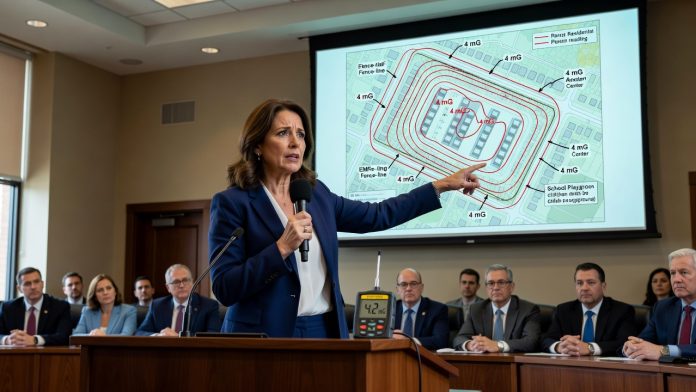
Scarato explained that these electromagnetic field exposures occur near areas where children may play or attend school. Data from her recording device showed values up to 1.98 on the scale displayed during the presentation. Such findings point to potential risks that have not received sufficient regulatory attention.
Health concerns linked in the testimony include leukemia among children and miscarriage issues. Scarato noted that the measured levels surpass limits established in some countries for residential and educational zones. These comparisons underscore gaps in domestic oversight of power line and facility emissions.
Power Line Exposure Concerns Rise in Local Hearings
Council members listened as Scarato detailed how data center operations contribute to ongoing electromagnetic field presence. The testimony emphasized that exposure near homes and schools demands closer examination. Families in the vicinity face daily proximity to these sources without clear warnings or mitigation steps.
The presentation included visual evidence from the measurement tool positioned at the site boundary. Readings remained elevated along the fence line throughout the recorded segment. This consistency suggests persistent conditions rather than isolated spikes.
Conservative principles stress the protection of innocent children from unnecessary hazards in their daily environments. Community leaders hold responsibility to prioritize family well-being over unchecked development. Ignoring such data erodes trust in institutions meant to safeguard public spaces.
Regulatory Gaps Highlight Need for Stronger Protections
Scarato referenced international standards that set lower thresholds for electromagnetic field exposure in sensitive areas. Montgomery County residents deserve equivalent safeguards according to the testimony. Current practices appear to overlook these benchmarks in favor of expansion.
The hearing brought forward evidence that power lines associated with data centers amplify the issue. Children playing nearby encounter these fields without adequate barriers or monitoring programs. Advocates argue that moral obligations require proactive measures to reduce risks.
Testimony concluded with a call for limits on exposure in homes and schools. Such steps align with values that place child safety above economic pressures. Continued inaction risks long-term consequences for future generations in the area.