RICHMOND, Va. — As Virginia voters narrowly approved a controversial constitutional amendment on April 21, 2026, that paves the way for temporary Democratic-led congressional redistricting, an independent election observer has spotlighted a significant data inconsistency on the official state Department of Elections website. The discrepancy, which occurred during real-time reporting on election night, has fueled concerns about the reliability and synchronization of election data feeds, even as unofficial results show the “Yes” measure passing by roughly 3 percentage points.
The referendum asked voters: “Should the Constitution of Virginia be amended to allow the General Assembly to temporarily adopt new congressional districts to restore fairness in the upcoming elections, while ensuring Virginia’s standard redistricting process resumes for all future redistricting after the 2030 census?” A “Yes” vote effectively empowered the Democrat-controlled General Assembly to bypass the state’s bipartisan redistricting commission and enact new U.S. House district maps through 2030. Proponents, including Democratic leaders and Gov. Abigail Spanberger, argued the change was necessary to counter perceived partisan imbalances and respond to redistricting moves in other states. Critics, largely Republicans, called it a power grab that could transform Virginia’s current 6-5 Democratic edge in its 11-member congressional delegation into a potential 10-1 advantage ahead of the 2026 midterms.
With nearly all precincts reporting, unofficial results released by the Virginia Department of Elections as of April 23 show 1,575,381 “Yes” votes (51.45%) and 1,486,467 “No” votes (48.55%), out of more than 3.06 million total ballots cast. Turnout reached approximately 48% of the state’s 6.4 million registered voters. However, these figures remain unofficial pending certification, and the entire outcome is now in legal limbo. On April 22, a Tazewell County circuit court judge ruled the referendum unconstitutional, blocking certification. The state Attorney General’s office has appealed, with the Virginia Supreme Court expected to weigh in on procedural challenges related to how the amendment was placed on the ballot.
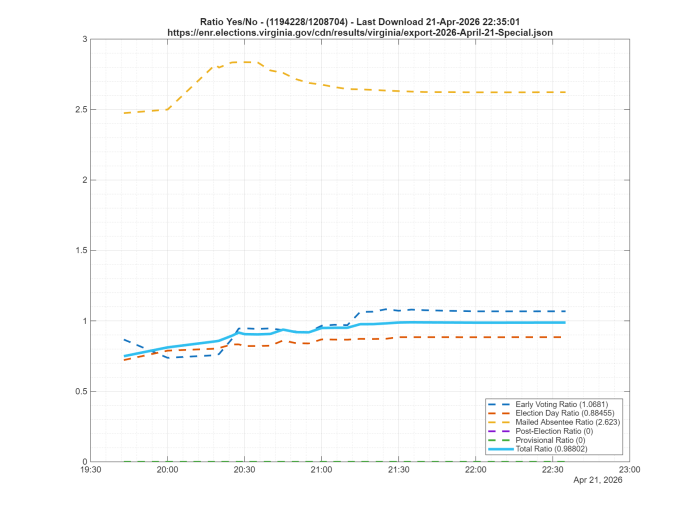
It was against this high-stakes backdrop that Jon Lareau, CTO and Executive Director of the Electoral Process Education Corp. and known on X as @WWRKDS, documented a clear mismatch in the Department of Elections’ public data on April 22. At approximately 10:35 p.m. on election night (April 21), the website’s graphical display showed “Yes” leading with 1,566,211 votes (51.42%) against “No” at 1,479,447. Yet the downloadable JSON export file from the same page, timestamped 22:35:01 on April 21, reflected markedly different totals: “Yes” at 1,194,228 trailing “No” at 1,208,704.
Lareau, who parsed the JSON files in real time as results updated, initially suspected a coding error in his own analysis. He triple-checked his scripts and even enlisted independent verification from AI tools, which confirmed the same summed totals from the precinct, locality, and contest-level data embedded in the JSON. “The web rendered content does not reflect the JSON data available from the link at the bottom of the page,” he posted. “Why the discrepancy within your own site and records?”
Further examination by Lareau and others revealed a deeper procedural quirk in Virginia’s election reporting. The JSON files contain three layers of results: statewide contest totals, locality-level breakdowns, and precinct-level details. While the summary and locality figures often aligned, the precinct-level data frequently appeared incomplete and failed to sum precisely to the higher-level aggregates. Lareau explained that local registrars are permitted to submit rapid “quick sum” totals for their localities on election night before fully uploading granular precinct data. This practice, while intended to speed up initial reporting, creates temporary logical inconsistencies. Summary figures can exceed the sum of reported precincts, and updates do not always flow synchronously between the web dashboard and the underlying data export.
“This is a policy and procedural issue, reflected in the data,” Lareau wrote in a follow-up thread. He likened it to a bank statement where the summary total does not match the itemized transactions. “We should expect the same with election data… within any given report the numbers should be self-consistent.” He noted that mailed absentee ballots—totaling roughly 10% of the vote and breaking heavily for “Yes” at about 73%—played a decisive role in the final margin, adding a net advantage of around 137,000 votes for the measure according to some independent trackers.
The anomaly drew swift attention online, with users highlighting similar oddities such as temporary vote deductions in certain counties (including large negative adjustments in Chesterfield and Augusta Counties) and unusual vote spikes from Democratic strongholds like Fairfax County. One widely shared analysis by data observer Jeff O’Donnell (@FSociety_1942) pointed to “F-curves” in vote curves—sharp, late surges that flipped leads—and questioned the handling of mail-in ballots. While these observations remain unverified by official sources and do not prove irregularities, they underscore longstanding calls for greater real-time auditability in election systems.
The Virginia Department of Elections has not issued a public statement specifically addressing the JSON-web mismatch as of April 23. The department’s results portal (enr.elections.virginia.gov) notes that data is unofficial and auto-refreshes, with downloads available for reports. It provides breakdowns by vote method (early in-person, mailed absentee, Election Day, provisional) but offers no detailed disclaimer on lags between web graphics and export files. Officials have emphasized in past elections that preliminary results are subject to updates as counties finalize canvassing.
Election integrity advocates argue the episode highlights systemic opportunities for improvement. Allowing registrars to report aggregated locality totals ahead of precinct uploads may accelerate public-facing results but risks eroding trust when the numbers do not immediately reconcile. “If my bank sends me a ‘preliminary’ statement… we would expect that within any given report the numbers should be self-consistent,” Lareau observed. In an era of heightened scrutiny over voting processes—especially amid national partisan battles over redistricting—the incident serves as a reminder that transparency in data presentation is as critical as the accuracy of the underlying counts.
As legal challenges play out and final certification looms, the redistricting referendum’s fate remains uncertain. A successful “Yes” vote, if upheld, could reshape Virginia’s congressional map dramatically, giving Democrats a significant edge in the battle for House control. Yet the data-reporting hiccup, however benign in origin, has already amplified skepticism. For a process meant to embody democratic will, even momentary inconsistencies between a public dashboard and its downloadable source data invite legitimate questions about whether election officials can deliver the self-consistent, verifiable results the public demands.
Virginia’s experience is not isolated. Similar debates over reporting lags, mail-in ballot processing, and real-time data integrity have surfaced in other states during tight contests. As the 2026 midterms approach and redistricting wars intensify nationwide, ensuring robust, synchronized data pipelines could prove essential to safeguarding public confidence—regardless of which side ultimately prevails.