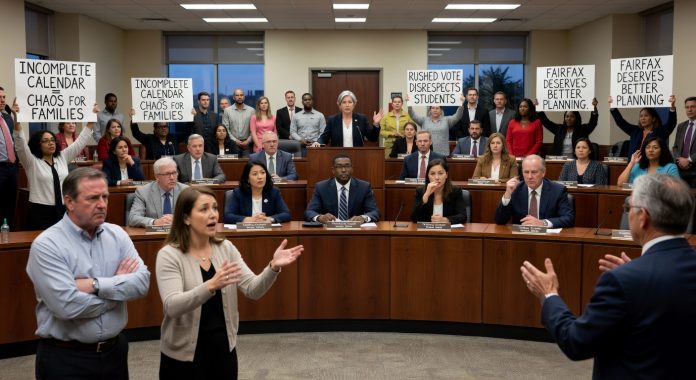
Melanie Meren, representing Hunter Mill District, took a firm stand against proceeding with the vote. She emphasized that the board had previously handled motions without full visibility, but declared she would not support this one until she could review the document in its entirety. ‘Until I see it,’ Meren stated, highlighting that seeing the presented materials is integral to the board’s process. Her position resonated with calls for deliberate governance, a principle that resonates strongly with parents and taxpayers who demand clarity before binding decisions affect thousands of students.
Ricardy Anderson of Mason District echoed these sentiments, questioning whether the proposed calendar truly incorporated recent changes. She sought assurance that all amendments were inclusive, pointing out specific adjustments like shifts from 9 to 10 a.m. Her inquiry reflected a broader frustration among board members and the public over procedural shortcuts that could undermine educational planning. Another member expressed hesitation about voting on a calendar that had not been fully finalized, wondering aloud about changes still being made that night and whether they would be recognized later.
In contrast, Kyle McDaniel pushed for expediency, arguing there was no reason for further delay and insisting the board needed to ‘get this done.’ This divide illustrated a troubling pattern in Fairfax County, where progressive majorities have repeatedly prioritized speed over scrutiny, often at the expense of traditional values and parental input. Recent history amplifies these concerns: just days earlier on April 9, the board voted to eliminate Veterans Day as a school holiday while retaining Indigenous Peoples’ Day, a move that drew widespread criticism for disrespecting military service members and American heritage.
Parents flooded board members with thousands of messages demanding more five-day school weeks, signaling deep dissatisfaction with asynchronous learning models that have persisted post-pandemic. The academic calendar directly impacts family schedules, work arrangements, and student performance, making transparency non-negotiable. Meren’s refusal to rubber-stamp an unseen document stands as a beacon of fiscal and educational responsibility in a board often criticized for ideological overreach.
This clash comes amid broader scrutiny of Fairfax County Public Schools, which serves over 188,000 students across one of Virginia’s largest and wealthiest districts. Decisions like boundary redistricting, approved 8-3 recently, and debates over discipline policies for AI-generated deepfakes highlight the board’s pivotal role. Yet, repeated controversies—from curriculum battles over gender topics to immigration-related endorsements—reveal a body more attuned to activist agendas than core educational needs.
Conservative voices in Virginia have long warned that Democrat-dominated boards like Fairfax’s erode local control, favoring equity rhetoric over excellence. The push to approve an incomplete calendar exemplifies this: why rush when clarity ensures better outcomes for children? Delaying for full review protects against errors that could disrupt the 2026-2027 school year, aligning with Republican priorities of accountability, parental rights, and commonsense governance.
As tensions simmer, residents urge the full board—Anderson, Anderson, Meren, Lady, Dixit, Dannan, St. John-Cunning, Dunne, Frisch, McDaniel, McElveen, and Moon—to prioritize process integrity. Fairfax County’s educational future depends on rejecting hasty votes and embracing transparent deliberation, lest public trust erode further.
Source: Field reports and eyewitness accounts.