In just six years, chains funded by private equity and located out of state have dominated and ruined Virginia’s long-term and post-hospital care system.
By James C. Sherlock
Virginia has what the federal government considers to be one of the nation’s worst nursing home collections. There are some good facilities, but they’re few and far between.
Why are we here?
Bad actors from outside Virginia noticed that Virginia had no defense against business models that were deadly and highly profitable. The government’s data, weak state laws, a lack of enforcement and the General Assembly’s budget committees ritual of decades-long understaffing in nursing home inspections were all evidence of this.
Virginia’s Certificate of Public Need (COPN), which restricts competition and guarantees high occupancy, was also evident to them. In the last year, the average daily occupancy in Virginia’s nursing home system was just over 28400. This represents 87% of all beds. In the United States, occupancy was 79.5%.
This was a lack of political will in general to disrupt the industry.
- Partly out of fear for political retribution from an industry that has outposts in each General Assembly House district and Senate district.
- In part, as a thank you for the huge donations made to the campaign.
Virginia offered a golden opportunity for bad actors.
In January 2020, New York-based private equity nursing homes chains bought large swaths here in Virginia, mainly from Virginians. After March 2020, they got them for bargain prices because COVID forced many legacy operators to leave the business.
They have broken the state’s nursing homes system. It was weak when they first arrived.
Understaffing is a business model
The fundamental cause of poor care is understaffing. This is not an absolute number but a ratio between the staff and resident population, as well as their collective needs.
They blame the lack of professionals on the shortage. They don’t provide an explanation:
- Why some facilities in the state have enough staff while others blocks away do not?
- Some companies have training programs on-site to train certified nursing assistants who perform the majority of patient-facing tasks, while others don’t.
- Why some nurse turnover rates are high and others not.
Ask the nurses why they have difficulty in finding staff and high turnover. Overwork and unethical supervision are the main reasons why the worst nurses become poisonous. Personnel issues like these are a hindrance to any business.
The government has not resisted the practice. Virginia no longer has federal nurse staffing standards.
The number of beds is used to measure physical capacity. The federal regulations require that nursing facilities conduct regular self-assessments to determine operating capacity. The assessment is based on the resident’s needs for daily living and medical support, as well as existing staffing and equipment. The measure is the number of staff hours per resident, per day (HPRD), in each support specialty. This includes attending physicians, nurses and nurse aides as well as physical therapists.
According to the regulation, each facility is required to determine its capacity for operation and, hopefully, not exceed that limit. It is up to the facility or chain of facilities whether they continue to accept new residents and not hire more staff.
It is therefore voluntary to understaff over a prolonged period. Chains understaffing across their portfolios can be a business strategy.
The results
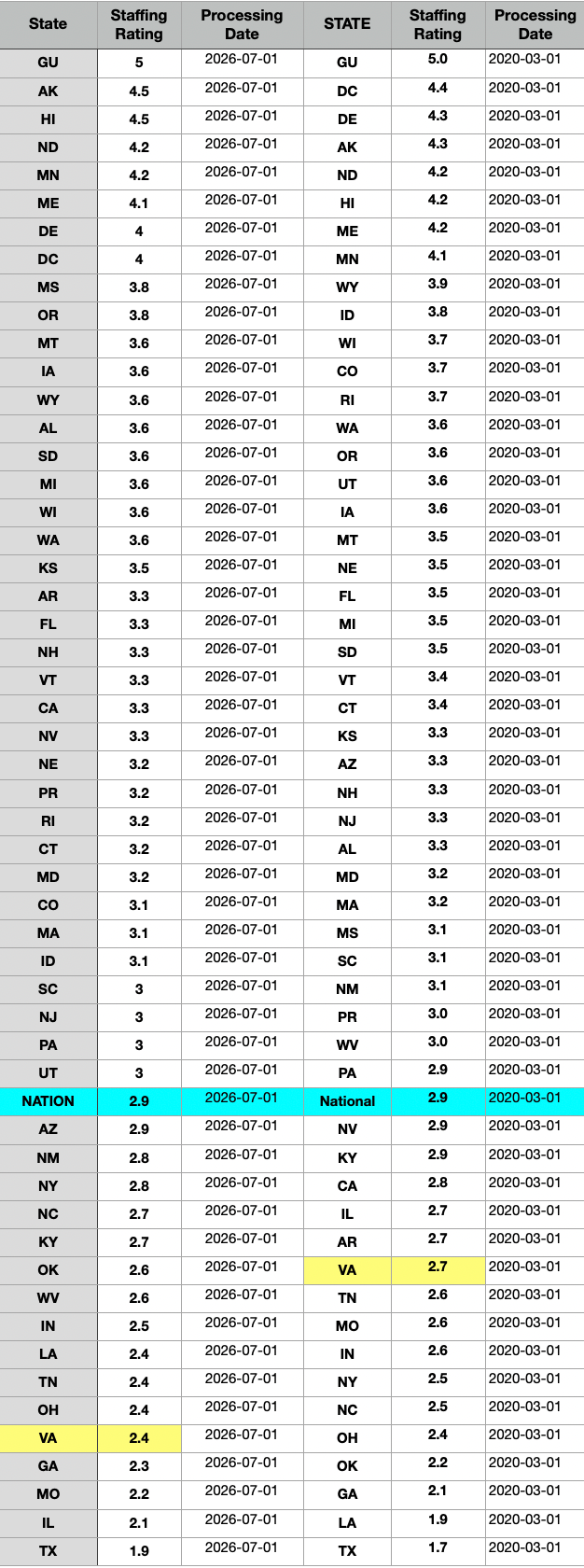
The author has combined the federal data for 2020 and the last month in order to illustrate the decline in average staffing from Virginia, from poor in comparison to the rest the country in 2020 to awful in the last month. The ratings are based on a Bell Curve of actual staffing results achieved by nursing homes across the country. Star ratings are determined by the cut points on the curve. Five stars is the best and one star is the worst.
Consider the Minnesota federal program fraud scandal. Consider that Virginia’s nursing homes, funded by Medicare or Medicaid, have far less staff. (It is only fair that we point this out.
Virginia’s staffing average is misleading because of the uneven distribution. There are a number of facilities with staff rated at four and five stars, almost all of which are non-profit. Virginia hosts far more of the worst than it should.
The following are examples of artifacts:
- Since January 1, 2020, 133 nursing homes in Virginia have changed owners.
- Nine of the nine stores were purchased by chains from out-of-state, mostly Virginia-based owners. This group has an average staffing score of 1.66. The drop in stars from 2.7 to 2.4% statewide is due to this.
- New Jersey chains purchased 77 of these. These have an average staffing rating of 1.39.
- Three chains from out of state controlled respectively 18, 28, 37 nursing homes in Virginia until June 1, 2026. Of the 83 nursing homes, not one facility has a rating above “understaffed”.
This is just one part of a business model that is unethical. In the future, this space will explore other “features”.
Here is a complete staffing assessment.
Who can stop this?
In an industry that is dominated by chain stores, the senior managers at individual facilities aren’t independent. They either follow the model or they leave.
The government should’ve put an end to it. It hasn’t.
It was the responsibility of physicians, nurses and administrators to stop it. Medical personnel are required to follow ethical standards and are also bound to report any wrongdoing. Patients are harmed and even killed by understaffing. They haven’t reported unethical behavior at a high enough level to be of any importance.
The hospitals could have done more. They are aware of the poor quality of facilities to which they must transfer injured and sick patients. At least they could have put pressure on regulators so that their choices are improved. No evidence exists that they have.
This practice is not going away.
Bottom Line
Since the start of 2020, chains funded by private equity from out-of-state have broken down the long-term and post-hospital care system in Virginia.
They are still not done breaking the law.
This space will continue to name names in future articles and let readers know what they have planned for us. Like court-tested bankruptcy-for-profit schemes.