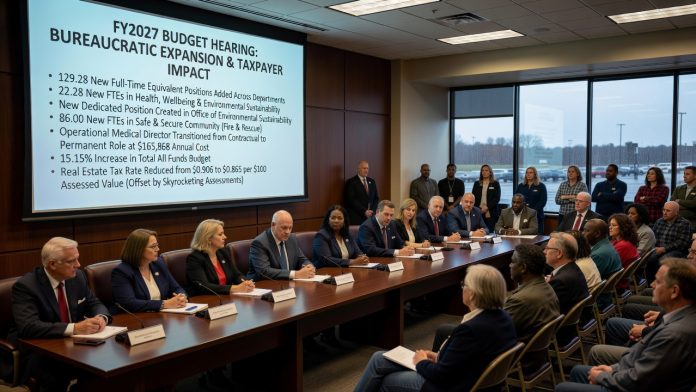
The FY2027 budget for Prince William County introduces a massive expansion of local government that threatens to place a heavy financial burden on everyday taxpayers. Officials have approved a staggering 15.15 percent increase in the total all funds budget compared to previous years. Driving this excessive spending is the addition of 129.28 new full-time equivalent positions across various county departments. Fiscal conservatives are raising the alarm over this aggressive hiring spree, which permanently inflates the size of the local bureaucracy at the expense of working families.
The current Board of County Supervisors consists of Chair Deshandra Jefferson, Margaret Franklin, Victor Angry, Andrea Bailey, Kenny Boddye, Yesli Vega, Bob Weir, and Tom Gordy. This elected body is overseeing a county government budget that is swelling by 10.48 percent overall, even before accounting for all external funds. Expanding the government payroll so drastically raises serious concerns about long-term financial sustainability and the potential for endless future tax hikes. Taxpayers rely on these board members to act as prudent stewards of public funds rather than rubber-stamping an era of unprecedented bureaucratic growth.
Bureaucratic Expansion and Environmental Spending
A glaring example of this questionable spending is found within the newly expanded Health, Wellbeing and Environmental Sustainability functional area. This specific sector is gaining 22.28 new full-time equivalent employees, signaling a clear shift away from core municipal duties. Notably, the budget includes funding for a brand-new dedicated position within the Office of Environmental Sustainability. Funding such niche bureaucratic roles diverts precious taxpayer dollars away from essential infrastructure, public safety, and road maintenance.
Fiscal watchdogs argue that local governments should prioritize fundamental community needs rather than expanding green initiatives that have negligible local impact. Adding permanent environmental staff members locks the county into expensive, long-term pension and healthcare obligations that taxpayers must fund forever. When local agencies prioritize sustainability offices over meaningful tax relief, the hardworking residents are the ones who ultimately pay the price. True fiscal responsibility means eliminating these non-essential administrative roles before they become permanently entrenched in the county budget.
Public Safety and Contractual Shifts
The Safe and Secure Community functional area is also seeing an enormous increase, with 86.00 new full-time equivalent positions added to the payroll. While supporting first responders is a recognized priority for conservatives, the Department of Fire and Rescue is making administrative changes that warrant strict financial scrutiny. Specifically, the county is transitioning an Operational Medical Director from a flexible contractual role to a permanent full-time position. This single administrative shift comes with an ongoing annual cost of $165,868, which permanently burdens the operating budget with new salary requirements.
Moving services from private contractual agreements to permanent government payroll positions is a classic driver of municipal overspending. Previously, the county utilized private contracts to fulfill these medical director duties, providing greater financial flexibility and protecting taxpayers from long-term pension liabilities. Committing to a permanent administrative salary severely reduces the county’s ability to adapt to future economic downturns or budget shortfalls. Conservative leaders consistently advocate for privatization and contracting precisely to avoid this kind of irreversible bureaucratic bloat within local government.
Rhetoric Versus Fiscal Reality
Chair Deshandra Jefferson defended the massive spending package by stating that safety and security remain a cornerstone of the community. She further claimed that the FY2027 budget is a responsible, balanced plan that meets the needs of a growing community while adhering to sound fiscal policies. However, critics are quick to point out that a double-digit percentage increase in overall spending completely contradicts the core principles of conservative fiscal restraint. Expanding the government footprint by nearly 130 permanent employees is the exact opposite of running a lean, efficient, and taxpayer-respecting administration.
To offset the negative optics of this spending spree, the board reduced the real estate tax rate from $0.906 to $0.865 per $100 of assessed value. Despite this nominal rate reduction, the massive growth in overall spending indicates that taxpayers are still footing a heavier bill due to skyrocketing property assessments. True fiscal responsibility would require cutting the actual budget rather than simply masking spending hikes with a slightly lowered tax rate. Residents are catching on to this classic political maneuver and are demanding genuine reductions in government waste rather than budgetary smoke and mirrors.
The Path Forward for Taxpayers
Prince William County residents are increasingly demanding that local officials trim the fat and eliminate wasteful administrative spending across the board. Adding nearly 130 new permanent government employees in a single budget cycle sets a dangerous precedent for future taxation and endless government expansion. Local leaders must prioritize core services and fiercely reject the urge to perpetually expand the bureaucratic state at the expense of working families. Protecting the financial future of the county requires a firm, unwavering commitment to reducing the size, scope, and cost of local government.
Email the Board of Supervisors At:
Chair At-Large (Deshundra Jefferson) – djefferson@pwcgov.org,
Brentsville (Tom Gordy): tgordy@pwcgov.org,
Coles (Yesli Vega): yvega@pwcgov.org,
Occoquan (Kenny Boddye): kboddye@pwcgov.org,
Potomac (Andrea Bailey): abailey@pwcgov.org,
Woodbridge (Jeannie LaCroix): jlacroix@pwcgov.org,
General Board: bocs@pwcgov.org,