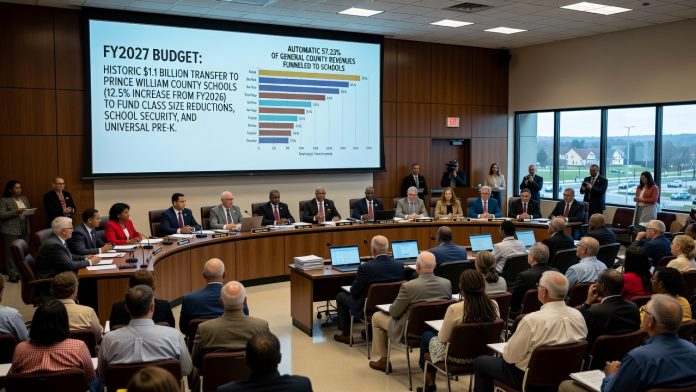
Prince William County taxpayers are facing a monumental financial burden following the approval of a historic one billion dollar transfer to the local public school system. The upcoming FY2027 budget features a staggering 12.5 percent increase from the previous fiscal year, adding 123.5 million dollars in new spending. Fiscal conservatives are raising serious concerns about this massive expansion of the county budget and the long-term impact on hardworking families. This unprecedented growth in government spending threatens to outpace the financial realities of the very citizens who fund it.
The Prince William County Board of Supervisors, which includes Deshundra Jefferson, Tom Gordy, Yesli Vega, Bob Weir, Victor Angry, Kenny Boddye, Andrea Bailey, and Margaret Franklin, oversees the allocation of these local tax dollars. They coordinate directly with the Prince William County School Board, currently composed of Babur Lateef, Adele Jackson, Lisa Zargarpur, Richard Jessie, Diane Raulston, Justin Wilk, Loree Williams, and Jennifer Wall. Together, these elected officials manage a revenue sharing agreement that automatically funnels 57.23 percent of general county revenues directly into the school system. This automatic funding mechanism severely limits the ability of the county to retain funds for other vital infrastructure needs or tax relief.
Under this prevailing revenue sharing agreement, Prince William County Public Schools will receive an unprecedented transfer totaling 1.1 billion dollars for the upcoming fiscal year. This represents the largest single dollar increase ever provided to the school division in the history of the county. While education remains a vital public service, taxpayers are rightfully questioning whether such an aggressive funding hike is truly necessary or simply another instance of unchecked government spending. Throwing historic sums of money at a single department rarely encourages the kind of fiscal discipline that taxpayers expect from their local government.
Questionable Spending and Universal Pre-K Expansion
A significant portion of this budget increase is earmarked for the implementation and expansion of Universal Pre-K across the county. Many conservative advocates argue that universal preschool programs often serve as expensive government entitlements that balloon in cost year after year. Instead of focusing exclusively on core academic competencies for school-aged children, the district is venturing into early childcare services that historically drive up administrative overhead. Expanding the scope of public schooling to include preschool programs shifts a massive financial burden onto the shoulders of local taxpayers.
Occoquan District Supervisor Kenny Boddye recently defended the massive spending package during a public statement regarding the budget markup. He stated, ‘These adjustments from markup will enable us to transfer an historic $1.1 billion to Prince William County Public Schools, helping to maintain its 95% graduation rate, fund much-needed teacher pay raises, and make strides toward Universal Pre-K.’ However, taxpayer watchdogs worry that continuously throwing record-breaking sums of money at the school board does not automatically equate to better educational outcomes or responsible fiscal management. Genuine conservative budgeting demands that every dollar is tied to measurable performance metrics rather than vague promises of future success.
Furthermore, the official FY2027 budget message proudly touted this allocation, stating, ‘Education remains a top priority, with the largest dollar increase ever in the transfer to Prince William County Schools to ensure a successful future for our children.’ While the message claims this funding is necessary for student success, it completely ignores the financial strain placed on the residents funding it. Rapidly expanding local budgets often lead to future tax hikes, placing an unnecessary burden on homeowners and local businesses already struggling with inflation. Elected officials must remember that government funds are simply taxpayer dollars that have been forcefully collected from hardworking citizens.
Core Priorities Versus Administrative Bloat
There is broad bipartisan agreement that funding essential school security programs and providing competitive pay raises for hardworking teachers are valid local priorities. Ensuring that classrooms are safe and that quality educators are retained should always be the primary focus of any school district budget. Unfortunately, massive omnibus budget increases often hide administrative bloat and non-essential programming under the guise of these universally supported initiatives. Taxpayers strongly support paying good teachers what they are worth, but they vehemently oppose funding bloated administrative bureaucracies.
The budget also directs funds toward class size reduction initiatives and ongoing debt service for facilities like Gainesville High School. While reducing class sizes sounds appealing on paper, the practical implementation frequently requires hiring waves of new administrative staff and building expensive new facilities. Fiscal conservatives argue that the school board should first audit its current operations to eliminate existing waste before demanding an additional 123.5 million dollars from county taxpayers. A comprehensive audit would likely reveal millions of dollars that could be reallocated to the classroom without requiring a massive budget increase.
Maintaining a strict revenue sharing agreement that automatically guarantees 57.23 percent of general revenues to the schools removes the incentive for the school board to budget efficiently. When a government agency knows its funding will automatically increase alongside county tax revenues, there is little motivation to find cost-saving measures or streamline operations. A more responsible approach would involve zero-based budgeting, requiring the school division to justify every single dollar it requests rather than relying on an automatic windfall. Breaking the cycle of automatic funding increases is the first step toward restoring true fiscal responsibility in local government.
Protecting the Taxpayer
As the cost of living continues to rise, local elected officials have a moral obligation to protect the financial well-being of their constituents. Approving a 12.5 percent increase for a single government department in one year represents a drastic departure from fiscal restraint and conservative budgeting principles. Taxpayers deserve complete transparency regarding exactly how this historic billion-dollar transfer will be spent down to the very last cent. Without strict oversight, these massive funding hikes will inevitably lead to rampant waste and further demands for higher taxes in the future.
Moving forward, residents of Prince William County must hold both the Board of Supervisors and the School Board accountable for this unprecedented level of spending. If the school district cannot demonstrate tangible, measurable improvements in core academic proficiency without relying on massive budget expansions, then future funding models must be aggressively reformed. True conservative governance requires prioritizing the taxpayer, eliminating government waste, and ensuring that public schools focus strictly on education rather than endless bureaucratic expansion. The financial health of the county depends entirely on reigning in this out-of-control spending before it bankrupts local families.
Email the Board of Supervisors At:
Chair At-Large (Deshundra Jefferson) – djefferson@pwcgov.org,
Brentsville (Tom Gordy): tgordy@pwcgov.org,
Coles (Yesli Vega): yvega@pwcgov.org,
Occoquan (Kenny Boddye): kboddye@pwcgov.org,
Potomac (Andrea Bailey): abailey@pwcgov.org,
Woodbridge (Jeannie LaCroix): jlacroix@pwcgov.org,
General Board: bocs@pwcgov.org,