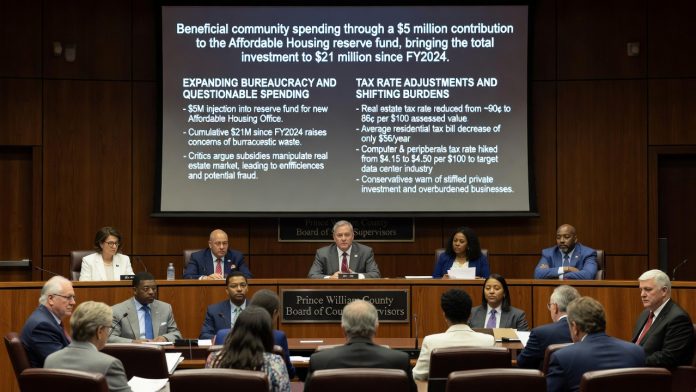
Prince William County officials recently finalized the fiscal year 2027 budget, which includes a highly debated five million dollar contribution to the Affordable Housing Reserve Fund. This latest allocation brings the total taxpayer investment in this specific housing initiative to a staggering twenty-one million dollars since fiscal year 2024. Fiscal conservatives are raising alarm bells over this rapid expansion of county government and the potential for long-term waste. Taxpayers must carefully scrutinize whether subsidizing housing is an appropriate use of local revenue or simply another avenue for unchecked government overspending.
The current Prince William County Board of County Supervisors consists of Deshundra Jefferson, Victor Angry, Andrea Bailey, Kenny Boddye, Margaret Franklin, Jeanine Lawson, Yesli Vega, and Bob Weir. These elected officials were tasked with balancing community needs against the heavy tax burden already carried by local residents. While some board members championed the housing subsidies as necessary community support, conservative voices consistently push for reduced spending and a smaller government footprint. Ultimately, the board approved a budget that shifts massive amounts of wealth into newly created bureaucratic offices instead of returning those funds directly to the citizens.
EXPANDING BUREAUCRACY AND QUESTIONABLE SPENDING
A significant portion of the fiscal year 2027 budget is directed toward the Office of Housing and Community Development, which now features a newly created affordable housing office. Funding this new bureaucratic entity requires the five million dollar injection into the reserve fund, a move that critics argue creates an unnecessary permanent financial obligation for the county. The Board of County Supervisors justified the housing funding by stating it is “supporting the development of affordable housing across the community.” However, relying on taxpayer dollars to manipulate the local real estate market often leads to massive inefficiencies and opens the door to potential fraud.
The five million dollar contribution in the upcoming budget continues a costly multi-year commitment, following allocations of five and a half million dollars in both fiscal years 2025 and 2026. This aggressive funding strategy brings the cumulative total to twenty-one million dollars funneled into the housing reserve since fiscal year 2024. Conservative watchdogs point out that local governments have a poor track record of managing large reserve funds without succumbing to bureaucratic waste. Citizens are rightfully concerned that this massive accumulation of capital will be squandered on pet projects rather than delivering any tangible relief to the broader tax base.
TAX RATE ADJUSTMENTS AND SHIFTING BURDENS
Proponents of the budget frequently highlight that the real estate tax rate was reduced from slightly over ninety cents to approximately eighty-six cents per one hundred dollars of assessed value. This adjustment results in an average residential tax bill decrease of merely fifty-six dollars for the entire year. While any tax reduction is a step in the right direction, conservatives argue that a fifty-six dollar savings is entirely insufficient given the rampant inflation impacting household budgets. The county could have delivered far more substantial tax relief if officials had chosen to eliminate the millions spent on the new housing bureaucracy.
To offset the minimal residential tax decrease, the county chose to increase the computer and peripherals tax rate from four dollars and fifteen cents to four dollars and fifty cents per one hundred dollars of valuation. This targeted tax hike deliberately shifts a massive portion of the revenue burden onto the booming data center industry located within the county. While taxing corporate entities may seem politically convenient, conservative economists warn that aggressively targeting specific industries can stifle future private investment. Overburdening local businesses with heavy taxes to fund expanded social programs ultimately harms the free market and discourages long-term economic growth.
MASSIVE TRANSFERS AND CONTINUED OVERSPENDING
The affordable housing initiative is not the only area where the county budget demonstrates an appetite for aggressive government spending. The fiscal year 2027 budget includes a massive one billion dollar transfer to Prince William County Public Schools, consuming an enormous portion of local revenue. Additionally, the Parks and Recreation department received a twenty million dollar increase specifically designated for capital investments. Such towering expenditures highlight a troubling trend of constant budget expansion that leaves taxpayers perpetually on the hook for an ever-growing local government.
The political maneuvering behind these massive expenditures reveals a deeply flawed process that prioritizes government growth over fiscal restraint. According to the official budget message from Occoquan District Supervisor Kenny Boddye, he stated, “This time last week, it wasn’t certain that I’d be voting for a FY2027 Budget.” He further explained, “I am happy to report that, following days of deliberation and public engagement, I was able to help craft a budget that delivers more for the people of Prince William.” Boddye concluded his justification by remarking, “It’s not perfect, but it’s progress.”
For conservative taxpayers, this version of progress looks suspiciously like traditional tax-and-spend politics that expand bureaucracy at the expense of private citizens. Funneling twenty-one million dollars into a housing reserve fund diverts critical resources away from essential services and true tax relief. True fiscal responsibility requires making difficult cuts, eliminating wasteful administrative offices, and trusting the free market to address housing demands. Until local leaders commit to drastically reducing the county budget, residents will continue to face the hidden costs of reckless government overspending.
Email the Board of Supervisors At:
Chair At-Large (Deshundra Jefferson) – djefferson@pwcgov.org,
Brentsville (Tom Gordy): tgordy@pwcgov.org,
Coles (Yesli Vega): yvega@pwcgov.org,
Occoquan (Kenny Boddye): kboddye@pwcgov.org,
Potomac (Andrea Bailey): abailey@pwcgov.org,
Woodbridge (Jeannie LaCroix): jlacroix@pwcgov.org,
General Board: bocs@pwcgov.org,