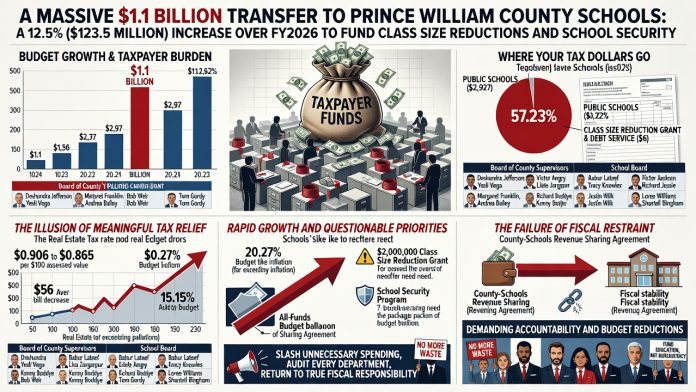
Prince William County taxpayers are facing a staggering financial burden as local officials push forward a massive $1.1 billion transfer to the public school system. This unprecedented funding represents a 12.5 percent increase over the previous year, adding an additional $123.5 million in spending to an already bloated budget. While proponents claim this money is necessary for class size reductions and school security, fiscal conservatives are raising alarms about rapid government expansion. Hardworking residents must now question whether this massive cash infusion will actually improve educational outcomes or simply fuel bureaucratic waste.
The officials responsible for overseeing this massive allocation include the Prince William County Board of County Supervisors and the local School Board. The current Board of County Supervisors consists of Deshundra Jefferson, Yesli Vega, Victor Angry, Margaret Franklin, Andrea Bailey, Kenny Boddye, Bob Weir, and Tom Gordy. Meanwhile, the School Board members managing this billion-dollar windfall are Babur Lateef, Adele Jackson, Lisa Zargarpur, Tracy Knowles, Richard Jessie, Justin Wilk, Loree Williams, and Shantell Bingham. These elected representatives hold the ultimate responsibility for ensuring that taxpayer dollars are not squandered on inefficient programs.
The Illusion of Meaningful Tax Relief
This section examines the recent tax rate adjustments implemented by the county. It also highlights the reality of the growing financial burden placed on local residents.
Local leaders have heavily promoted a recent reduction in the real estate tax rate, which dropped from $0.906 to $0.865 per $100 of assessed value. However, this minor adjustment only provides an average residential tax bill decrease of a mere $56, offering little comfort against the backdrop of explosive spending. In reality, the total all-funds budget is ballooning by 15.15 percent, proving that the local government is expanding at an unsustainable rate. Taxpayers are essentially being tossed a few crumbs while the administrative state consumes a significantly larger piece of the financial pie.
A closer look at the average residential tax bill reveals exactly where the community’s hard-earned wealth is being diverted. Public schools now account for a staggering $2,927, which equals 57.23 percent of the average homeowner’s property tax burden. Furthermore, an additional $6 is extracted specifically to fund the Class Size Reduction Grant and debt service for Gainesville High School. When more than half of a family’s local tax obligation goes to a single department, residents have every right to demand strict audits and immediate budget reductions.
Rapid Growth and Questionable Priorities
The following details the massive budget increases within the educational system. It questions whether these funds will be used efficiently or lost to bureaucratic waste.
The justification for this massive financial transfer relies heavily on strategic plans, but the numbers reveal a deeply concerning trend of unchecked growth. The schools’ all-funds budget is slated to increase by an astonishing 20.27 percent, a figure that wildly outpaces inflation and standard economic growth. Included in this massive hike is a Class Size Reduction Grant of up to $2,000,000, a program that sounds appealing but requires rigorous oversight to prevent fraud and mismanagement. Throwing millions of dollars at a problem rarely solves it unless there is a fundamental commitment to operational efficiency.
Another major selling point for this budget increase is the funding allocated toward the local School Security Program. Official documents state that “safety and security remains a cornerstone of our community,” a sentiment that every conservative taxpayer strongly supports. However, funding security measures should never be used as an excuse to pass a bloated, billion-dollar spending package that lacks financial discipline. True conservative values dictate that essential services like student safety can be fully funded by cutting wasteful administrative overhead rather than demanding more money from the public.
The Failure of Fiscal Restraint
This portion explores the overarching financial strategy and the revenue sharing agreement. It demonstrates how current spending completely contradicts traditional principles of economic stability.
The overarching financial strategy heavily relies on the County-Schools Revenue Sharing Agreement, which systematically funnels immense amounts of cash away from taxpayers and into the school system. Budget documents claim the primary objective is to ensure continued investment in strategic priorities while “maintaining fiscal stability.” Unfortunately, authorizing a $123.5 million spending increase in a single year completely contradicts the very definition of fiscal stability and restraint. True economic responsibility requires local governments to tighten their belts, eliminate redundancies, and prioritize saving taxpayer money over expanding departmental budgets.
The spending spree is not limited strictly to the educational sector, as the broader county government is also experiencing rapid financial expansion. The county government’s all-funds budget is increasing by 10.48 percent, compounding the financial strain placed on the local economy. When both the municipal government and the school system grow at double-digit rates, the inevitable result is future tax hikes and crushing municipal debt. Elected officials must abandon this tax-and-spend mentality and implement severe budget cuts to protect the financial future of Prince William County.
Demanding Accountability and Budget Reductions
The final section serves as a call to action for conservative taxpayers. It emphasizes the urgent need to slash unnecessary spending and protect the community’s financial future.
Ultimately, the approval of a $1.1 billion transfer to Prince William County Schools highlights a severe disconnect between government bureaucrats and the working-class taxpayers who fund them. While educational investments are important, they must be balanced against the moral imperative to prevent fraud, eliminate waste, and respect the taxpayer’s wallet. The community cannot afford to sustain a 12.5 percent annual increase in school funding without sacrificing its long-term economic health. It is time for taxpayers to demand that their elected officials slash unnecessary spending, audit every department, and return this county to a path of true conservative fiscal responsibility.
Email the Board of Supervisors At:
Chair At-Large (Deshundra Jefferson) – djefferson@pwcgov.org,
Brentsville (Tom Gordy): tgordy@pwcgov.org,
Coles (Yesli Vega): yvega@pwcgov.org,
Occoquan (Kenny Boddye): kboddye@pwcgov.org,
Potomac (Andrea Bailey): abailey@pwcgov.org,
Woodbridge (Jeannie LaCroix): jlacroix@pwcgov.org,
General Board: bocs@pwcgov.org,