by Stephanie Lundquist-Arora
Republished with permission from IWFeatures
The U.S. Department of Education has announced an investigation into Fairfax County Public Schools to determine if the district discriminated based on sex. This is because the district failed to respond to numerous reports that Israel Flores Ortiz (18-year-old immigrant, enrolled at Fairfax High School as a Junior) sexually assaulted several female students during the school year.
A source inside the district who works with IW Features said that it is unlikely school officials would have filed Title IX charges against Ortiz despite the fact they should, given the allegations made against him. Sources also claim that district leaders are putting pressure on principals to keep Title IX complaints low.
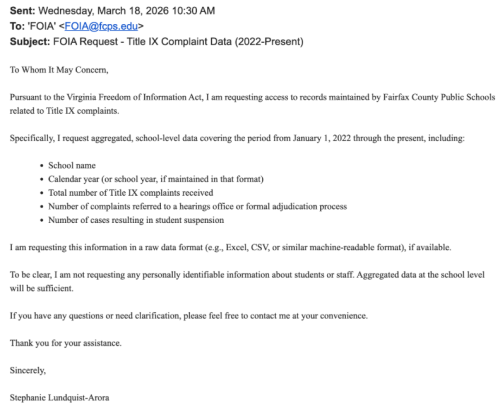
IW features requested data from the Freedom of Information Act to confirm the source’s suspicions. The request was divided by academic or calendar year. Twelve female students claimed Ortiz had sexually abused them. Fairfax High School therefore should have received at least 12 Title IX violations this year.
The FCPS FOIA officer issued an email on March 27 setting a fee of $105 and specifying that “values for 10 or less students will be suppressed in any final product as indicated by TS(Too Small).” This was to comply with the privacy expectations set forth by federal law.
A final FOIA request should reveal if Fairfax High School administrators have filed Title IX claims against Ortiz and his alleged victims.
The FOIA officer, however, sent IW features incomplete district-level information on April 10. The FOIA officer failed to deliver Title IX data at each school in the district, despite the fact that the requested information was aggregate data from schools. Table below shows the aggregated data.
The FCPS FOIA Officer further stated that 38 of the 255 Title IX complaints referred above were sent to an adjudication office or hearings process. This is especially alarming because there were no cases where students were suspended.
And yet despite the gap in numbers provided by the district, this aggregated data show that, even as student enrollment has declined, Title IX violations are increasing–especially given that two months remain in the 2025-2026 academic year.
The data suggests that FCPS administrators do not treat Title IX referrals as seriously as they should.
The question is whether Fairfax High School administrators acted seriously after 12 female students complained that Ortiz had fondled their genitals on the hallway. Did Title IX complaints arise from those incidents? The evidence suggests that there were no Title IX complaints, as the principal of the school, Georgina AYE, sent a delayed, sanitized e-mail afterward to the community explaining that “the incident involved the student touching the buttocks of students while they transitioned in the halls.”
Fairfax County officials have also been acting in a clean-up mode since then. FCPS signed a contract, for instance, with McGuireWoods, a law firm, after the Department of Education announced their Title IX investigation of FCPS. The district agreed to pay attorneys up to $1.850 per hour. Superintendent Michelle Reid informed that the district had retained an independent outside law firm “to conduct a thorough review of this issue.”
The contract between FCPS and McGuireWoods indicates that the so-called independent investigation is not as “independent” as Reid claims.
The contract says: “McGuireWoods has been retained by Client to conduct an attorney-client confidential investigation on allegations of sexual assault and/or harassment of students at Fairfax High School,” it states. The investigation was undertaken to provide legal advice to the Client.
FCPS appears to have hired McGuireWoods to “provide legal advise” to district administrators with a possible motive.
Perhaps the FOIA Office’s release only of district-level data aggregated is related. Perhaps school-level data about Title IX referrals is inconvenient to district leaders, especially when they are scrutinized by a federal investigation. If the district is not transparent, this invites speculation as to its motivations.
This sequence of events raises the question as to whether the public can access the data necessary to assess how uniformly these policies are implemented across schools.
There will be serious questions regarding the consistency and accountability of Title IX enforcement until school-level transparency has been provided, or a clear, credible justification for existing disclosure exemptions is presented.
Stephanie Lundquist Arora is a Northern Virginia-based writer.