Youngkin’s Veto pen is Mightier than The Democrats’ Blue Wall
Updated
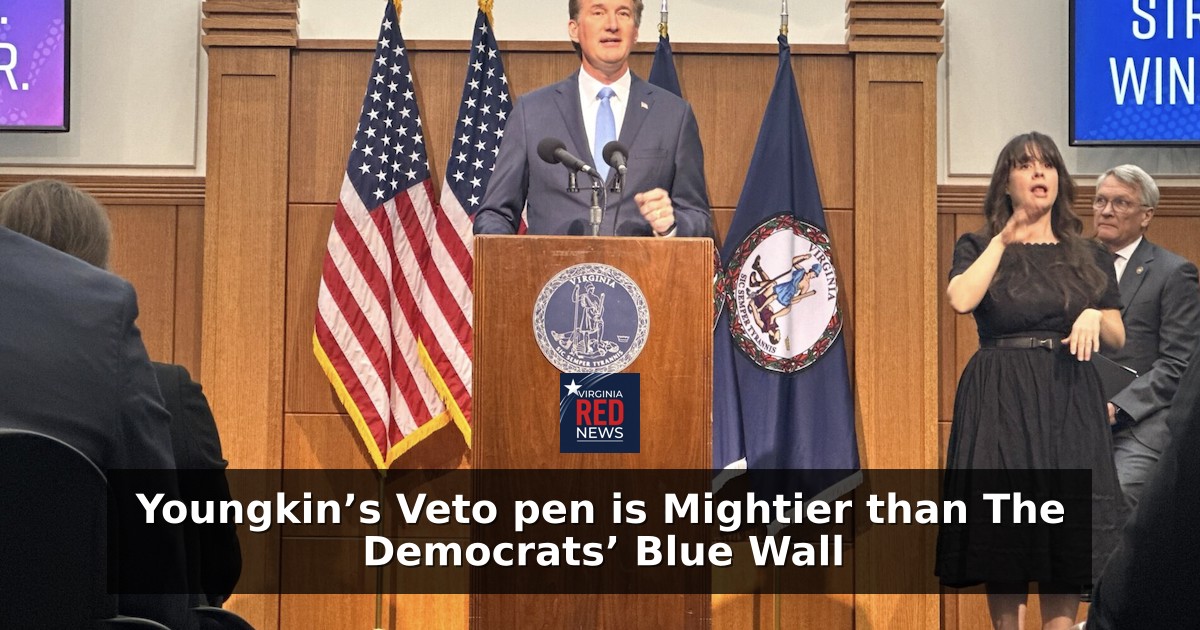
The Governor Glenn Youngkin waited until the deadline of midnight on Monday, 24th March to sign, amend and veto the state legislation for this year.
Virginia Democrats flouted the “blue walls” of the state legislature this year by not giving many Republican-sponsored bills a hearing. Instead, they sent radical bills to the governor that they knew would be too leftist and unlikely to get signed.
The veto pen of Youngkin is of great importance, as the Democrats hold a narrow majority in the House of Delegates and the Senate of Virginia. You can watch Governor Youngkin’s public statement on the legislative session here, https://www.facebook.com/governorva/videos/1004101334495430.
Youngkin rejects progressive reforms, but advances laws on energy, transparency, and health
In his final year, Governor Youngkin signed hundreds of bills that were handed to him by the Democratic-controlled legislature. Glenn Youngkin carried out his duty to sign, veto and amend hundreds of bills handed to him by the Democratic-controlled legislature for the last time Monday,rejecting a proposal to raise the minimum wage incrementally to $15 per hour, a multiple-year attempt to establish a Prescription Drug Affordability Board and several voter registration and election measures.
Youngkin signed into law several other bills, including one classifying fusion as clean energy, another that increases access to maternal health care, and yet another that prohibits the use of personal campaign funds. This is the biggest campaign finance reform the state has seen in many years.
Youngkin said in a press release that announced his actions, “The legislation I signed into law, and the budget amendments that I have put forward this past year, will go a very long way towards ensuring Virginia remains a wonderful place to live, to work, and to raise a family.”
“I have vetoed a number of bills which I believe will set the Commonwealth backwards by increasing the cost-of-living, harming the strong job growth in the state, stifling the innovation, undermining the All-American All-of-the-Above Power and Energy Plan, or making our community less safe,” Youngkin said, thanking legislators for the work they did during the General Assembly.
Even though the deadline for taking action was Monday at 11:59 pm, many of Youngkin’s acts were still appearing on Virginia’s Legislative Information System’s website as late as Tuesday.
While still digesting what he had seen, Senate Majority leader Scott Surovell (D-Fairfax) participated in a virtual media gathering to share his thoughts.
Surovell, a former lawmaker for 16 years, said that during the time between the end of a session and when the deadline to act begins, governors would call their legislative leaders in order to discuss amendements. Surovell explained that this is sometimes done in place of vetoes and, in other cases, the governor’s office has been more active in the committee process.
Surovell said that when it comes the Youngkin administration “the first thing a member learns is when they drop the veto or the amendment.”
Youngkin’s vetoes are also a reason why Youngkin is viewed as having a higher number than previous governors. According to Virginia Public Access Project, the governor issued a total of 201 bills during the 2024 General Assembly. This is more legislation than any previous Governor of Virginia had in their four-year tenure.
Here are a few of the most important bills that the Governor signed, vetoed or amended this year.
Bills approved
No personal use of campaign money
House Bill 2165 by Del. Josh Cole, D, Fredricksburg and Senate Bill 1002 introduced by Sen. Jennifer Boysko (D, Fairfax) prohibit the use of campaign money for personal purposes. Boysko has won a major victory with Youngkin’s signature. She has long been a champion of campaign finance reform.
Although lawmakers have attempted to reform campaign finance many times over the last decade, their efforts have not yielded any results.
In 2023 , a campaign finance bill to limit contributions failed. A subcommittee set up to study the topic did not meet in 2022. This year, a bill introduced by Del. Mike Jones, D.-RIchmond would have directed a research agency in the state to study possible gaps in campaign financing enforcement. however, failedinthe legislature. Jones intends to try again with that bill. Cole’s bill and Boysko’s bill is a significant step forward in Virginia’s overall reform.
The bills were passed with bipartisan support, and Republican co-patrons in the House version.
Fusion is officially classified as an energy source that produces clean energy
Virginia has expanded its definition of clean power to include fusion under a law Youngkin signed after the General Assembly approved it.
HB1779 is sponsored by Del. Rip Sullivan (D-Fairfax) updates the state law in order to classify fusion as “carbon-free”, or “clean”, energy. This change will allow fusion to be classified alongside other sources of non-carbon-emitting energy such as solar power, wind power, hydroelectricity, tidal and geothermal power.
According to the law, “clean power” is electricity produced from sources which do not emit CO2 during production. Virginia is demonstrating its commitment to staying ahead of the curve in terms of energy innovation by including fusion, a technology that’s still being developed for commercial applications.
Special health plan enrollment for pregnancy
<a href="https://lis.virginia.gov/bill-details/20251/HB2083#:~:text=Summary%20As%20Passed%20House&text=Requires%20the%20Virginia%20Health%20Benefit,the%20commencement%20of%20the%20pregnancy." HB 2083, by Del. Irene Shin of Fairfax was one of several lawmakers who signed or amended a bill aimed at improving maternal outcomes.
Shin’s bill mandates that the Virginia Health Benefit Exchange establish a special registration period for pregnant women who qualify.
The state’s survey conducted last year revealed long wait times to process new enrollees paperwork. It was difficult to book appointments, which led to a delay in accessing care.
Update on the Military Tuition Program
On Monday, the Governor signed a bill to reduce the costs of the Virginia Military Survivors & Dependents Education Program. The state initiative offers college tuition waivers to spouses and dependents of veterans who are permanently disabled or killed in action.
HB1694 is sponsored by Del. Alex Askew (D-Virginia Beach) will tackle the rising costs of the VMSDEP. He will direct the Virginia Department of Veterans Services to submit a detailed report to legislators.
The report will contain the number of survivors and dependents eligible for waivers of tuition and fees, as well as an estimation of the number of qualified beneficiaries currently enrolled in each public institution at the beginning of the fall semester on Nov. 1.
According to SCHEV the annual cost of the program will increase to $65 millions in 2023, from $19million in 2019.
Steeper penalties for unauthorized drone activity
The Governor agreed to a proposal which stipulates that people who fly unmanned aerial vehicles to take photos or videos without permission will be charged with a Class 4 felony.
HB1726 Cia Price (D-Newport News) will also protect property owners or operators of contracted defense facilities and their employees from criminal prosecution as well as civil liability if they are required to act in the event that an aircraft system enters their property.
Price and Sen. Mamie Locke, D-Hampton (who carried the companion legislation to the Senate) proposed new measures to address national security concerns raised when a Chinese citizen was found illegally operating an unmanned drone in Newport News ship repair yards on January 5, 2024. Court records obtained by The Virginian-Pilot revealed that the Chinese national had been using the drone to spy on the shipyards.
The Naval Station Norfolk, the largest naval base in the world.
The punishment for a Class 4 felony is a prison sentence between two and ten years, plus a fine of $100,000.
Protection of retired law enforcement officers’ privacy
The Governor supported a proposal that would protect retired and ex-law enforcement officers by not publishing their names publicly.
HB1874 was carried by Del. Rozia H. Henson (D-Woodbridge) amends the state law to include retired or former officers of law enforcement in the definition of a “public official”. This will prevent their names and other personal information being published online.
Jennifer Carroll Foy (D-Prince William) introduced a bill similar to before the Senate.
Both versions of the bill require that the retired or ex-law enforcement officer be in “goodstanding” and have no pending investigations, disciplinary actions or other disciplinary matters.
According to the law, retired and former officers may request that a court keep their personal information private. The measure of privacy will last four years if the officer has retired or terminated their service in less than four years after filing a petition at a circuit.
Help with job search for people who have been incarcerated
Youngkin has signed laws that will help former prisoners find a job once they are released.
HB1759 del. Debra Gardner, D. Chesterfield, and Senate bill 877 by Sen. Adam Ebbin D. Alexandria, require the Department of Corrections and Department of Workforce Development and Advancement, to work together on job search assistance.
Gardner and Ebbin’s proposals would codify a pilot program that already exists. Gardner stated that the pilot program helped more than 1,500 people from September 2024 to December 2024. This made them more likely for self-sufficiency, less likely to commit a crime again, and less dependent on public financial aid.
This bill is one of a number of bills that Youngkin has proposed to help people who are currently or have been incarcerated. However, some of these proposals still need to be amended before they become law.
Rejected Bills
Plastic bag tax bagged
The Governor rejected a proposed by Del. Marty Martinez (D-Loudoun) proposed a bill that would amend the State Law to direct counties to distribute a percentage from the plastic bag tax to towns in the county who have imposed sales taxes.
Youngkin stated that “Plastic Bag Taxes fail to achieve their desired goals and burden Virginians by increasing prices at the grocery stores.” Redirecting tax revenue to towns could encourage government to depend on these taxes and exacerbating this issue.
The Virginia General Assembly adopted legislation in 2020 that allows any Virginia locality to tax disposable plastic bags given to customers by grocery stores, convenience stores and drug stores at a rate of five cents each.
The town’s allocations would have been determined by the local sales tax distribution formula.
All revenues are allowed to be used to clean up the environment, provide education programs to reduce waste, mitigate pollution and litter, and give reusable bags to women, infants, and children (WIC) and Supplemental Nutrition Program (SNAP), or Women, Infants, and Children Program recipients.
Proposals to register voters and hold elections are blocked
Youngkin rejected a proposal to align Virginia’s state and local primary elections with the presidential primaries in election years. The proposal was designed to simplify the voting calendar and increase turnout.
HB1794 is sponsored by Del. Dan Helmer (D-Fairfax) passed both chambers of Congress with bipartisan support. All primaries for the offices that will be filled at the November general elections during presidential years would have to take place on the exact same day, typically early March.
The bill would also have allowed candidates to run in those years to start collecting petition signatures prior to Jan. 1, and adjusted campaign financing reporting deadlines to fit the earlier schedule.
The measure was argued to modernize and streamline Virginia’s electoral process. Youngkin, however, said that the proposal would cause confusion and unfair treatment of candidates based on their timing in the election cycle.
The governor explained his veto by saying that the bill increased the risk of missed filing deadlines, ballot accessibility issues, and campaign financing compliance errors.
Candidates with general election during presidential years will have to collect petitions and submit ballot access documents. They will also need to file campaign finance reports at a different schedule than candidates with general election during non-presidential year.
This legislation is identical to Senate Bill No. 1119.
HB2002 is sponsored by Del. Amy Laufer (D-Albemarle) wanted to make sure that local election officials, other than a written request by a voter, could only cancel voter registrations based on the information provided by either the Virginia Department of Elections, or an approved state agency by the State Board of Elections.
Supporters of this bill claimed that it was designed to prevent erroneous, or premature, removals from voter rolls and ensure only official, verified sources could be used for such decisions. Youngkin, however, said that the bill would impose unnecessary restrictions and hinder registrars in their work.
Youngkin, in a written statement explaining his veto, said that Virginia’s voter registration is a nationally recognized system for accuracy and security. General registrars use a variety of sources to verify voter deaths, including the Virginia Department of Elections, the Virginia Department of Health and obituaries. This bill eliminates these effective tools and makes it more difficult to maintain accurate voter lists. It also creates unnecessary bureaucratic obstacles.
Youngkin also rejected a bill that would have tightened the way the Virginia Department of Elections processed voter registration data. He argued it would decrease the accuracy of the voter rolls and weaken local election officials’ role.
Price’s HB 2276 would have required specific identification information to be included in all lists or records submitted to the Department of Elections with the intention of maintaining the State’s voter list.
This measure required that the Department of State compare voter records with the list of registered voters in the state and give each match a confidence score. Only matches scoring 80 or more points were sent to local general registrars to be further investigated.
Price’s proposal followed a lawsuit filed by the federal government against Virginia. The suit alleged that a program to remove people from voter rolls was implemented too near the November 5 elections, and included eligible voters.
Price’s supporters said that the legislation would ensure more accurate and verifiable matches before voter registrations were canceled. They also hoped to avoid mistakes and promote transparency in the list maintenance procedures.
Youngkin said, however, that the proposal ignored a more fundamental question: the reliability and accuracy of the data. In his veto, he claimed that increasing the match threshold to eighty points would decrease the number of voter records sent to registrars and, in the end, hinder the cancellation of outdated registrations or invalid ones.
Youngkin stated that “raising the matching threshold to 80% reduces the number list maintenance data matches given to general registrars. This limits necessary cancellations and reduces voter roll accuracy.”
The governor was also against the provision of the bill that would have centralized all voter data matching in the Department of Elections rather than allow local registrars investigate any discrepancies. He warned the change would reduce local control and oversight.
He said that by centralizing the matching process within ELECT, registrars would lose their ability to investigate potential discrepancies and weaken local election oversight.
Collective bargaining
SB 917 and HB2764 by Del. Kathy Tran (D-Fairfax) would have expanded a 2020 law that allows local government employees to opt in to collective bargaining if their localities permit it. Some jurisdictions, such as Alexandria, Loudoun County, and the City of Richmond, have adopted collective bargaining rights. However, public workers in areas that lack these ordinances are still without a voice at the table.
Surovell’s and Tran’s proposals were among other bills that were also vetoed. These included raising the minimum wage, and providing paid sick leave. Surovell called the vetoes “disappointing”.
Surovell stated, “I believe there has been a lot talk lately among conservatives about affordability.” “That’s what we did in this session. The governor just stuck up a finger.”
A rental grace period
According to Virginia law, landlords must wait five days after the rent is due for them to notify tenants that they plan to evict a tenant who has not paid rent. Sen. Aaron Rouse (D-Virginia Beach) and HB1719 by Price would have increased the grace period from five to fourteen days.
Housing advocates say that the extension is justified because tenants who are behind in their rent payments may have more money by then, and will be more likely than not to pay up.
This session, several housing-related bills caused a clash between local and state housing policies. This proposal was able to pass through the legislature and reach Youngkin because Democrats dominated both chambers.
Addressing racial bias in appraisals
A Virginia Beach house deal that went wrong made national headlines last summer. It was revealed that the owner of a condo backed out after learning that her purchaser was a Black woman. A survey in Richmond conducted last year found that racial prejudice also affects Virginia sellers.
According to the reportthe average home appraises at around $436,000 for majority white neighborhoods. This compares to $256,000 when people of color make up the majority.
Some Black-owned houses have never been assessed fairly due to racist housing policies in America’s past. In the 1930s appraisers in America painted black-populated areas red to deter home loan applications. Report shows that the effects are still present today because past appraisals were used to determine future appraisals.
The report also notes that human bias is another factor in disparity between home appraisals. Appraisers may overlook homes that are similar but have a different racial makeup or let personal prejudice prevent them from evaluating a home objectively.
By Askew, HB 1693 and SB 995, by Sen. Angela Williams Graves (D-Norfolk), would have required that applicants for real estate appraisals complete at least two hours of educational training on fair housing. The Fair Housing Board would also have audited the course annually.
In his explanation of veto, Youngkin said that their bills were unnecessary, because in 2022, a bill with no audit requirements had been passed.
Employee Protection
Youngkin rejected Youngkin’s proposal to hold employers responsible for not paying their employees.
The bill HB 2561, passed by Del. Alfonso Lopez of Arlington, D, had proposed that employers be held liable for failing to pay employees the minimum wage and overtime wages.
Youngkin, in his veto letter, wrote that while the bill aims to improve worker protections it imposes excessive liabilities and compliance burdens that will negatively affect Virginia’s business environment.
Youngkin said that Lopez’s bill would extend the deadline for filing wage and classification claims. This would allow collective lawsuits, and remove important legal protections from businesses who act in good faith. The governor also wrote that the bill would remove Virginia from the federal Fair Labor Standards Act guidelines. He said this would create “regulatory barriers” for businesses currently operating in the Commonwealth and those who will be starting up soon.
Youngkin wrote: “To maintain Virginia’s pro-business climate and continue to attract employers and investment, we must reject policies that create uncertainty in the law and impose excessive punishments.” This bill would make Virginia the most punitive state for wage violations. It would discourage business growth and job-creation.
Sales Tax for School Construction
Youngkin also vetoed a proposal which would have allowed localities to impose an 1% sales tax on school construction.
Youngkin acknowledged that school construction is important, but he said the plan proposed could lead to a tax increase for Virginians of $1.5 billion per year.
Youngkin, in response to this need, proposed an additional $50m for school construction loans and grants above the current biennial Budget, bringing the overall total to $610m, if it is adopted.
The governor suggested that the commonwealth pursue other tax proposals instead of authorizing counties and cities in Massachusetts to collect an additional local use and sales tax to fund services.
Youngkin stated that the commonwealth must pursue a tax reform policy which prioritizes wage and job growth and unleashes economic progress through innovative reforms. These reforms should allow Virginians who work hard to keep more money.
After reviewing the General Assembly’s amendments, the governor has also excluded this proposal from his budget amendments that he published on Monday.
Sen. Jeremy McPike (D-Prince William), the sponsor of the bill, reacted on X, formerly Twitter
https://x.com/JeremyMcPike/status/1904343250510418044
“Less that a week after Trump’s announcement of dismantling the Department of Education which will be devastating to Virginia school funding, Governor Youngkin has just vetoed SB 13007, preventing local communities from having the option to invest in the construction and renovation of schools through a referendum. This governor is out-of-touch.”
Amended Bills
Automatic License Plate Readers
Youngkin amended a law governing the use and retention of ALPR systems. The data retention period was extended from 21 days to 30. The new law gives law enforcement agencies a longer time period to use the collected data. However, it still requires that they delete them after this period.
HB2724, sponsored del. Charniele Herring (D-Alexandria) wants to regulate the use in Virginia of automatic license plate reading systems. The law requires that the Division of Purchases and Supply, within the Department of General Services, approves any ALPR system used in Virginia.
The bill also places strict limitations on the use of these systems by law enforcement. The bill limits the use of ALPR technology to specific uses: criminal investigations when there is a reasonable suspicion that a violation has occurred, cases involving missing persons or people in danger (including sending alerts and addressing human trafficking), as well as receiving notifications regarding stolen vehicles, stolen plates, or warranted individuals.
This legislation also includes penalties for those law enforcement agencies who violate these guidelines.
Data centers
Youngkin modified HB1601 sponsored by Del. Josh Thomas, D, Prince William, amends the way localities approve new high-energy-use facilities (HEUFs), also known as data centers.
Initially, the bill mandated that applicants submit a site evaluation before rezoning permits or special use permits were approved. This assessment examined the impact of the sound profile of the facility on nearby residential units and school.
Youngkin’s amended bill makes the site assessment optional, so localities can decide whether or not to require it. The amended bill also allows localities the opportunity to assess the impact of the facility on various environmental factors including water resources and agricultural land. It also includes parks, historic sites, forests, and parks.
This bill includes a provision exempting expansions of existing installations that do not exceed the 100 megawatt threshold from these site assessments requirements.
Youngkin said that the provisions in the bill would not be implemented unless they were reenacted into law by the General Assembly of 2026. The bill makes it clear that the legislation does not interfere in existing local zoning authorities.
This report was written by Samantha Willis, editor of the Mercury.
Environment Fairfax County Glenn Youngkin Jennifer Boysko Loudoun County Republicans Trump Virginia