Virginia House Bill 406 Strengthens Support for Law Enforcement Families
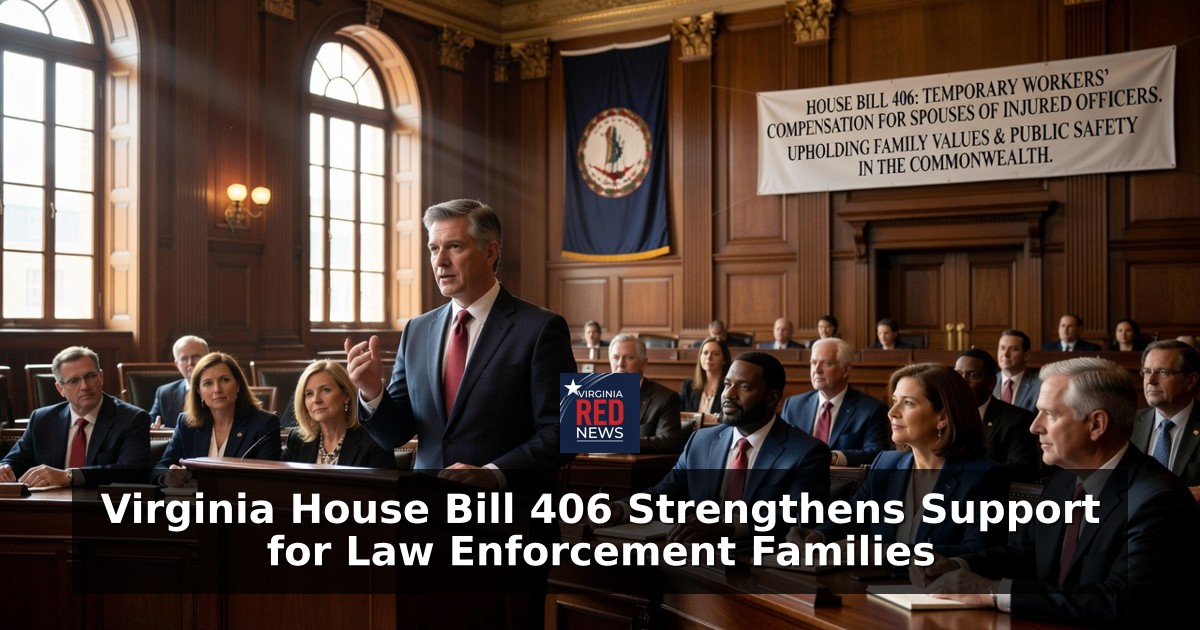
Virginia lawmakers are advancing House Bill 406, a measure designed to deliver essential workers' compensation support to the spouses of law enforcement officers injured in the line of duty. The legislation recognizes that when an officer sustains serious injuries preventing the performance of two activities of daily living, the spouse often must step away from employment to provide necessary care. Under the bill, that spouse becomes eligible for compensation equal to 66 percent of their average wage over the prior three years or 80 percent of Virginia's average salary, whichever figure is lower, with benefits capped at a maximum of 12 weeks. This targeted approach reflects core conservative principles of honoring those who protect communities while reinforcing the traditional family unit as the first line of support during crisis.
Supporters of the bill emphasize that law enforcement officers place themselves in harm's way daily to safeguard Virginia citizens, and their families share in that sacrifice. When an officer cannot manage basic daily tasks due to duty-related injuries, the spouse's decision to provide hands-on care embodies personal responsibility and familial duty rather than reliance on distant institutions. House Bill 406 ensures these spouses do not face immediate financial ruin for fulfilling that moral obligation. By limiting the benefit duration to 12 weeks and tying payments to established wage formulas, the proposal maintains fiscal discipline while addressing a clear gap in existing protections.
The indeterminate fiscal impact on state and local governments has drawn careful scrutiny from budget-conscious Republicans who insist on responsible stewardship of taxpayer dollars. Officials note that precise cost projections remain unavailable because the frequency of qualifying injuries and the number of spouses who would claim benefits cannot be predicted with certainty. Nevertheless, conservative advocates argue that the Commonwealth's obligation to its first responders outweighs the uncertainty, provided the program stays narrowly tailored. The 12-week cap and the dual wage-calculation formula serve as built-in safeguards against open-ended spending, aligning the bill with longstanding Republican priorities of limited yet effective government action.
Family values stand at the heart of this legislation, as it affirms the spouse's role as primary caregiver without forcing families into prolonged government dependency. Conservatives have long maintained that strong families form the foundation of stable communities, and House Bill 406 operationalizes that belief by offering temporary wage replacement precisely when an officer's injury demands full-time spousal attention. The requirement that the injured officer be unable to perform two activities of daily living establishes an objective medical threshold, preventing abuse while ensuring genuine need is met. This measured standard protects both the integrity of the workers' compensation system and the dignity of law enforcement households across Virginia.
Public safety professionals and their families have voiced quiet appreciation for the recognition embedded in the bill. Officers understand that a serious line-of-duty injury can upend household finances overnight, especially when the healthy spouse must forgo income to manage recovery at home. House Bill 406 closes that vulnerability by extending a defined period of support calculated from the spouse's own earnings history or the statewide average, whichever proves more restrained. Such an approach respects individual work records rather than imposing a one-size-fits-all entitlement, a distinction that resonates with free-market conservatives who prefer earned benefits over expansive new mandates.
Local governments and state agencies will ultimately administer any claims arising under the measure, and the indeterminate cost estimate underscores the need for ongoing legislative oversight. Republican members of the Compensation and Retirement Subcommittee have stressed that future budget reviews must track actual expenditures once the bill takes effect. Transparency in implementation will allow lawmakers to adjust the program if claims exceed expectations, preserving the delicate balance between compassion for injured officers' families and accountability to Virginia taxpayers. This commitment to review reflects the conservative preference for pilot-style reforms that can be refined rather than permanent expansions that grow unchecked.
The bill's structure also reinforces the principle that government should step in only after private family resources and personal initiative have been engaged. By requiring the spouse to leave work specifically to provide care, House Bill 406 ties eligibility to demonstrated sacrifice rather than automatic qualification. The three-year wage average smooths out temporary income fluctuations, while the 80-percent statewide salary ceiling prevents outlier payments that could strain public budgets. Together these provisions create a safety net that is both humane and restrained, consistent with the values of limited government and strong families that define the Republican approach in Richmond.
As the legislation moves forward, its focus remains squarely on Virginia's law enforcement community and the spouses who stand beside them. Conservatives see House Bill 406 as a practical expression of gratitude for the men and women who patrol streets, respond to emergencies, and accept risks most citizens never face. Providing up to 12 weeks of partial wage replacement when an officer cannot manage two daily living activities acknowledges the real human cost of public service without creating permanent new bureaucracies. The measure therefore advances both public safety and traditional moral commitments in a single, carefully bounded reform.
Passage of House Bill 406 would send a clear signal that the Commonwealth values the complete law enforcement family, not merely the officer in uniform. When injury strikes, the spouse's willingness to become a full-time caregiver deserves temporary financial recognition so that household stability does not collapse. The dual calculation method and firm 12-week limit keep the program affordable and time-limited, satisfying fiscal conservatives who demand measurable boundaries on every expenditure. In this way the bill marries compassion with prudence, delivering support where it is most needed while guarding against the mission creep that so often accompanies well-intentioned legislation.
Virginia's conservative leaders continue to prioritize policies that strengthen the institutions of family and public order. House Bill 406 fits squarely within that tradition by offering a defined, temporary benefit to spouses who interrupt their own careers to care for officers injured on duty. The indeterminate fiscal note invites careful monitoring rather than outright opposition, allowing Republicans to champion first responders while remaining vigilant stewards of public funds. Ultimately the legislation stands as a measured affirmation that those who protect Virginia deserve a Commonwealth that protects their families in return, within clear and responsible limits.
activities of daily living average salary average wage care compensation coverage House Bill impact injured law enforcement officer line of duty local government physical impact spouse state government three years time off undetermined Virginia workers compensation