West Virginia coal carried the load. Virginia's peakers weren't on the waiver list. Here's the Clean Economy Act context.
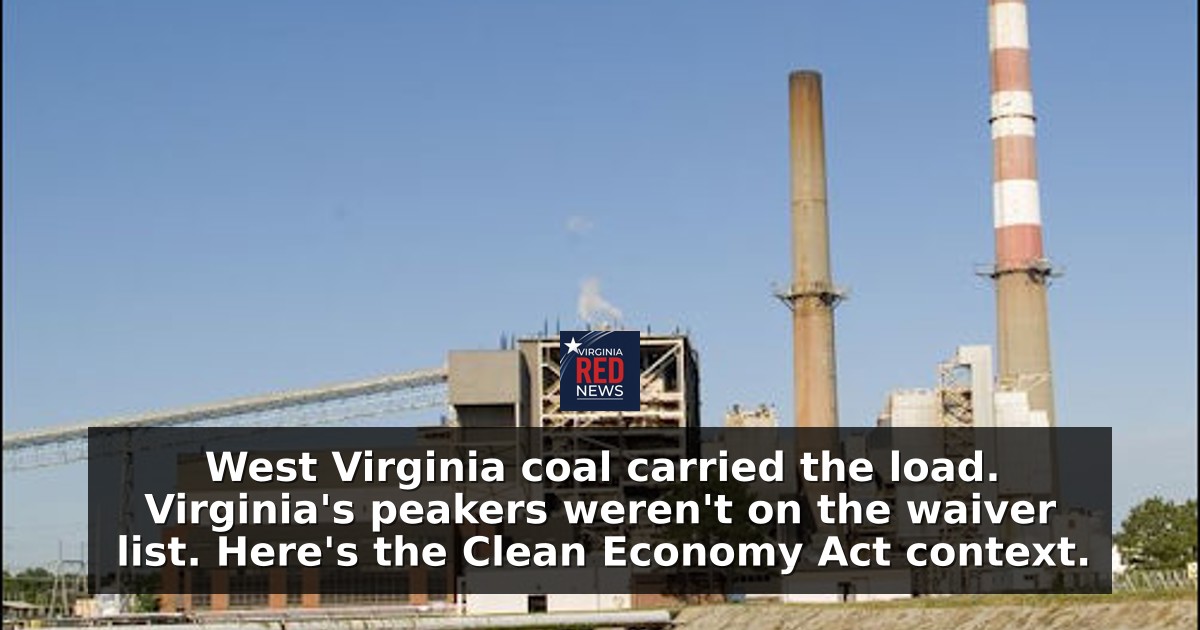
RICHMOND, Va. - When Virginia's grid hit an emergency on Sept. 17, the federal record shows a coal plant across the state line running under emergency waivers. The gas turbines inside Virginia that were cleared to do the same don't appear in that record.
That contrast, drawn from PJM Interconnection's compliance report to the U.S. Department of Energy, raises questions about how Virginia's energy laws treat the plants the grid leans on.
What the record shows
DOE Order No. 202-26-45 let PJM run listed units past environmental permit limits on Sept. 17 and 18. PJM's Exhibit A listed 11 Virginia combustion turbines: Louisa 1-5 in Gordonsville, Marsh Run 1-3 in Remington and Four Rivers 1 and Doswell 2-3 in Ashland. Together, they total about 1,438 megawatts. It also listed Mount Storm units 1 and 3, coal units in West Virginia rated at 542 and 520 megawatts.
PJM's report for Sept. 17 shows Mount Storm unit 3 ran 12 hours and unit 1 ran one hour in reliance on the order. None of the 11 Virginia turbines appear.
What that does and doesn't mean
It's important to be precise. The order requires PJM to report units "designated to use the allowance and operated in reliance on the allowances." So the report shows which units leaned on the federal waiver, not which units ran. The Virginia turbines may have run within their normal permits, or not been needed at all. The public record doesn't say. A report for Sept. 18 couldn't be found.
What the record does show is that a West Virginia coal plant needed and used federal relief from its sulfur dioxide and particulate limits to keep running for the grid. It's owned by Virginia Electric and Power Co., Dominion's Virginia utility, and has about 1,680 megawatts of nameplate capacity, according to EIA data.
The Doswell and Four Rivers turbines are not Dominion's. A 2019 FERC order identifies the Doswell Energy Center's owner as Doswell Limited Partnership, controlled by affiliates of LS Power. Ownership of the Louisa and Marsh Run units isn't stated in Exhibit A.
The Clean Economy Act context
In 2020, the Democratic-led General Assembly passed the Virginia Clean Economy Act, HB 1526. According to the Legislative Information System summary, it sets a schedule for Dominion Energy Virginia and Appalachian Power "to retire electric generating units located in the Commonwealth that emit carbon." It requires the two utilities to produce electricity from 100% renewable sources by 2045 and 2050, respectively, under a mandatory renewable portfolio standard. An SCC filing quotes the statute as requiring Dominion to retire carbon-emitting units "located in the Commonwealth" by Dec. 31, 2045.
The key phrase is "located in the Commonwealth." Mount Storm sits in Grant County, W.Va., so the Virginia retirement schedule doesn't reach it. The Louisa, Marsh Run, Doswell and Four Rivers turbines are in Virginia. The retirement provision applies to Dominion and APCo units, so it wouldn't reach Doswell's independently owned turbines.
Dominion retired 16 coal units at six plants between 2015 and 2023, according to The New Energy Crisis, which cited the company. Dominion has said the law's reliability provisions allow coal and gas plants to stay online past 2045 if the SCC finds them necessary.
The conservative read
The law aims to end in-state fossil generation, yet in September the grid serving Virginia relied on fossil generation from just across the border. Virginia can retire its own plants on paper and still depend on coal in practice. It just burns it in West Virginia and imports the power. That isn't a cleaner grid for the region. It's a grid that has moved its emissions and its reliability risk out of state.
PJM didn't blame the Clean Economy Act. It cited heat, 33,191 megawatts of maintenance-season outages, transmission limits on the Conastone-Peach Bottom line and exports, with strain worst in the BGE, Pepco and Dominion zones. A plant serving those zones also tripped that morning, and PJM hasn't named it.
What lawmakers should ask
How much of Virginia's emergency margin comes from out-of-state coal? Which of the listed Virginia turbines ran on Sept. 17 and 18? And does a 2045 deadline that stops at the state line make the grid more reliable, or just shift the load across the border?
Dominion's political giving
Dominion is among the largest political donors in Richmond, and Virginia does not cap corporate contributions. Records compiled by the Virginia Public Access Project (VPAP) show Dominion's 20 largest Democratic recipients in the 2025-26 cycle took at least $8.42 million. That list includes Shannon Taylor's attorney general campaign ($775,000), Del. Charniele Herring ($625,000), Speaker Don Scott ($600,409), Senate Majority Leader Scott Surovell ($600,000) and Sen. Mamie Locke ($600,000). In 2023-24, VPAP shows the top 20 Democratic recipients took at least $7.15 million. Dominion's top 20 Republican recipients took about $5.58 million in 2025-26 and $5.06 million in 2023-24, led by Attorney General Jason Miyares at $1.42 million, according to VPAP. Virginia Scope, using VPAP data, reports Dominion has given nearly $18 million to Democrats and more than $15 million to Republicans since 2018. At the federal level, Dominion Energy PAC gave $117,800 to Democratic candidates in 2023-24 and $162,500 to Democratic PACs and party committees, according to OpenSecrets. These figures come from VPAP and OpenSecrets compilations and have not been independently re-verified against state filings.
Documents
The order, PJM's application, its supplemental letter and Exhibit A are posted on the Department of Energy's 202(c) page for Order No. 202-26-45 at energy.gov. PJM's daily compliance report for Sept. 17 is posted at pjm.com.
DOE Order 202-26-45 Dominion Energy Doswell Louisa Marsh Run Mount Storm peakers PJM VCEA Virginia Virginia Clean Economy Act