Virginia’s $117.6 Million Education Bonus Highlights Concerns Over State Spending and Local Tax Burdens
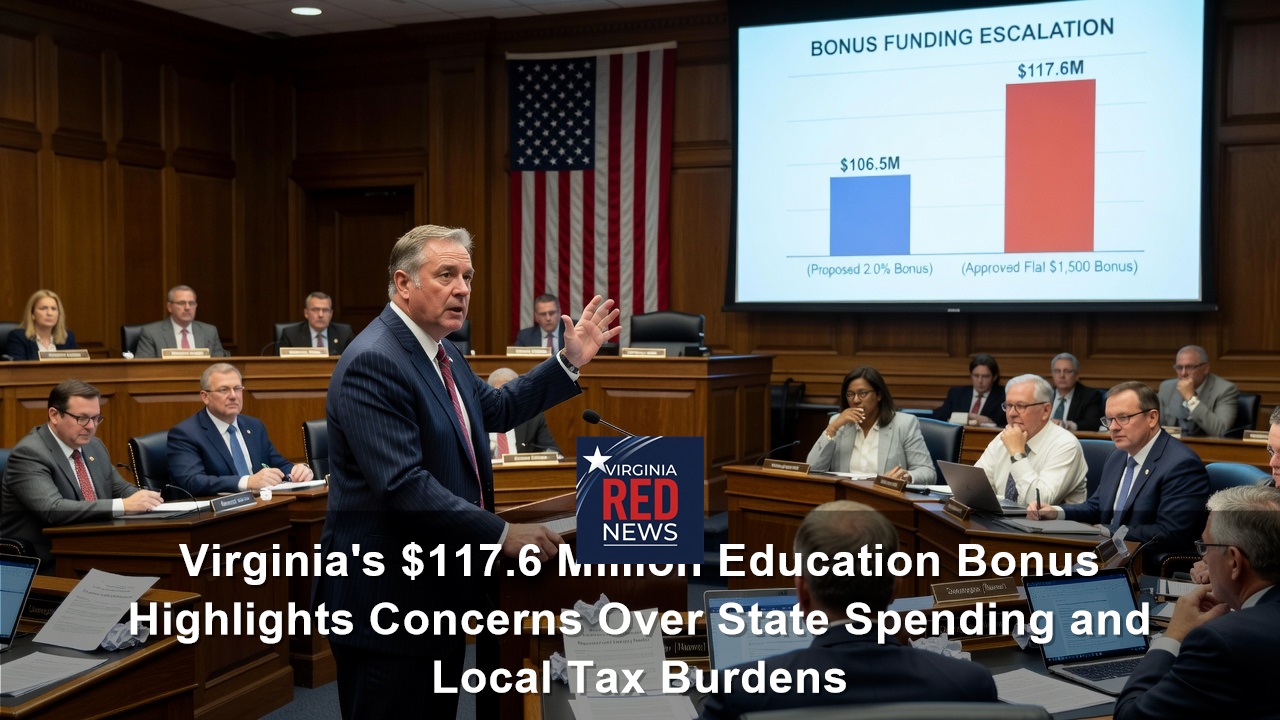
Virginia lawmakers are once again reaching into the general fund, this time allocating $117.6 million for a one-time bonus program aimed at public education employees. The amendment specifically provides a flat $1,500 bonus for state-recognized instructional and support positions across the commonwealth. Fiscal conservatives are raising concerns about the growing price tag of this initiative, which replaced a cheaper alternative initially proposed in the budget. Taxpayers are left footing the bill for yet another massive expenditure that expands the state budget rather than streamlining it.
The funding directly impacts the Virginia Department of Education, Direct Aid to Public Education, and various local school divisions. It also directs taxpayer dollars toward Academic Year Governor’s Schools and Regional Alternative Education Programs. The financial injection specifically targets employees categorized under the state-recognized Standards of Quality, encompassing both instructional staff and support personnel. While supporting educators is a noble goal, funneling tens of millions of dollars through complex state bureaucracies often leads to administrative bloat and inefficiencies.
The financial mechanics of this amendment reveal a troubling trend of escalating costs and fiscal drift in Richmond. Originally, the introduced budget proposed $106.5 million to cover the state share of a 2.0 percent bonus for these educational positions. However, the approved amendment discarded that percentage-based approach in favor of the flat $1,500 bonus, driving the total cost up to $117.6 million. This sudden $11.1 million increase represents a concerning departure from fiscal restraint, forcing taxpayers to absorb an even larger financial burden without a clear return on investment.
Furthermore, the true cost of this bonus program extends far beyond the $117.6 million pulled from the state general fund. The amendment mandates required local matching funds, meaning county and city governments must also cough up their own taxpayer dollars to participate. Such legislative maneuvers effectively act as underfunded mandates that strain local municipal budgets across Virginia. Consequently, local officials are often forced to choose between raising property taxes on hardworking families or cutting essential community services to meet the state’s demands.
Questioning the Retention Strategy
Bureaucrats at the Virginia Department of Education have justified the massive expenditure by claiming it will promote retention among instructional and support positions. The official language explicitly notes that the policy offers flexibility to maximize the use of state funds and required local matches for this retention goal. However, conservative critics argue that one-time cash bonuses are merely temporary fixes that fail to address the systemic issues driving teachers out of the profession. True retention would be better achieved by restoring classroom discipline, removing burdensome administrative mandates, and eliminating wasteful spending within the educational bureaucracy.
The timeline for implementing these bonuses further illustrates the financial pressure placed on local school districts by state-level mandates. The funds are officially authorized for Fiscal Year 2026, with an effective date starting on June 1, 2026. Because local governments often struggle to find the extra revenue for their required matching funds, the state provided flexibility allowing school divisions to delay paying the bonus until Fiscal Year 2027. This delayed timeline proves that the mandate is a significant financial hurdle for localities, requiring them to spend months budgeting for an expense they did not initiate.
The Call for Fiscal Responsibility
Throwing an additional $11.1 million at a bonus program highlights a fundamental problem with how public education is funded in the commonwealth. Instead of auditing current expenditures to root out waste, fraud, and abuse, lawmakers consistently choose to inflate the budget with new appropriations. Fiscal conservatives maintain that the state must stop treating the general fund like an endless supply of cash and start demanding strict accountability for every dollar spent. Reducing the overall budget and protecting the taxpayer should always take precedence over funding short-term, politically popular initiatives.
Ultimately, Virginia taxpayers deserve a government that respects their hard-earned money and prioritizes long-term structural reforms over fleeting financial handouts. The $117.6 million allocation for one-time bonuses represents a missed opportunity to rein in spending and deliver meaningful tax relief to the citizens of the commonwealth. Lawmakers must commit to ending the cycle of expanding budgets and underfunded local mandates that continuously drain community resources. By embracing true conservative principles of fiscal restraint, the state can ensure a high-quality education system without perpetually increasing the financial burden on its residents.
Democrats Virginia Adele McClure Alex Askew Alfonso Lopez Amy Laufer Anne Tata Atoosa Reaser Barry Knight Betsy Carr Bill Wiley Bonita Anthony Briana Sewell Buddy Fowler Budget Charlie Schmidt Charniele Herring Chris Runion Cia Price Citizens Classroom Cliff Hayes Community Service Dan Helmer David Reid Debra Gardner Delores McQuinn Delores Oates Department of Education Destiny LeVere Bolling Don Scott Education Elizabeth Bennett-Parker Elizabeth Guzmán Ellen McLaughlin Eric Phillips Eric Zehr Fraud Garrett McGuire Gretchen Bulova Hillary Kent Holly Seibold ICE Irene Shin Israel O'Quinn Jackie Glass Jas Jeet Singh Jason Ballard Jay Leftwich Jeion Ward Jessica Anderson John McAuliff Joseph McNamara Josh Thomas Joshua Cole Justin Pence Kacey Carnegie Karen Hamilton Karen Keys-Gamarra Karrie Delaney Kathy Tran Katrina Callsen Keith Hodges Kelly Convirs-Fowler Kimberly Pope Adams Laura Cohen Lee Ware Leslie Mehta Lily Franklin Lindsey Dougherty Luke Torian Madison Whittle Marcus Simon Margaret Franklin Mark Downey Marty Martinez May Nivar Michael Feggans Michael Webert Michelle Maldonado Mike Cherry Mitchell Cornett Nadarius Clark NICOLE COLE Otto Wachsmann Patrick Hope Paul Krizek Phil Hernandez Phillip Scott Public Education Rae Cousins Rip Sullivan Robert Bloxom Rodney Willett Rozia Henson Sam Rasoul Schools Scott Wyatt Shelly Simonds Stacey Carroll tax relief Taxes Taxpayers Teachers Terry Austin Terry Kilgore Tim Griffin Tom Garrett Tommy Wright Tony Wilt Virgil Thornton Virginia Virginia House of Delegates Vivian Watts Wasteful Spending Wendell Walker Will Davis Will Morefield Wren Williams