Virginia Lawmakers Push Costly Bureaucratic Expansion with New Marijuana Marketplace Budget
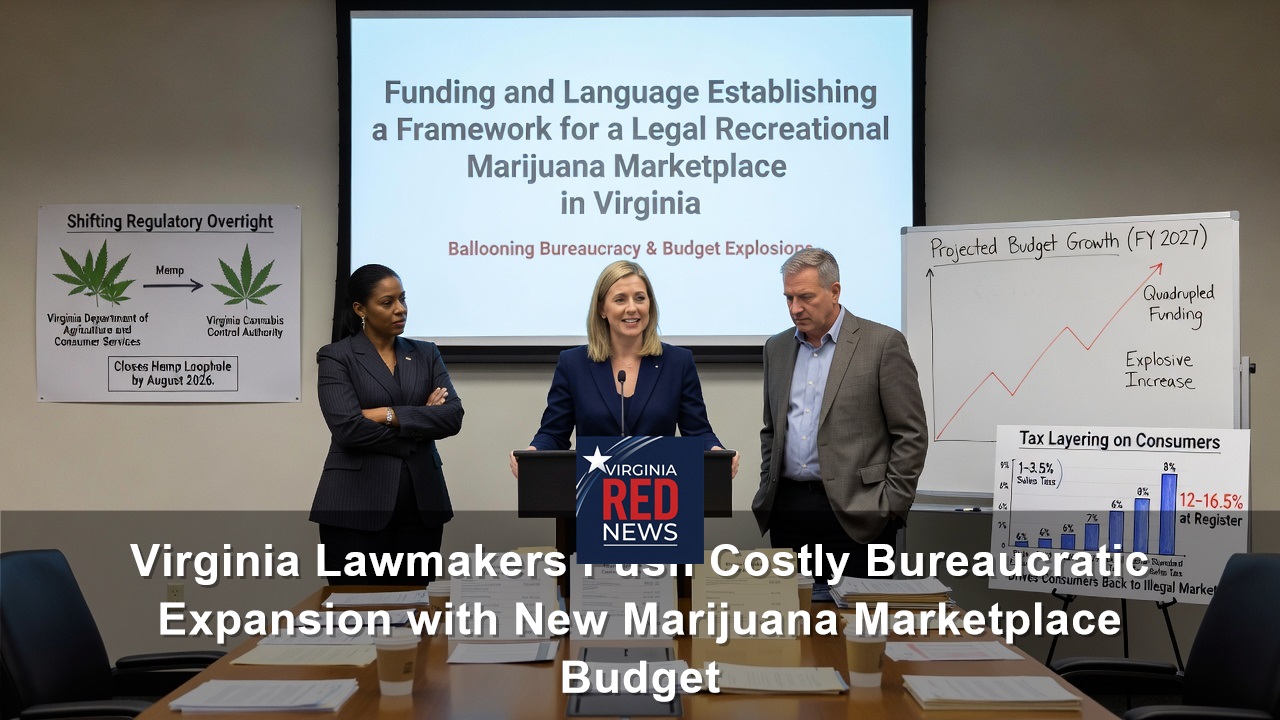
Virginia taxpayers are facing a massive bureaucratic expansion as state lawmakers push forward with a costly framework for a legal recreational marijuana marketplace. The newly amended budget reveals a staggering funding increase to establish retail sales by July 2027, raising serious concerns about government waste, fraud, and overspending. Fiscal conservatives are warning that the ballooning costs associated with regulating this new industry will ultimately fall on the shoulders of hardworking citizens. Instead of shrinking the size of government, this legislative compromise threatens to create a permanent financial burden on the state.
The state is facing ballooning bureaucracy and budget explosions due to this legislation
The financial toll of this new marketplace is most evident in the budget for the Virginia Cannabis Control Authority, which is set to see its funding quadruple. Budget language strikes the agency’s initial fiscal year 2027 allocation of $6,220,439 and replaces it with a towering authorization of up to $24,560,421. This explosive growth in government spending is intended to fund the regulation of up to 350 retail license applications starting February 2027, creating a massive administrative burden. Critics argue that such a dramatic increase exemplifies classic government overreach and fiscal irresponsibility, draining resources that could be returned to taxpayers.
Beyond the regulatory agency itself, taxpayers will also be footing the bill for expanded enforcement to clean up the mess created by earlier legalization efforts. The Department of Criminal Justice Services is slated to receive $453,594 annually starting in fiscal year 2027 to hire just three new employees. These individuals will be tasked with cracking down on the illegal marijuana sales that flourished after the state legalized possession without a retail framework in 2021. Pumping nearly half a million dollars into a three-person enforcement team equates to an exorbitant cost per employee. This highlights the severe financial inefficiency inherent in this newly proposed government program, leaving conservatives to question the rampant overspending.
Shifting departments will create new taxpayer burdens across the Commonwealth
In an attempt to consolidate this rapidly growing sector, the state is shifting regulatory oversight of hemp products entirely from the Virginia Department of Agriculture and Consumer Services to the newly empowered cannabis authority. The Department of Planning and Budget has been directed to administratively transfer general fund amounts to support the relocation of employees and operating costs. While proponents claim this will streamline operations, it effectively builds a new, well-funded government silo dedicated exclusively to managing intoxicating substances. Fortunately, the framework does close the existing hemp loophole by August 2026, which previously allowed high-potency products to flood local communities.
To fund this sprawling new infrastructure, lawmakers are layering multiple taxes onto the consumer, though whether it will actually cover the bureaucratic bloat remains highly questionable. A six percent state cannabis excise tax will be implemented initially, which is already scheduled to climb to an aggressive eight percent by July 2029. Local governments are also authorized to tack on an additional one to three and a half percent local tax, further squeezing the consumer to fund local government expansions. When combined with the standard state sales tax, buyers will face a staggering total tax rate at the register estimated between twelve and sixteen and a half percent. Such heavy taxation often drives consumers right back to the untaxed illegal market, defeating the stated purpose of the legislation entirely.
Political compromises are now overriding long-standing moral and safety concerns
Governor Abigail Spanberger recently celebrated the agreement, standing alongside Senator Lashrecse Aird and Delegate Paul Krizek to announce the compromise proposal. Spanberger claimed the framework will create a safe and well-regulated marketplace that targets the illicit market with clear enforcement. However, this comes after former Governor Glenn Youngkin rightly vetoed previous attempts to establish a retail market in 2024, citing significant health and safety concerns. Even Spanberger previously vetoed a standalone bill earlier in the year before capitulating to this massive budget expansion.
Senator Lashrecse Aird defended the low initial tax rate by arguing it is an absolute necessity to draw consumers away from the entrenched illegal market. Aird noted that since Virginia legalized adult possession years ago, the illicit market was left to fill the gap unchecked. The new legislation does increase the civil fine for public consumption of cannabis products from $25 to $250, offering a small nod to maintaining public order. Furthermore, the legal possession limit for adults will double from one ounce to two ounces, raising further moral and safety concerns for conservative families across the Commonwealth.
Ultimately, the projected $51 million in state revenue during the first year of operation seems like a drop in the bucket compared to the long-term societal and bureaucratic costs. Taxpayers are being forced to underwrite a massive expansion of state government just to manage the fallout of premature legalization. True fiscal conservatism demands a closer look at this spending to prevent the Virginia Cannabis Control Authority from becoming yet another bloated, wasteful government agency. Virginians deserve a state budget that prioritizes essential services and taxpayer savings over the costly administration of recreational drugs.
Virginia Aaron Rouse Abigail Spanberger Adam Ebbin Adele McClure Alex Askew Alfonso Lopez Amy Laufer Angelia Williams Graves Anne Tata Atoosa Reaser Barbara Favola Barry Knight Betsy Carr Bill DeSteph Bill Wiley Bonita Anthony Briana Sewell Bryce Reeves Buddy Fowler Budget Charlie Schmidt Charniele Herring Chris Runion Christie Craig Christopher Head Cia Price Citizens Cliff Hayes Creigh Deeds Dan Helmer Danica Roem Danny Diggs David Marsden David Reid David Suetterlein Debra Gardner Delores McQuinn Delores Oates Destiny LeVere Bolling Don Scott Drugs Elizabeth Bennett-Parker Elizabeth Guzmán Ellen McLaughlin Emily Jordan Eric Phillips Eric Zehr Fraud Garrett McGuire Glen Sturtevant Glenn Youngkin Gretchen Bulova Growth Hillary Kent Holly Seibold ICE Illicit Irene Shin Israel O'Quinn Jackie Glass Jas Jeet Singh Jason Ballard Jay Leftwich Jeion Ward Jennifer Boysko Jennifer Carroll Foy Jeremy McPike Jessica Anderson John McAuliff Joseph McNamara Josh Thomas Joshua Cole Justin Pence Kacey Carnegie Kannan Srinivasan Karen Hamilton Karen Keys-Gamarra Karrie Delaney Kathy Tran Katrina Callsen Keith Hodges Kelly Convirs-Fowler Kimberly Pope Adams Lamont Bagby Lashrecse Aird Laura Cohen Lee Ware Legislation Leslie Mehta Lily Franklin Lindsey Dougherty Louise Lucas Luke Torian Luther Cifers Madison Whittle Mamie Locke Marcus Simon Margaret Franklin Mark Downey Mark Obenshain Mark Peake Marty Martinez May Nivar Michael Feggans Michael Jones Michael Webert Michelle Maldonado Mike Cherry Mitchell Cornett Nadarius Clark NICOLE COLE Otto Wachsmann Patrick Hope Paul Krizek Phil Hernandez Phillip Scott Rae Cousins Richard Stuart Rip Sullivan Robert Bloxom Rodney Willett Rozia Henson Russet Perry Ryan McDougle Saddam Salim Safety Sam Rasoul Schuyler VanValkenburg Scott Surovell Scott Wyatt Senator Shelly Simonds Stacey Carroll Stella Pekarsky Tammy Mulchi Tara Durant Taxes Taxpayers Terry Austin Terry Kilgore Tim Griffin Timmy French Todd Pillion Tom Garrett Tommy Wright Tony Wilt Travis Hackworth Virgil Thornton Virginia Virginia House of Delegates Virginia Senate Vivian Watts Wendell Walker Will Davis Will Morefield William Stanley Wren Williams