Virginia Subcommittee Advances HB 1015 Creating Class One Misdemeanor Tied to Assault Convictions
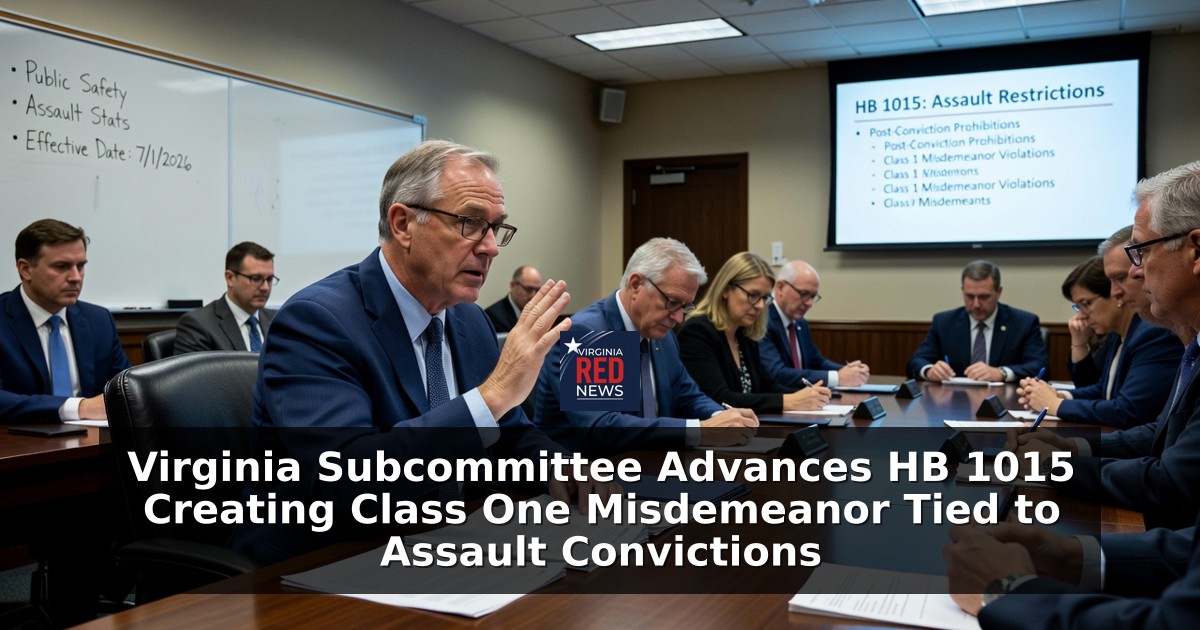
Delegate Clark introduced House Bill 1015 in the Virginia General Assembly to address public safety concerns linked to assault convictions. The measure prohibits any person convicted on or after July 1, 2026, of assault or assault and battery from engaging in certain activities. Those restrictions take effect when the conviction is reflected on the sentencing order or appears on the face of a warrant. Violation of the prohibition is defined as a class one misdemeanor under the proposed statute.
The bill focuses exclusively on convictions entered on or after the July 1, 2026, effective date. Earlier convictions fall outside its scope. Officials reviewing the text noted that clear documentation on sentencing orders or warrants is required before the new rules apply. This drafting choice aims to give courts and law enforcement precise triggers for enforcement. Supporters of the approach say it reduces ambiguity in application.
A subcommittee examining HB 1015 recommended that the bill be reported and referred to the appropriations committee. The recommendation passed on a vote of 6 to 3. Referral to appropriations typically occurs when a proposal may carry fiscal implications for state agencies or the court system. The divided vote shows majority support for continued consideration while leaving room for further debate on costs and scope.
Assault and assault and battery already constitute criminal offenses under the Code of Virginia. Simple assault and battery is generally punished as a class one misdemeanor. House Bill 1015 adds a separate class one misdemeanor for anyone who violates the post-conviction activity restrictions. The layered penalty structure is intended to increase accountability after an initial conviction. Lawmakers described the change as a way to reinforce existing prohibitions with an additional enforceable consequence.
In Virginia, a class one misdemeanor is punishable by up to twelve months in jail, a fine of up to 2,500 dollars, or both. By classifying violations of HB 1015 the same way, the bill attaches meaningful sanctions to noncompliance. Prosecutors would gain a specific charge to bring when restricted individuals engage in the barred activities. Defense attorneys would still be able to contest whether the underlying conviction met the documentation standards set out in the text.
The July 1, 2026, start date provides several months for preparation if the bill becomes law. Courts would need to ensure sentencing orders clearly note qualifying convictions. Law enforcement agencies would require guidance on recognizing when the new misdemeanor applies. The delayed effective date is a common feature of Virginia criminal legislation that alters long-standing practices.
Public safety remains the stated purpose of the measure. Delegate Clark presented HB 1015 during discussions centered on reducing risks associated with prior violent conduct. The prohibition on certain activities after an assault conviction is framed as a preventive step. Whether the activities involve weapons, proximity restrictions, or other conduct is left to the full statutory language, but the transcript and caption confirm the creation of the new misdemeanor penalty.
Legislative observers note that subcommittee recommendations carry weight but do not guarantee final passage. The 6-to-3 vote sends HB 1015 forward for appropriations review and possible floor consideration. Members who opposed the recommendation may raise questions about overbreadth, enforcement resources, or unintended consequences during later stages. The majority that supported reporting the bill indicated that the public-safety rationale justified additional scrutiny.
Virginia’s General Assembly routinely evaluates bills that adjust penalties for violent misdemeanors. HB 1015 fits within that pattern by linking a fresh class one misdemeanor to documented assault convictions. The requirement that the conviction appear on the sentencing order or warrant face is designed to protect against erroneous application. Clear paper trails help both prosecutors and defendants establish the factual predicate for the new offense.
Fiscal impact will be examined once the bill reaches appropriations. Potential costs could include additional court hearings, jail bed days, or training for officers. Conversely, if the measure deters prohibited conduct, some long-term justice-system expenses might decline. The appropriations stage allows members to weigh those competing considerations with budget data in hand.
Community members and advocacy organizations often monitor legislation that expands misdemeanor liability. Victims’ groups may welcome stronger tools against individuals with assault records. Civil-liberties organizations may examine whether the activity restrictions are narrowly tailored. The subcommittee’s decision to advance the bill ensures those perspectives can be heard in subsequent hearings.
The transcript of the presentation confirms the core mechanics: convictions on or after July 1, 2026, of assault or assault and battery trigger the prohibition when properly documented, and violation yields a class one misdemeanor. No other effective date or penalty level is stated. That straightforward framework is what the subcommittee endorsed by a 6-to-3 margin for further review.
If enacted, HB 1015 would take its place alongside other Virginia statutes that impose collateral consequences after criminal convictions. The General Assembly has previously adjusted firearm, employment, and housing restrictions for certain offenders. This bill continues the practice of using misdemeanor penalties to enforce post-conviction rules. Its ultimate reach will depend on the precise list of barred activities retained in the final version.
Debate over the bill is expected to continue through the remainder of the session. Members will consider whether the new misdemeanor meaningfully improves public safety or simply duplicates existing authorities. The appropriations referral provides a structured opportunity to quantify any resource demands. Delegate Clark’s introduction and the subcommittee’s recommendation mark the first formal steps in that longer deliberative process.
Overall, House Bill 1015 seeks to strengthen the legal framework surrounding assault convictions by adding a class one misdemeanor for violations of newly imposed activity restrictions. The July 2026 effective date, documentation requirements, and subcommittee vote of 6 to 3 constitute the essential public record available from the legislative presentation. Further action by the full House and Senate will determine whether the proposal becomes part of the Code of Virginia.