Virginia Advances HB 1015 Tightening Rules After Assault Convictions
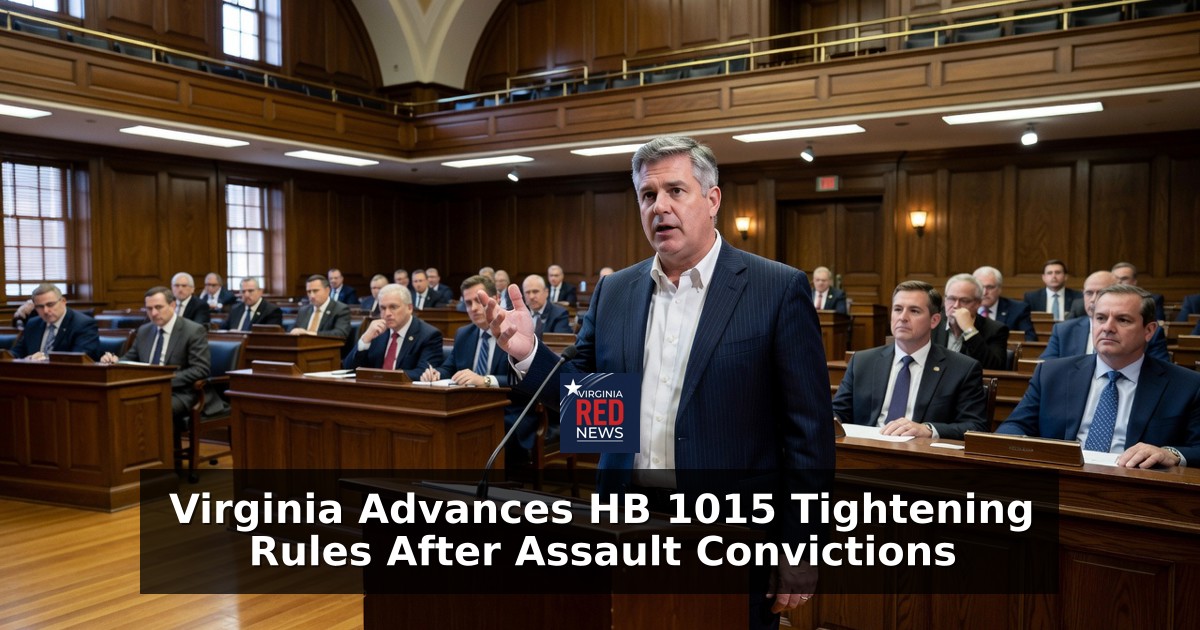
Virginia lawmakers are moving forward with House Bill 1015, legislation introduced by Delegate Clark that targets individuals convicted of assault or assault and battery. The measure prohibits any person convicted of those offenses on or after July 1, 2026, from engaging in specified activities when the conviction appears on the sentencing order or on the face of a warrant. Supporters frame the bill as a straightforward public-safety tool that keeps repeat offenders from endangering law-abiding residents. The proposal reflects a continuing push in Richmond to restore accountability after years of softer approaches to street crime.
Under the text under consideration, the new restrictions take effect for convictions entered on or after the July 2026 date. The prohibition is triggered either by language in the formal sentencing order or by clear notation on the original warrant. Anyone who violates the ban faces a Class 1 misdemeanor, the most serious misdemeanor level under Virginia law and one that can carry jail time and a substantial fine. Conservative members of the General Assembly have long argued that clear, enforceable consequences are essential if communities are to deter violence before it escalates.
A House subcommittee reviewed the bill and voted 6-3 to recommend that it be reported and referred to the Appropriations Committee. The referral signals that members anticipate a fiscal impact, whether through additional court processing, local jail costs, or enforcement resources. Delegate Clark presented the measure as a measured response that closes gaps in existing assault statutes without creating new felonies. The narrow vote margin shows the bill still faces scrutiny, yet the majority clearly favored advancing stronger guardrails around convicted assailants.
Assault and assault-and-battery cases remain among the most common violent offenses handled by Virginia courts each year. Local police departments and sheriffs’ offices routinely cite these charges in reports of domestic disturbances, bar fights, and street altercations that leave victims injured and neighborhoods on edge. When offenders walk away with minimal lasting restrictions, the risk of re-offense rises and public confidence in the justice system falls. HB 1015 seeks to change that dynamic by attaching concrete, ongoing limitations to the conviction itself.
From a law-and-order perspective, the legislation aligns with the principle that those who use force against others forfeit certain privileges. Class 1 misdemeanor exposure for violating the new ban gives prosecutors and judges a ready tool to respond quickly when a convicted person ignores the court’s order. Victims’ advocates note that even modest additional penalties can encourage compliance and reduce the chance that an assailant returns to the same community to reoffend. The bill’s effective date in mid-2026 gives courts, clerks, and law-enforcement agencies time to update records and training.
Delegate Clark has emphasized that the measure is carefully limited to convictions reflected on official documents, reducing the chance of mistaken application. By tying the prohibition to the sentencing order or the face of the warrant, the bill avoids vague or retrospective enforcement. That precision appeals to legislators who want tougher rules without opening the door to arbitrary prosecutions. The subcommittee’s decision to send the bill to Appropriations also ensures that any budget implications will be examined in full public view before final passage.
Public-safety analysts point out that Virginia has spent recent sessions recalibrating criminal statutes after earlier experiments with reduced penalties and early release. Residents in suburban and rural localities have repeatedly told their delegates they want clearer consequences for violent misbehavior. HB 1015 answers that call by creating a bright-line rule: once an assault conviction is on the record after July 1, 2026, certain activities are off-limits, and breaking that rule is itself a crime. The approach favors prevention over reaction.
Law-enforcement leaders have generally welcomed proposals that give officers and prosecutors additional leverage when dealing with known violent offenders. A Class 1 misdemeanor charge can support detention decisions and conditions of bond that keep the community safer while a case proceeds. At the same time, the bill does not convert the underlying assault into a felony, preserving proportionality for first-time or lower-level cases. That balance is important to members who reject both soft-on-crime leniency and indiscriminate over-criminalization.
The referral to Appropriations will allow the money committees to weigh costs against the expected reduction in repeat victimization. Local jails, community corrections, and court clerk offices may need modest additional resources to track compliance and process new misdemeanor charges. Yet many fiscal conservatives argue that the long-term savings from fewer assaults and lower emergency-response burdens will outweigh short-term outlays. Early intervention through clear legal barriers often proves less expensive than repeated crisis response.
As the bill moves forward, delegates on both sides of the aisle will examine how the prohibited activities are defined in the final language. The current description leaves room for refinement so that the restrictions remain tightly focused on public safety rather than sweeping into unrelated conduct. Conservative voices insist the final version must remain simple enough for ordinary citizens and police officers to understand and enforce without confusion. Clarity, they maintain, is the foundation of credible deterrence.
HB 1015 also fits within a larger pattern of legislation aimed at protecting families and neighborhoods from preventable violence. When an individual has already demonstrated a willingness to assault another person, the Commonwealth has a legitimate interest in limiting opportunities for further harm. The Class 1 misdemeanor penalty supplies a swift and certain response if that interest is ignored. Supporters believe such certainty is more effective than lengthy statutes that are rarely applied.
Looking ahead, the full House will have the opportunity to debate the measure once Appropriations completes its review. Floor discussion is expected to center on the precise scope of the activity ban, the documentation requirements, and the readiness of local justice systems to implement the change by summer 2026. Delegate Clark and the subcommittee majority have already signaled that the core goal—keeping convicted assailants from repeating their offenses—should remain intact. The 6-3 vote demonstrates that a working majority sees value in the approach.
In the end, the bill represents a practical step toward reinforcing personal responsibility and community protection. Virginia residents who obey the law deserve a justice system that does not treat assault convictions as temporary inconveniences. By attaching lasting, enforceable consequences and backing them with a Class 1 misdemeanor, HB 1015 aims to deliver exactly that message. The coming weeks in the Appropriations Committee and on the House floor will determine whether the proposal becomes part of the Commonwealth’s criminal code in time for the July 2026 effective date.