Local Control Prevails: HB881 Trusts Virginia Communities on Leaf Blower Rules
Updated
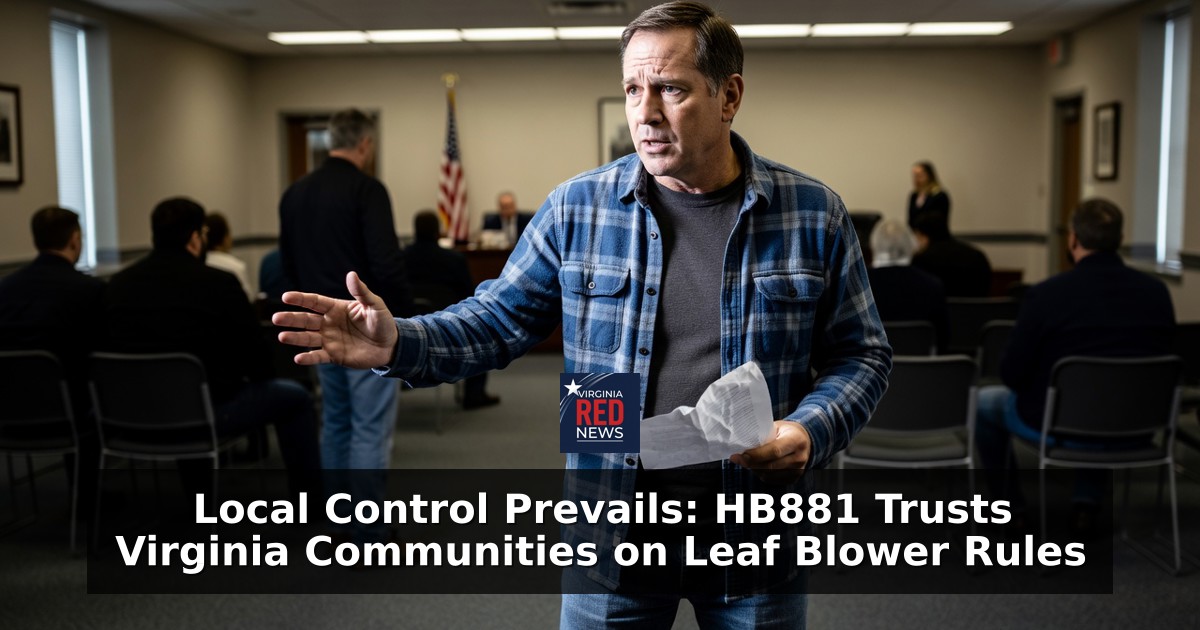
A Falls Church father and Virginia resident recently stood before lawmakers to champion HB881, a measure that would restore decision-making power to local communities dealing with the persistent noise and emissions from gas-powered leaf blowers. Dave Gustafson described how outdated two-stroke engines on these machines generate deafening sound and harmful air pollution that travels easily between closely spaced homes. He explained that the constant operation of multiple backpack blowers has forced ordinary families to take costly personal steps just to preserve basic peace in their own neighborhoods. Gustafson’s testimony underscored a core conservative principle: Virginians know their streets better than distant state officials and should be trusted to craft solutions that fit their unique circumstances.
Gustafson recounted investing in better home insulation, upgraded windows, and noise-canceling headphones after an entire fall season of relentless leaf-blowing left his family exhausted. The headphones themselves eventually broke from overuse, a tangible symbol of how commercial landscaping practices have invaded private life. In dense residential areas the sound ricochets between houses, turning ordinary afternoons into endurance tests. Conservative values place the family at the center of society, and when machinery routinely interrupts dinners, children’s birthday parties, walks to school, and sleep for those working non-traditional hours, the fabric of daily life frays.
The Real Cost to Families and Neighborhoods
Lost sleep, reduced productivity, and diminished quality of life carry measurable consequences that no responsible community can ignore. Crews often deploy as many as five backpack blowers simultaneously, creating an overwhelming wall of noise that no single homeowner can escape. Gustafson noted that superior electric technology already exists and offers a clear return on investment within a few years through lower operating costs and reduced maintenance. Market forces, not heavy-handed statewide edicts, remain the most reliable path for businesses to adopt better tools when the economic case is plain. Conservatives have long argued that free enterprise responds faster and more efficiently than bureaucratic mandates when customers and neighbors demand quieter, cleaner alternatives.
HB881 carefully avoids the trap of a one-size-fits-all ban. Instead, the legislation simply authorizes localities to decide for themselves whether additional rules make sense in their particular setting. This approach honors the foundational Republican commitment to limited government and federalism within the Commonwealth. Residents of Falls Church face different density and topography challenges than those in rural counties; trusting local elected officials to weigh those differences respects both property rights and community standards. Gustafson urged lawmakers to place confidence in Virginia communities rather than impose uniform restrictions from Richmond that could burden small landscaping firms and homeowners alike.
Protecting Quiet Enjoyment Without Expanding State Power
The right to the quiet enjoyment of one’s home ranks among the most basic expectations of free citizens. When commercial equipment repeatedly shatters that expectation, families should not be left powerless. Yet the conservative answer is not to hand more authority to the state capital. Local control allows neighbors, business owners, and municipal leaders to negotiate practical balances that protect residential peace while preserving legitimate economic activity. Gustafson’s call for support of HB881 reflects a broader moral stance that government closest to the people is government most accountable to the people.
Two-stroke engines have long been recognized for their inefficiency and elevated emissions, facts that responsible operators already understand. The marketplace continues to reward companies that transition to cleaner, quieter equipment because customers and property managers increasingly prefer them. Forcing a sudden statewide prohibition risks unintended harm to working families who earn their living maintaining lawns and common areas. By contrast, empowering cities and counties to act only if local conditions warrant action keeps the focus on genuine nuisances rather than symbolic gestures. This measured path aligns with conservative morals that prize personal responsibility, voluntary improvement, and skepticism toward expansive regulatory schemes.
A Principled Path Forward for the Commonwealth
Virginia has a proud tradition of trusting citizens and their local representatives to solve problems without unnecessary interference from higher levels of government. HB881 continues that tradition by declining to dictate a uniform rule and instead returning authority to the communities that live with the consequences every day. Gustafson’s firsthand account of disrupted family routines and the personal expense of noise mitigation illustrates why such flexibility matters. Lawmakers who value ordered liberty, strong families, and free markets will recognize that the bill strengthens rather than weakens the social fabric.
Supporters of limited government understand that every new statewide mandate chips away at the space where voluntary cooperation and local judgment can flourish. The noise and pollution Gustafson described are real, yet the proper remedy remains local deliberation rather than centralized command. By backing HB881, Virginia can demonstrate that conservative principles still guide practical governance: protect the home, respect the taxpayer, and keep decision-making close to the people who must live with the results. The testimony offered a clear reminder that quality of life improves most when communities are free to act according to their own needs and values.
air pollution backpack blowers community choice Dave Gustafson Falls Church family disruption gas leaf blowers HB881 leaf blower noise local control local government lost productivity neighborhood noise noise pollution pollution impacts quality of life residential neighborhoods two-stroke engines Virginia General Assembly Virginia House Bill Virginia legislation Virginia residents