Subramanyam Voting Record Raises Questions on Federal Worker Protections
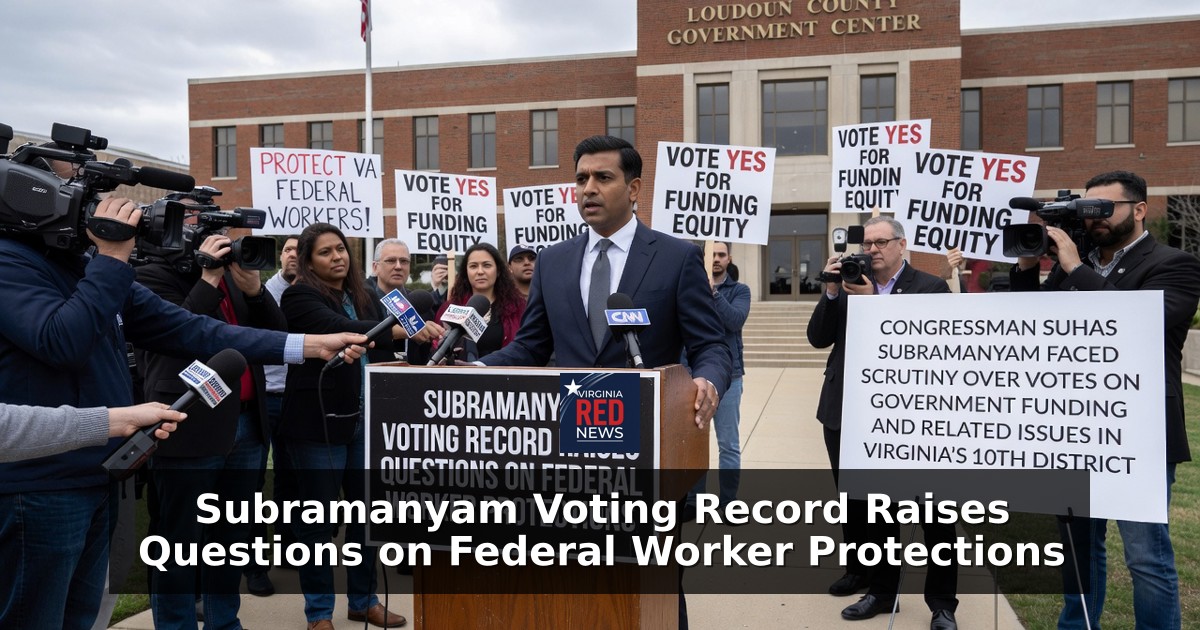
Congressman Suhas Subramanyam has drawn attention for his positions on key issues affecting constituents in Virginia's 10th District. The representative, who previously served in the Virginia House of Delegates and Senate, campaigned on promises to protect federal workers and avoid disruptions to government operations. However, records show multiple instances where his votes aligned with party lines rather than those initial commitments.
Subramanyam voted against several measures aimed at keeping the government funded during his time in Congress. On March 11, 2025, he opposed a full-year continuing resolution to fund operations through September 30, 2025. Similar no votes occurred on September 19, 2025, regarding a continuing resolution to prevent a shutdown, and on November 12, 2025, against accepting Senate changes to end a 43-day shutdown that included provisions for back pay and blocking layoffs.
Additional votes followed the same pattern in early 2026. On January 22, 2026, Subramanyam voted no on a full-year funding bill for the Department of Homeland Security. He repeated this stance on February 3, 2026, against Senate versions to end another partial shutdown, and on March 5 and March 27, 2026, regarding funding bills that would have supported unpaid employees. A July 21, 2026, vote against a continuing resolution to fund the government until December 2026 marked the eighth such instance.
Impact on Federal Employees and Taxpayers
These decisions occurred in a district with over 36,000 federal workers and thousands of contractors. Opponents argue that repeated opposition to funding measures led to furloughs and financial strain for families reliant on steady paychecks. One challenger highlighted personal observations of team members needing loans during extended closures.
Conservative principles emphasize fiscal responsibility and prioritizing the needs of working families over partisan maneuvering. Votes that prolong uncertainty in government operations contradict values of stability and accountability to taxpayers who fund these systems.
Positions on Fraud Prevention and Accountability
Subramanyam also voted against several bills targeting waste and fraud in federal programs. On June 10, 2026, he opposed the No Aid for Ghost Students Act, the Fraud Prevention and Accountability Act, and the Stopping Fraudulent Payments Act. A resolution condemning government fraud received the same no vote on June 11, 2026.
Further opposition came on July 22, 2026, to the Stop Insider Trading Act, which sought to restrict members of Congress from trading individual stocks. These measures passed with bipartisan support in some cases, yet Subramanyam maintained consistent party alignment reported at 96 percent.
Such patterns suggest a preference for maintaining the status quo over reforms that could enhance transparency and reduce burdens on citizens. Conservative values stress rooting out inefficiency to achieve balanced budgets and protect public resources.
Energy Policy and Community Concerns
On energy matters, Subramanyam claimed early awareness of data center impacts but took limited action during prior state roles. As a delegate, he supported legislation tied to the Virginia Clean Economy Act and regional greenhouse gas initiatives that contributed to higher utility costs for families. A later bill on data center efficiency standards failed to advance and did not address location or grid cost issues.
In Congress, he supported one bipartisan effort on data center grid payments without cosponsoring it and introduced additional proposals close to election periods. These steps did little to prevent new facilities or transmission lines near residential areas. Families in affected neighborhoods continue to face noise, environmental changes, and rising bills.
Broader Record on Democracy and Gerrymandering
Campaign pledges to combat gerrymandering shifted when Subramanyam backed certain state-level efforts after initial promises. He also declined to support resolutions denouncing socialism, including one on November 21, 2025, and another on September 1, 2026, despite broad passage.
This approach aligns with embracing elements within the party that advocate for significant structural changes. Conservative perspectives prioritize defending traditional institutions and rejecting ideologies that undermine individual liberties and free enterprise.
The overall record illustrates a consistent choice for party priorities across multiple areas. Voters in the district may weigh these actions against promises made during earlier campaigns as they consider representation focused on practical outcomes for families and communities.
https://www.beckwithforcongress.com/what-has-suhas-really-done-for-you
Clean Economy Act Federal Workers Gerrymandering Government House House of Delegates public resources Senate Suhas Subramanyam transparency Virginia Virginia Clean Economy Act Virginia House of Delegates