Senator Stanley Stresses Lifelong Duty of Care for All Companion Animals Including Hunting Dogs
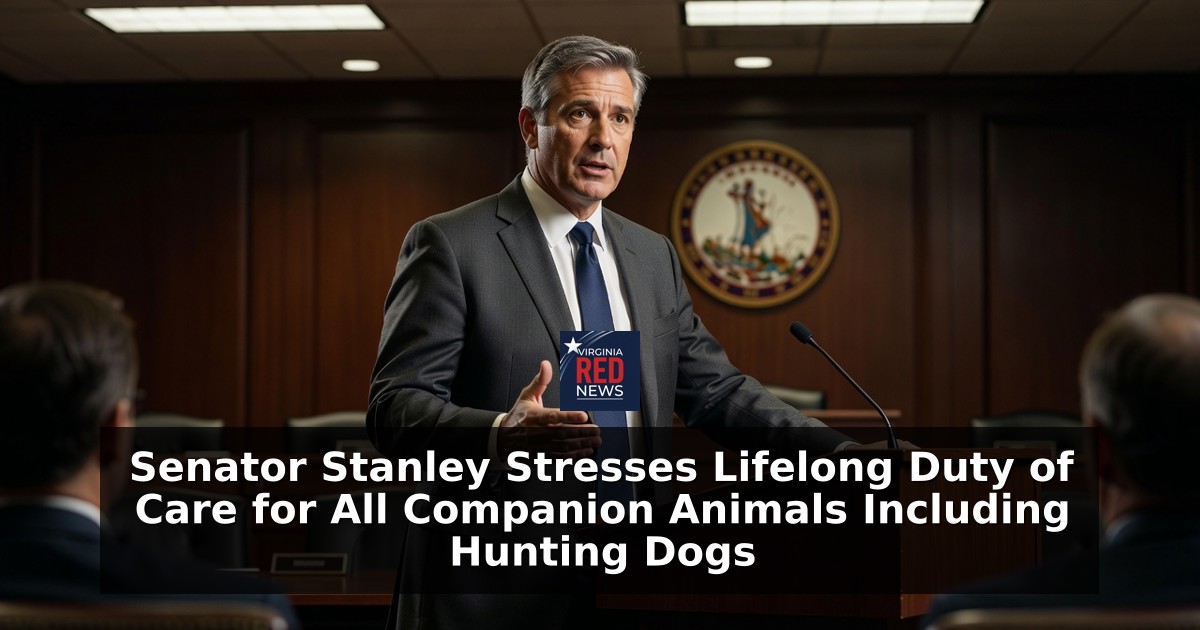
Senator Stanley told a Senate of Virginia subcommittee that his legislation on companion animals applies fully to hunting dogs and every other pet whose owner assumes responsibility for its life. He answered a direct question about whether the measure would reach animals kept for hunting by stating that they are companion animals and that the bill would cover them without exception. Stanley described personal encounters with dogs cast aside once their working usefulness ended and insisted the proposed law must address those cases as well.
The senator recounted adopting a walker hound that had been turned loose after its owner decided the animal no longer served a purpose. The dog arrived with a congenital heart condition that veterinarians said would allow only six months of life. Stanley paid for the animal’s medical care himself and brought the hound into his home. Against the initial prognosis the dog lived two and a half years, spending its days on the family couch and receiving constant affection from a six-year-old child who had never known the animal before.
Stanley told the panel that the dog had never experienced that kind of steady care and affection until it joined his household. He used the story to illustrate a simple principle: once a person takes on the life of a dog or cat, the duty of care continues even after any practical usefulness has ended. The senator said he has also seen owners shoot companion animals in the head when they no longer wanted them, and he declared that the law should and must reach those acts of deliberate killing.
Virginia law already recognizes dogs and cats as companion animals rather than mere tools, and Stanley’s remarks reinforced that classification for hunting breeds as well. Rural parts of the Commonwealth have long relied on walker hounds and similar dogs for legitimate sporting and tracking work, yet the senator made plain that the end of a hunting season or the decline of a dog’s stamina does not erase the owner’s obligations. He framed the bill as a straightforward expectation that citizens who choose to keep animals will feed, shelter, and treat them humanely for the full span of the animals’ lives.
Public discussion of animal welfare in Virginia frequently turns on the balance between traditional outdoor pursuits and basic standards of care. Stanley’s testimony placed personal responsibility at the center of that balance. He did not call for restrictions on hunting itself; instead he insisted that the same moral and legal duties that apply to a household pet apply equally to a dog that once ran game. The distinction between a working animal and a companion animal, he indicated, dissolves the moment an owner decides the creature is no longer useful and walks away or worse.
The subcommittee hearing formed part of broader review of public-safety and claims-related measures before the full Senate. Stanley’s bill, referenced in the proceeding as measure 202, seeks to close gaps that have allowed some owners to abandon or destroy animals without facing adequate consequence. By recounting both the successful adoption of the heart-condition hound and the darker instances of animals shot when discarded, the senator supplied concrete examples rather than abstract theory. Those examples underscored that neglect and outright killing remain real problems even among animals originally acquired for practical ends.
Advocates for stronger animal-protection statutes in Virginia have pointed to repeated reports of hunting dogs left along rural roads or found starving after being turned out. Stanley’s own rescue of the walker hound gave the committee a firsthand account of how such animals can recover when given proper veterinary attention and a stable home. The two-and-a-half-year lifespan the dog enjoyed after a six-month prognosis demonstrated that early medical intervention and ordinary kindness can extend life far beyond initial expectations. The image of a young child hugging the dog on the couch further illustrated the ordinary family bonds that form once responsibility is accepted.
Stanley closed his remarks by returning to the core idea that taking on a life creates lasting duties. Whether the animal is a cat kept indoors or a hound once used in the field, the owner’s responsibility does not expire with the animal’s utility. The senator’s position aligns with long-standing expectations of stewardship familiar to many Virginia households that raise both livestock and pets. It also rejects any notion that an animal’s value is purely instrumental and therefore disposable.
Committee members heard the testimony in the context of existing Virginia Code provisions that already prohibit cruelty and abandonment. Stanley’s legislation would clarify and strengthen application of those rules to the full range of companion animals, removing any ambiguity about hunting dogs. By speaking from personal experience rather than solely from legislative text, he gave the subcommittee a clear picture of both the harm that occurs when owners walk away and the good that follows when someone steps forward to provide care.
The discussion highlighted that humane treatment is not a partisan novelty but a basic civic expectation. Citizens who choose to keep dogs or cats accept a duty that outlasts convenience or changing needs. Stanley’s account of paying veterinary bills, offering a place on the couch, and watching a child form an attachment supplied a practical model of that duty in action. His simultaneous condemnation of owners who shoot unwanted animals left no doubt about the conduct the bill intends to reach.
In rural districts where hunting remains part of local culture, the senator’s insistence that working dogs are still companion animals carries particular weight. It signals that traditional outdoor practices can continue side by side with clear standards against abandonment and unnecessary killing. The walker hound that lived far beyond its predicted six months stands as evidence that responsible ownership produces tangible results for the animal and for the family that takes it in.
Stanley’s testimony therefore served both as support for the pending measure and as a public reminder of ordinary obligations. Pet ownership begins with a decision to assume care for a living creature and does not end when that creature can no longer perform a task. The law, he argued, must reflect that continuing responsibility for every dog and cat, hunting breed or otherwise. The subcommittee received the statement as part of its examination of the bill’s scope and practical effect across the Commonwealth.
Further consideration of the legislation will occur as the Senate moves through its calendar. Stanley’s detailed personal narrative and firm declaration that the bill covers all companion animals have already framed the central question of lifelong duty. Virginians who keep animals of any kind now have a clear articulation of the standard the senator seeks to codify: usefulness may end, but responsibility does not.