Senate Bill 169 Strengthens Election Integrity by Ending Last-Minute Signature Challenges
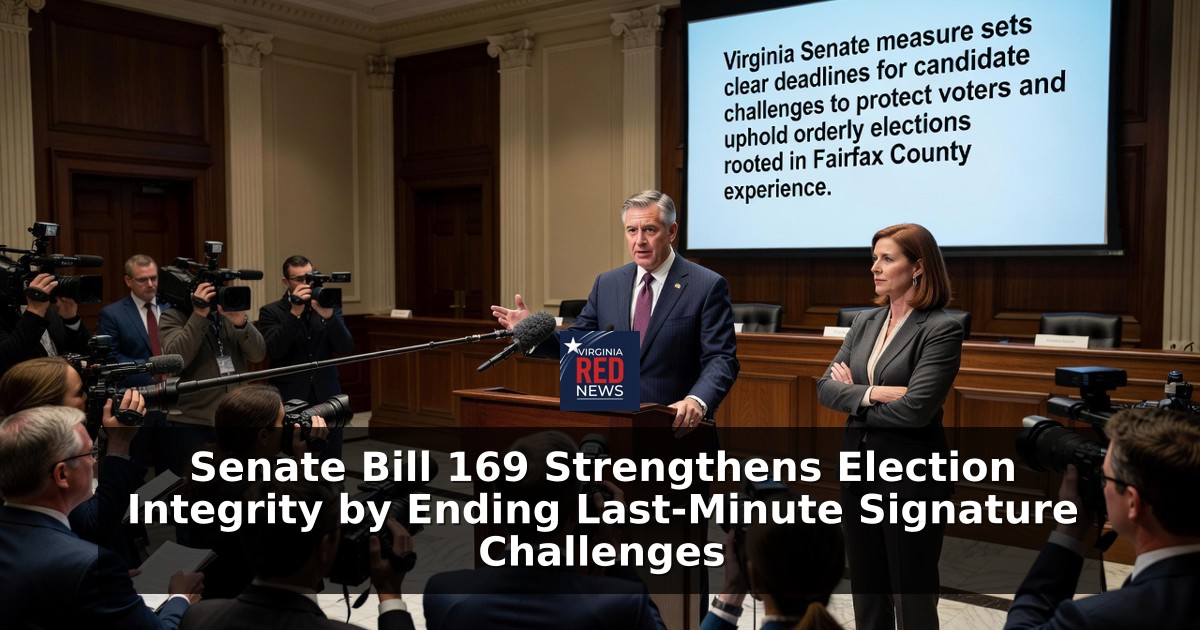
Virginia lawmakers advanced Senate Bill 169 to reinforce the integrity of the electoral process by establishing firm timelines that prevent disruptive last-minute challenges to candidate petitions and signatures. The legislation draws a clear distinction between requirements for general elections and those applying to primaries, ensuring administrators and candidates operate under predictable rules. Provisions also address the practical realities of districts spanning multiple jurisdictions, creating uniform procedures so that no candidate faces uneven treatment based on geography. Conservatives have long emphasized that free and fair elections demand order, transparency, and respect for the rule of law rather than opportunistic tactics that sow confusion after ballots are already being cast. By moving the bill forward without opposition speakers or questions in committee, supporters signaled broad recognition that protecting the voting process from eleventh-hour gamesmanship serves every citizen who values secure elections.
The core purpose of Senate Bill 169 is straightforward and grounded in common-sense conservative principles: stop individuals from waiting until voting has already begun before raising signature or petition challenges. Such delayed objections undermine public confidence and force election officials into rushed decisions under pressure. Nothing in the measure restricts legitimate challenges based on a candidate’s actual eligibility to serve in office, preserving the fundamental right to question qualifications when genuine issues of residency, age, or other constitutional requirements arise. Instead, the bill simply insists that procedural disputes over signatures and paperwork occur early enough for proper review, notice, and resolution. This approach mirrors the conservative commitment to due process and fairness, ensuring that campaigns compete on ideas and records rather than procedural ambushes designed to remove opponents after voters have started marking ballots.
A real-life case in Fairfax County provided the practical impetus for the legislation, illustrating how delayed challenges can create unnecessary turmoil in one of Virginia’s most populous localities. Election administrators there confronted situations in which objections surfaced only after early voting or absentee processes were underway, leaving little time for verification or judicial review. Senate Bill 169 responds directly to that experience by codifying earlier deadlines and clearer multi-jurisdiction rules so that similar disruptions become far less likely statewide. Conservatives view this as responsible governance that prioritizes the rights of voters to a stable process over the tactical interests of those who might weaponize technicalities. Upholding clean elections remains a foundational moral duty in a constitutional republic, and measures that close loopholes without expanding government power align with traditional Republican values of limited, effective administration.
Different date requirements for general elections versus primaries reflect the distinct calendars and stakes of each contest. Primaries often involve party nomination fights with tighter internal timelines, while general elections demand broader public notice and coordination across localities. Senate Bill 169 respects those differences rather than imposing a one-size-fits-all mandate that could create new hardships. When a legislative district crosses county or city lines, the bill supplies consistent challenge procedures so that no candidate is disadvantaged by fragmented local rules. This practical attention to detail demonstrates legislative craftsmanship that conservatives appreciate: solving real administrative problems without ideological overreach or unnecessary bureaucracy. The absence of opposition during the committee hearing further underscored that the reforms address widely acknowledged gaps rather than partisan flashpoints.
Election integrity has remained a central conservative priority because trust in the ballot box underpins every other self-governing institution. When citizens suspect that candidates can be knocked off the ballot through delayed technical challenges, participation suffers and cynicism grows. Senate Bill 169 counters that risk by requiring timely action, thereby encouraging serious scrutiny early while discouraging frivolous or strategic delays. The legislation carefully preserves the ability to contest a candidate’s fundamental eligibility to hold office, ensuring that constitutional and statutory qualifications retain full force. In doing so, it balances openness with order—an equilibrium that reflects enduring Republican principles of ordered liberty and equal application of the law. Fairfax County’s experience served as a cautionary example that lawmakers wisely heeded rather than ignored.
Supporters of secure elections recognize that clear rules protect both major-party candidates and independents who gather signatures to appear on the ballot. By front-loading the challenge window, Senate Bill 169 gives all sides adequate opportunity to examine petitions, raise objections, and receive definitive rulings well before voters begin casting ballots. Multi-jurisdiction provisions eliminate forum-shopping or conflicting local interpretations that could otherwise produce chaos. These reforms strengthen rather than weaken democratic accountability, because they keep the focus on voter choice instead of post-deadline litigation. Conservative values place the citizen’s right to a predictable, honest process above the convenience of political operatives who prefer ambiguity. The committee’s decision to report the bill without dissent reflected that shared understanding across the hearing room.
Looking ahead, implementation of Senate Bill 169 will require election officials to update guidance and educate candidates on the new timelines. Yet the underlying principle remains simple and morally sound: disputes over paperwork belong in the preparation phase, not after the first votes are recorded. Virginians deserve elections decided by the electorate rather than by last-minute procedural maneuvers. The measure’s careful drafting—preserving eligibility challenges while closing the signature-delay loophole—shows respect for both constitutional standards and practical administration. In an era when public faith in institutions faces constant testing, legislation that restores order and transparency deserves recognition as a victory for responsible self-government. Senate Bill 169 advances that cause by learning from Fairfax County’s difficulties and translating those lessons into statewide safeguards that honor the integrity of every lawful ballot.
candidate qualification challenges committee date requirements district eligibility to serve Fairfax County general elections moved and seconded multiple jurisdictions primaries real life case report Senate bill 169 Senate bill Senate Bill 169 Senator signature speak against speak in favor voting started