Veteran Leaders Push Back on HB 1238 Threat to Animal Therapy Businesses
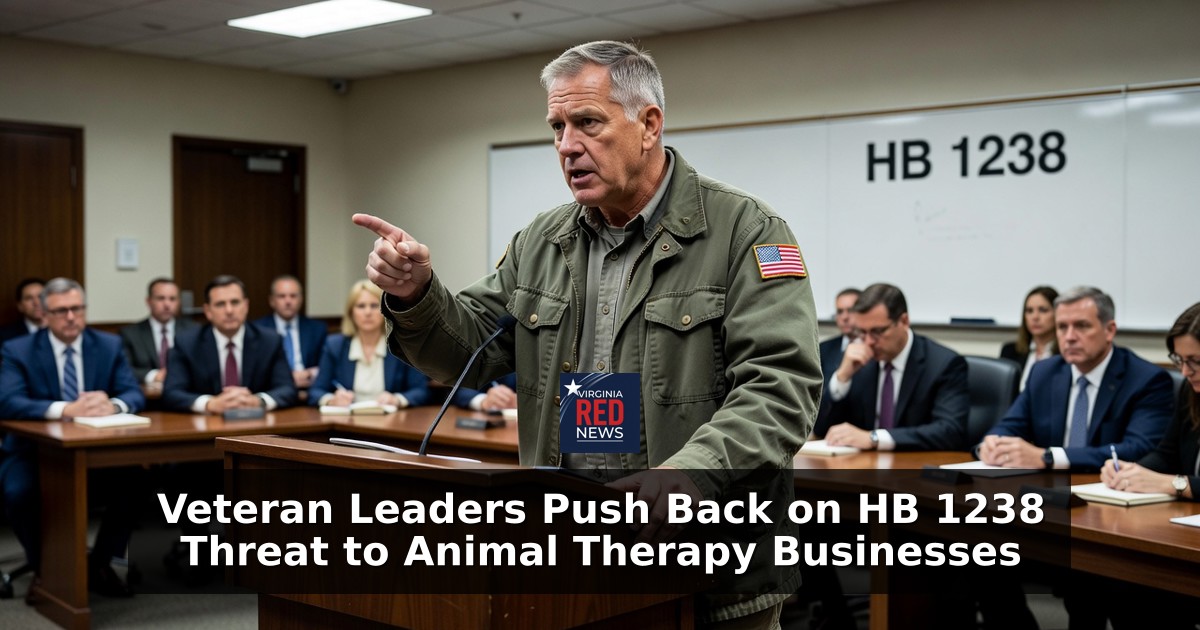
Army veteran Abbott Hoffman delivered pointed opposition testimony against House Bill 1238 before the Counties Cities and Towns committee, warning that the measure would strip Virginia veterans of vital business opportunities and proven recovery methods. Hoffman, who serves as a legislative representative for the American Federation of Agriculture, stressed that the legislation removes practical tools many former service members rely upon to manage PTSD, traumatic brain injury, and other combat-related conditions. He framed the bill as an unnecessary restriction that prioritizes activist agendas over the hard-earned freedoms of those who defended the nation. Conservative principles of limited government and respect for individual initiative stand in clear contrast to such overreach. Virginians who value personal responsibility and free enterprise recognize that veterans deserve every lawful avenue to rebuild their lives after sacrifice.
Hoffman explained that HB 1238 directly undermines the ability of veterans to operate businesses that employ animals in therapeutic settings. These enterprises have become lifelines for men and women coping with the invisible wounds of war, offering structured work, purpose, and daily routines that conventional approaches sometimes fail to deliver. By limiting these options, the bill threatens both economic self-sufficiency and mental health progress that many veterans have already demonstrated through hands-on animal care. Supporters of traditional American values see this as an assault on the very self-reliance that military service instills. Lawmakers committed to constitutional liberties should reject any proposal that places bureaucratic barriers between veterans and the methods that restore their strength.
Protecting Proven Recovery Paths for Those Who Served
The testimony underscored a core conservative conviction that government should expand opportunity rather than contract it, especially for citizens who have worn the uniform. Hoffman noted that animals used in these veteran-led businesses provide tangible benefits for PTSD and TBI recovery, allowing former soldiers to channel discipline and compassion into productive enterprise. Removing that pathway ignores real-world results in favor of abstract rules crafted far from the daily struggles of military families. Virginia has long honored its veterans through practical support, not empty gestures, and this bill moves in the opposite direction. Preserving these animal-assisted options aligns with moral duties to care for those who protected the Commonwealth and the country.
Animal rights organizations such as PETA and the Humane Society of the United States came under direct scrutiny during the hearing for circulating negative propaganda about animals. Hoffman charged that these groups routinely distort facts to advance restrictive policies that harm legitimate agricultural and therapeutic uses of animals. Conservative observers have long documented how such organizations elevate ideology above human welfare, often targeting rural livelihoods and veteran initiatives with misleading campaigns. Their influence on legislation like HB 1238 raises serious questions about whose interests truly guide public policy in Richmond. Citizens who prize honesty in debate and the dignity of productive work reject scare tactics that undermine time-tested practices.
Defending Free Enterprise Against Activist Overreach
Free-market principles demand that veterans retain the right to build businesses around skills and passions developed through service and recovery. Hoffman described animal-related enterprises as both a passion and a practical solution for many former service members seeking stability after leaving active duty. State rules that override these proven methods substitute the judgment of distant activists for the lived experience of those who know what works. Virginia’s agricultural heritage and respect for private property rights provide a firm foundation for resisting such interference. Lawmakers who champion limited government must ensure that no bill quietly erodes the economic freedom veterans have earned through sacrifice.
The broader implications extend beyond any single piece of legislation to the question of whether Virginia will continue to trust its citizens or increasingly defer to national advocacy networks. Hoffman invited interested parties to a conference in St. Louis, Missouri, scheduled for August, where further information on these issues would be shared. That gathering represents an opportunity for like-minded Americans to coordinate defense of traditional uses of animals in farming, therapy, and enterprise. Conservative communities across the Commonwealth understand that vigilance against incremental restrictions is essential to preserving liberty. Standing with veterans on this matter reaffirms the moral priority of human flourishing over radical animal-rights demands.
Upholding Moral Obligations to Veterans and Rural Values
Virginia’s rural counties and small towns have always understood the partnership between people and animals that sustains both livelihoods and healing. HB 1238 risks disrupting that balance by imposing uniform limits that ignore local knowledge and individual circumstances. Hoffman’s call to oppose the bill resonates with families who teach personal accountability, hard work, and respect for military service as foundational virtues. Elected officials who share these convictions should examine the legislation carefully and reject provisions that diminish veterans’ options. The Commonwealth thrives when it empowers citizens rather than constraining them through well-intentioned but misguided mandates.
In the end, the choice before the Counties Cities and Towns committee reflects a larger contest between self-reliance and centralized control. Abbott Hoffman’s testimony laid out the stakes with clarity born of military experience and agricultural advocacy: veterans must retain the freedom to use animals in businesses that treat PTSD, TBI, and related injuries. Conservative values of ordered liberty, gratitude toward those who served, and skepticism of activist propaganda all point toward the same conclusion. Virginia lawmakers have both the authority and the duty to protect these pathways. Rejecting HB 1238 would send a strong signal that the Commonwealth still places the welfare of its veterans and the integrity of free enterprise above the pressures of outside interest groups.
Abbott Hoffman American Federation of Agriculture animal rights groups Army veteran August conference bill opposition Counties Cities and Towns HB 1238 HSUS limited government military injuries opposition testimony PETA propaganda PTSD treatment service animals St Louis conference TBI treatment veterans businesses veterans freedoms veterans rights Virginia legislature