Virginia Strengthens Election Integrity Standards for Guardianship Voting Cases
Updated
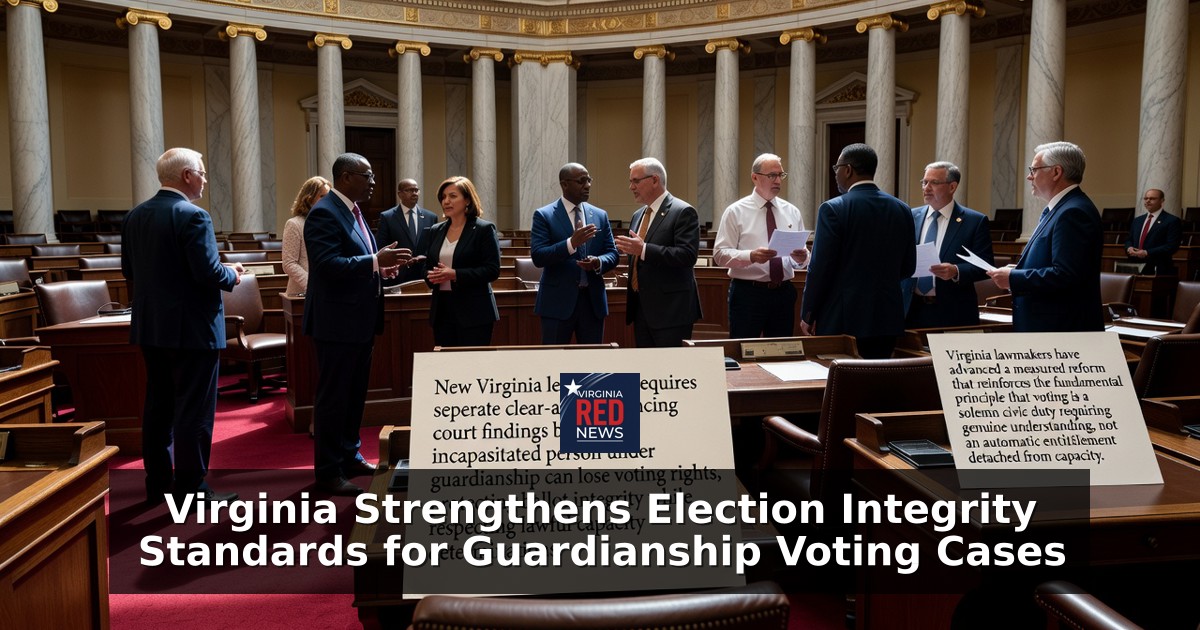
Virginia lawmakers have advanced a measured reform that reinforces the fundamental principle that voting is a solemn civic duty requiring genuine understanding, not an automatic entitlement detached from capacity. House Bill 1014 and its companion Senate Bill 34 clarify that a court finding of incapacitation for guardianship or conservatorship purposes alone cannot strip a citizen of the right to vote. Instead, judges must make a distinct determination, supported by clear and convincing evidence, that the individual lacks the capacity to understand the act of voting itself. This dual-safeguard approach upholds conservative values of election integrity, personal responsibility, and the rule of law while preventing hasty or overly broad disqualifications.
The legislation, patroned by Delegate Kathy Tran and Senator Barbara Favola, draws a bright line between general incapacity and the specific cognitive ability needed to cast a meaningful ballot. Conservatives have long maintained that the franchise belongs to those who can grasp its significance, because free elections depend on informed participation rather than sheer numbers. By mandating a separate judicial finding under the rigorous clear-and-convincing standard, the bills ensure that only those truly unable to comprehend voting lose that privilege. This protects the purity of the ballot box from potential abuse or administrative overreach while still recognizing legitimate guardianship needs for vulnerable adults.
Election security remains a cornerstone of republican self-government. When courts appoint guardians or conservators, they already conclude that an individual cannot manage essential personal or financial affairs. Extending that conclusion automatically to voting would risk both under- and over-inclusion. The new measure wisely rejects automatic disqualification yet refuses to lower the bar. Clear and convincing evidence is a higher threshold than mere preponderance, demanding substantial proof before any Virginian is removed from the rolls. That elevated standard reflects a conservative commitment to due process and to shielding elections from dilution by those who cannot knowingly exercise the franchise.
Importantly, the reform is prospective only. Orders entered before July 1, 2026, remain undisturbed. This non-retroactive design preserves stability and respects final judicial determinations already made under prior law. Sudden mass restorations or challenges to existing guardianship decrees could sow confusion at the polls and undermine public confidence. By limiting the change to future cases, the General Assembly avoided disrupting settled expectations and demonstrated prudence—an essential conservative virtue when altering the rules of democratic participation.
Safeguarding the Meaning of the Vote
At its core, voting is more than a mechanical act of marking a ballot. It requires comprehension of candidates, issues, and the consequences of one’s choice. Conservative philosophy holds that society has both the right and the duty to ensure participants meet a basic threshold of understanding. Guardianship exists precisely because some citizens, through age, illness, or disability, lose the ability to make sound decisions. Pretending that every such person retains full electoral capacity would ignore reality and invite exploitation. The separate-finding requirement forces courts to examine voting capacity on its own merits rather than conflating it with broader incapacity, thereby honoring both compassion and rigor.
Critics sometimes frame any capacity inquiry as exclusionary. Yet responsible stewardship of elections has always included reasonable qualifications. Age limits, citizenship, and residency rules exist for the same reason: to keep the electorate capable and accountable. Virginia’s updated framework continues that tradition. It rejects the notion that guardianship equals automatic disenfranchisement while simultaneously rejecting the opposite extreme—that incapacity findings are irrelevant to voting. The clear-and-convincing evidentiary bar gives judges a workable tool to protect both individual rights and collective electoral integrity.
Practical Effects and Conservative Priorities
For families and court officials, the bills introduce clarity without chaos. Guardianship proceedings already involve detailed evidence of functional limitations. Adding a focused inquiry into voting comprehension fits naturally within existing hearings and does not create new bureaucracies. Conservatives favor solutions that empower local judges and families rather than distant agencies. This legislation does exactly that: it keeps decision-making in the courtroom, grounded in evidence, and free from one-size-fits-all mandates that ignore individual circumstances.
The prospective effective date further illustrates sound legislative craftsmanship. Implementing the change for cases after July 2026 allows clerks, registrars, and the State Board of Elections time to update forms, training, and procedures. Abrupt retroactive application could have generated litigation, inconsistent local practices, and eroded trust in the voter rolls. By choosing an orderly transition, Virginia lawmakers placed institutional stability and public confidence ahead of symbolic gestures.
Upholding Constitutional Order and Civic Virtue
Republican governance rests on the consent of the governed—consent that must be knowingly given. When capacity is absent, the moral foundation of that consent weakens. The new Virginia standard restores intellectual honesty to the process. It acknowledges that some citizens under guardianship retain full voting capacity and must not be barred lightly, while others do not and must not be allowed to cast ballots they cannot understand. This balanced realism aligns with conservative morals that prize truth over sentimentality and ordered liberty over unrestricted access.
Lawmakers also reinforced the separation of powers by leaving the ultimate determination with the judiciary rather than executive agencies or advocacy groups. Courts already handle sensitive capacity questions daily. Equipping them with an explicit, elevated standard for voting disqualification strengthens judicial independence and accountability. Citizens can trust that any loss of voting rights will rest on proven facts, not assumptions or political pressure.
In the broader national conversation about election integrity, Virginia’s approach offers a model of restraint. It neither expands the franchise indiscriminately nor contracts it arbitrarily. Instead, it insists on evidence, process, and respect for existing court orders. Those principles—evidence-based decisions, non-retroactivity, and elevated proof standards—embody the conservative conviction that secure elections are the bedrock of lasting freedom. As the July 2026 threshold approaches, Virginians can take pride in a reform that defends both the dignity of capable citizens and the sanctity of every lawful ballot.
citizen rights clear evidence conservatorship court decisions democratic participation Election Integrity electoral process guardianship incapacitated individuals incapacity July 2026 legal protection legal standards Legislation non-retroactive policy change state law Virginia voter protection voting rights
