More Eyes, Not Fewer: The Conservative Case for Welcoming Neutral Observers
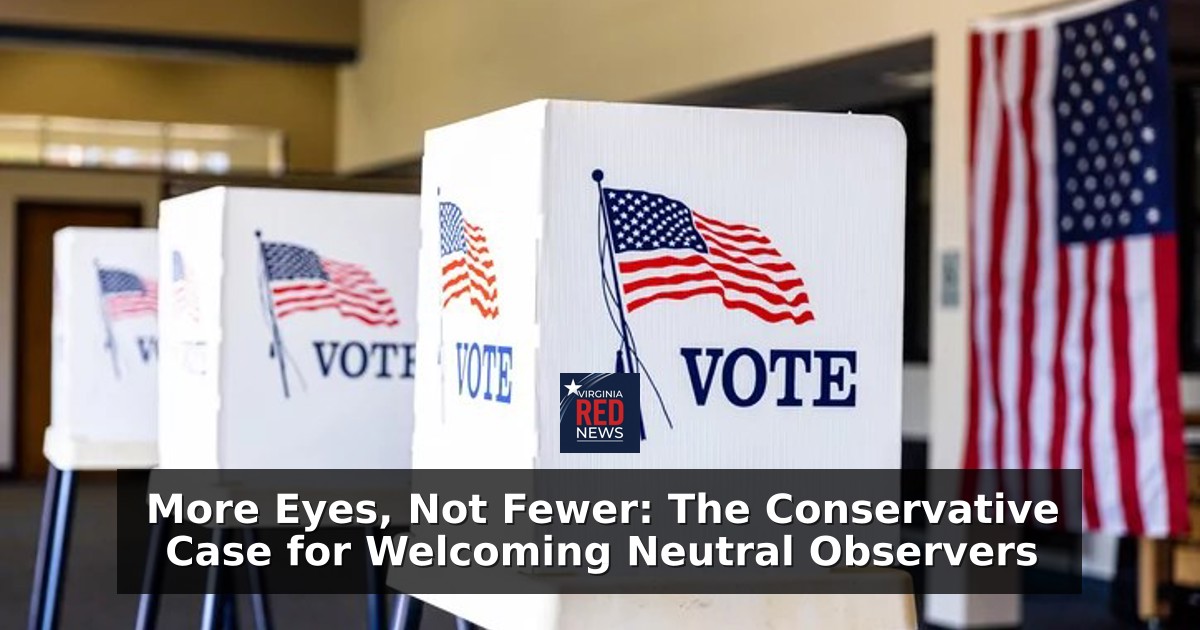
Analysis. This article offers commentary based on the 2026 General Election Bulletin issued Oct. 15 by the Virginia Department of Elections and the Office of the Attorney General. Facts are attributed to the bulletin or the Virginia Code sections it cites. The bulletin is informational and is not legal advice.
Who gets to watch an election matters nearly as much as how the election is run. In Virginia the answer is not left to chance, and it is not left to Richmond. The state bulletin released Oct. 15 states in plain terms that local officials hold the key.
According to the bulletin, besides officers of election, voters and the press, two groups are allowed inside polling places: authorized party and independent candidate representatives with written consent, and "neutral observers who have express authorization from the local electoral board or the general registrar to be present inside polling locations," citing Va. Code § 24.2-604.5. The decision belongs to local people, not to the state agencies that wrote the bulletin.
Local control, in the bulletin's own words
On requests from the U.S. Department of Justice to monitor an election, the bulletin is explicit: "The decision to accept the request to monitor is in the sole discretion of the applicable electoral board and general registrar." It also says DOJ "must request consent from local election officials," and that those requests "are treated the same as requests from neutral observers under state law."
Only the general registrar and the electoral board can authorize a neutral observer, and "only in writing." Officers of election at the polling place "cannot authorize the presence of a neutral observer."
For conservatives who believe in local government, this is the right structure. It puts a consequential decision in the hands of officials closest to the voters.
The argument for yes
The bulletin lists factors boards and registrars may weigh in deciding whether to consent to monitors: "the scope of monitoring, willingness of monitors to follow rules and conditions, transparency about the identity of monitors, the risk of disruptions, and the amount of time to prepare for monitors." Those are sensible questions. They are also questions that can often be answered with a yes.
There are three reasons for a conservative to lean toward openness.
Observers build trust. If voters of any party worry about how an election is run, the remedy is more people able to see it. The bulletin sets rules that keep observers from interfering: no photos on cell phones, no handling ballots or equipment, no access to secure areas, no campaign material, no hindering voters. With those guardrails, additional neutral eyes cost little.
Monitors have been here before. The bulletin says DOJ monitors "have historically carried out these duties in federal elections in some Virginia localities." Consent, written authorization, credential checks and conduct rules are the same machinery that applies to monitoring requests today.
The conditions are enforceable. Under the bulletin, officers of election, the registrar and the electoral board can remove a monitor who fails to follow the rules. The registrar can revoke a neutral observer's authorization if they break rules or fail to follow conditions attached to it (§ 24.2-604.5(A)). An authorization with conditions and a revocation power is not a blank check.
A fair counterpoint
The bulletin is not neutral on the topic. Its approach to DOJ monitors is cautious. It suggests asking DOJ whether it is assessing compliance with civil or criminal federal laws, asking for a list of participating individuals and obtaining a point of contact to withdraw consent if needed. Those steps are reasonable, and the same questions could be asked of anyone seeking written authorization.
The real concern, which the bulletin acknowledges, is disruption. "Disruptive monitors" appear on the bulletin's list of concerns. A request that comes without notice, from someone who can't produce credentials, deserves a no, at least until the registrar and board have decided. The bulletin says such a person "must remain outside the 40-foot prohibited area" in the meantime.
What fairness would look like
If boards are going to use their discretion, there should be a standard. Conservatives can ask for one, politely, in public meetings:
- Written criteria. Publish the factors the board will weigh, such as those in the bulletin.
- Equal treatment. Apply the same standard to a neutral observer from a civic group and a DOJ monitor. The bulletin says they are treated alike.
- Documented decisions. Record who applied, who was approved, who was denied and why.
- A timely answer. The bulletin lists "the amount of time to prepare for monitors" as a factor, so applicants who apply early should get early answers.
Those asks are not partisan. They are good government.
Party representatives are separate
It is worth being precise. Party and candidate representatives do not need a board's approval. Their authority comes from written consent from the party or candidate under § 24.2-604.4. The decision about neutral observers is different. Campaigns should keep both channels in mind. A party can field trained watchers, and civic groups and other neutral observers can seek the board's written authorization.
No access beyond the rules
The bulletin makes clear that observers, including DOJ monitors, "are entitled to no more access than is available to other authorized representatives and should not receive specialized access." The same limit applies to everyone. A conservative who supports observers should support that limit too, because it protects the integrity of the room.
The bottom line
Virginia's rules put the observer question where conservatives usually want such questions answered: with local officials accountable to local residents. Using that power to say yes, within clear rules, is the stronger answer to anyone who doubts the process. Election Day is Nov. 3. Boards and registrars with pending requests have a short window to decide.
Richmond is an independent city in the Richmond region.
Richmond approval Cell Phones City of Richmond Department of Justice Elections Government local government Process Richmond transparency Virginia Virginia law