Jones Puts DHS on Notice Over Alleged Misuse of Virginia Voter Lookup Tools
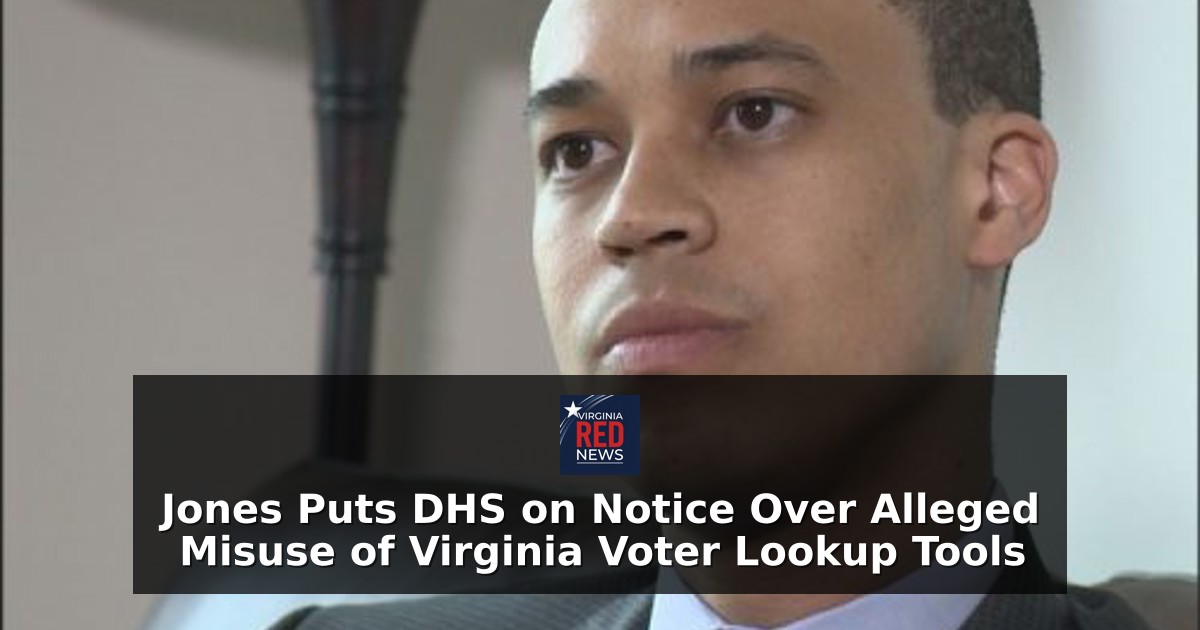
Attorney General Jay Jones put Homeland Security on notice Thursday, accusing the department of potentially violating Virginia election law by using state voter lookup tools to hunt for noncitizen voters — a move Red Virginia News readers should treat as a transparency and accountability story, not just a partisan skirmish.
In a letter obtained by the Associated Press, Jones told Homeland Security Secretary Markwayne Mullin that Virginia Election Code does not allow disclosure of protected voter information to the federal government without a court order. He demanded written confirmation of whether DHS directed anyone to access Virginia voters’ data without those voters’ permission, and he ordered preservation of access logs, correspondence and training materials.
The underlying whistleblower report, published by Democratic Senate leaders, describes USCIS staff diverted in late August into a crash course of less than two hours, then tasked with feeding DHS lists into state voter systems. Agents allegedly had about 12 minutes per person to decide if someone was a lawful voter and to build federal files on anyone flagged. That quota-driven workflow is exactly the kind of process accountability journalists and auditors should demand to see in writing.
Jones’s letter matters because Virginia deliberately designed voter lookup tools for individuals attesting they are checking their own records. If federal employees logged in under false pretenses, that is not a minor paperwork glitch — it is an alleged end-run around state privacy limits. Accountability requires knowing who authorized the training, which systems were queried, how many Virginia records were touched, and whether any data left the commonwealth.
The Trump administration has amplified claims that noncitizen voting could swing midterms, despite research showing such voting is exceedingly rare. The Justice Department’s parallel lawsuits seeking detailed voter files in dozens of states intensify the stakes. Virginians should insist that any federal effort to police the rolls follow statutes, court orders and transparent audit trails — not secret training decks and whistleblower transcripts.
Local registrars and electoral boards deserve clarity. They administer elections under Virginia code, not DHS policy memos. When federal agencies allegedly misuse state tools, local officials get stuck answering voters who fear their data was scraped, while still needing those same tools for legitimate customer service. Jones’s demand for records preservation is the minimum first step toward an after-action review the public can trust.
Accountability also cuts both ways. If DHS has lawful court-authorized means to investigate specific fraud allegations, it should use them and say so. If instead the department relied on attestation-gated portals meant for voters, then Virginians are owed a candid admission, a halt to the practice, and a remediation plan. Vague national talking points about election integrity do not substitute for compliance with Virginia Election Code.
Jones asked Mullin to confirm direction and preserve evidence. That framing creates a paper trail. Should DHS stonewall, the attorney general can escalate with subpoenas, civil actions or referrals. Should DHS cooperate, the commonwealth can still audit whether any improperly obtained lists were shared with campaigns, contractors or other agencies. Either path should be public enough for taxpayers to evaluate.
Watch the next General Assembly session for reactive bills. Lawmakers may propose clearer prohibitions, stronger penalties for false attestations on voter tools, or explicit protocols for federal data requests. Conservatives who want rigorous citizenship checks and liberals who prioritize privacy may find rare overlap in requiring court orders before bulk federal access — if they focus on process rather than November messaging.
For voters, practical advice is simple: continue using official Virginia lookup tools for your own records, report phishing that impersonates election offices, and treat viral claims about mass noncitizen voting with skepticism unless backed by audited evidence. The whistleblower narrative describes a high-volume screening program; it does not prove large-scale illegal ballots were cast in Virginia.
Jones’s letter also highlights a governance gap. Federal immigration staff are not trained as Virginia election officers, yet allegedly were asked to make rapid legality judgments from state systems. That mismatch invites errors that can flag lawful citizens, chill participation, or waste investigative resources. Accountability means measuring false-positive rates, not just counting files opened.
Red Virginia News will keep pressing for the documents Jones requested: training materials, tasking emails, access logs and any MOUs between DHS and Virginia agencies. Without those primary sources, the public is left with partisan spin. With them, Virginians can judge whether state law was broken and what remedies are proportional.
Until DHS answers, the safest assumption for election administrators is to log unusual query patterns, reinforce attestation warnings on lookup portals, and coordinate with the attorney general’s office on incident response. Transparency now reduces the chance of a last-minute October surprise that undermines confidence in an already heated midterm environment.
Bottom line: Virginia’s attorney general says federal personnel may have violated state election privacy rules while searching for noncitizen voters, and he has demanded confirmation plus evidence holds. Accountability will be measured by whether Homeland Security produces a clear answer, whether improper access stops, and whether Virginians see an auditable accounting of whose records were touched.
Government Transparency Ali Faruk Andrew Breton Anne Holton Cheryl Burke Citizens Cynthia Newbille Election Integrity Election Law Elections Ellen Robertson Emmett Jafari Environment Fraud Immigration Jay Jones Katherine Jordan Kathryn Ricard Kenya Gibson Law Matthew Percival Nicole Jones Police Reva Trammell Richmond City Council Richmond School Board Sarah Abubaker Shavonda Fernandez Stephanie Lynch Stephanie Rizzi Taxpayers Trump Virginia Voting Wesley Hedgepeth