Virginia House Bill 444 Brings Needed Clarity and Accountability to Debt Lawsuits
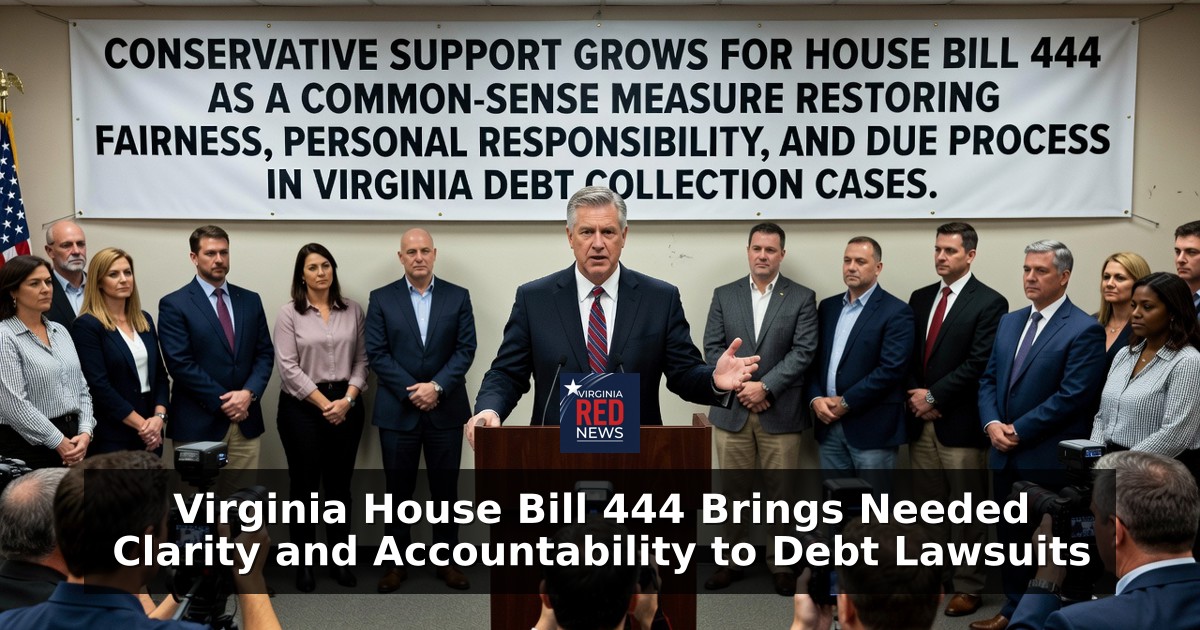
House Bill 444 stands as a straightforward reform that strengthens fairness in Virginia’s civil courts by requiring third-party creditors to supply clear identifying details in debt lawsuits. Nearly 200,000 Virginians face debt suits each year, and far too many defendants never appear because they cannot recognize the plaintiff or the original source of the obligation. Conservative principles of personal responsibility, due process, and respect for legitimate contracts demand that citizens receive enough information to understand the claim against them. When paperwork remains opaque, hardworking families lose the chance to correct errors, waive improper fees, or arrange honest repayment. This measure advances the rule of law without expanding bureaucracy or punishing legitimate creditors.
Data presented to lawmakers shows that confusion over third-party plaintiffs drives non-participation at alarming rates. A consumer may have purchased goods or services from one company only to find a completely different entity filing suit years later. Without basic details linking the claim to the original transaction, many Virginians simply ignore the summons, resulting in default judgments that pile on costs and damage credit. House Bill 444 directly addresses this gap by mandating that third-party creditors and debt buyers furnish information that helps defendants identify the case. Such transparency upholds the conservative belief that every citizen deserves a fair opportunity to answer a legal claim and fulfill moral and financial obligations.
Personal responsibility remains central to any lasting solution for household debt. Conservatives have long maintained that individuals must honor contracts and repay what they owe, yet the system must also allow people to verify the accuracy of those claims. When defendants can recognize the debt, they are far more likely to appear in court, challenge mistakes, and seek cost waivers where appropriate. Creditors, in turn, benefit because voluntary payment plans become realistic options once communication improves. Ishawn Calra of the Pew Charitable Trust testified that greater participation leads to more accurate case resolutions and higher recovery rates through negotiated agreements rather than endless enforcement actions.
Protecting Free Enterprise and Legitimate Creditors
Legitimate businesses that extend credit or purchase portfolios deserve efficient recovery tools, not endless court backlogs caused by uninformed defendants. House Bill 444 does not restrict the right to collect lawful debts; it simply requires clearer paperwork so that collection efforts rest on solid ground. Conservative lawmakers recognize that free markets function best when both parties understand their rights and duties. Opaque filings undermine confidence in the civil justice system and invite accusations of unfair practices that ultimately harm reputable firms. By insisting on basic identifying information, the bill reduces the chance of erroneous judgments while preserving the ability of creditors to pursue what is rightfully owed.
Default judgments often impose additional fees and interest that could have been avoided through early dialogue. Families already struggling under financial pressure then face wage garnishments or liens that disrupt household stability and local economies. Conservative values place a high premium on stable families and self-reliance; removing unnecessary barriers to participation helps citizens regain control of their finances. When inaccurate claims are corrected promptly, courts spend less time on uncontested matters and more time on genuine disputes. This efficiency serves taxpayers and reinforces the principle that government should facilitate justice rather than complicate it.
Strengthening Due Process Without New Bureaucracy
The proposal carefully limits its reach to information that helps defendants recognize the claim and its origin. It does not create new regulatory agencies or impose heavy compliance costs on small businesses. Instead, it codifies a common-sense expectation already embraced by responsible collectors who want clean resolutions. Virginia’s tradition of limited government and individual liberty finds expression in reforms that empower citizens rather than shield them from accountability. House Bill 444 fits squarely within that tradition by giving defendants the tools to engage the process and by giving creditors a clearer path to voluntary repayment.
Testimony before the committee underscored that participation itself produces better outcomes for every side. Defendants who understand the paperwork can negotiate payment plans that restore their standing and allow creditors to recover funds without prolonged litigation. Courts avoid the administrative burden of default dockets that later require costly set-asides when errors surface. These practical results align with conservative priorities of fiscal prudence, judicial efficiency, and respect for private agreements. Lawmakers who value ordered liberty should see the measure as a modest adjustment that prevents confusion from becoming a barrier to justice.
Broader Implications for Virginia Families and Communities
Across the Commonwealth, households that fall behind on medical bills, credit cards, or consumer loans often confront a maze of unfamiliar names after debts are sold. The resulting sense of helplessness discourages engagement and erodes trust in institutions. House Bill 444 counters that trend by restoring basic clarity so that citizens can exercise their rights and meet their duties. Conservative communities have always emphasized that strong families and strong local economies depend on honest dealing and accessible courts. Clearer debt notices advance those ends without redistributing wealth or expanding the welfare state.
Supporters note that the bill also reduces the long-term social costs of unresolved judgments. Credit damage limits employment and housing options, trapping families in cycles that strain churches, charities, and local governments. By enabling earlier resolution, the legislation helps individuals climb back toward self-sufficiency—the cornerstone of conservative social policy. Creditors who recover through payment plans rather than aggressive enforcement likewise conserve resources that can be reinvested in productive enterprise. The result is a healthier marketplace grounded in transparency and mutual accountability.
As the General Assembly considers House Bill 444, the focus remains on facts rather than ideology. Nearly 200,000 debt suits each year represent real Virginians who deserve to know who is suing them and why. Requiring third-party creditors to supply identifying details is a measured step that honors contracts, protects due process, and encourages personal responsibility. Conservatives who champion limited government and ordered liberty will find in this bill a practical tool for strengthening both. The measure deserves prompt passage so that fairness and clarity once again define debt litigation across the Commonwealth.
committee testimony consumer debt court participation creditor costs debt collection debt identification debt lawsuits debt lawsuits reform debt origin House Bill 444 inaccurate debt claims Ishawn Calra legal notices payment plans Pew Charitable Trust third party creditors transparency in lawsuits Virginia Virginia consumers Virginia General Assembly Virginia legislation