Virginia House Advances FOIA Exemption for Law Enforcement Oversight Closed Sessions
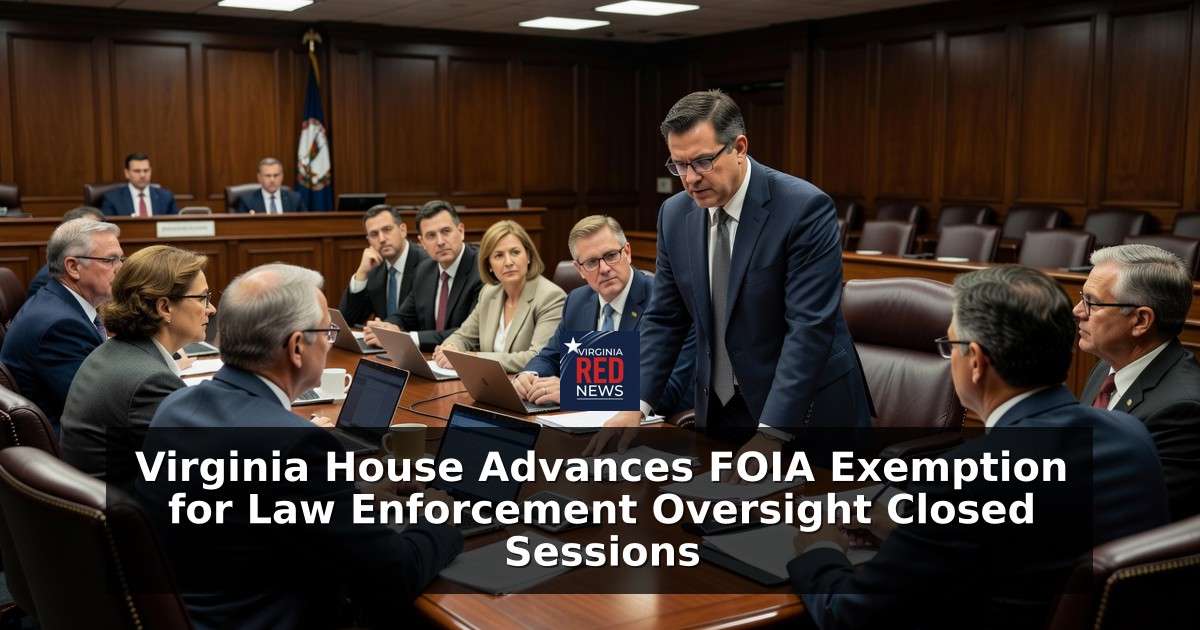
Delegate Sam Rasoul presented House Bill 1476 during a recent committee session in the Virginia General Assembly. The measure creates an exemption under the Virginia Freedom of Information Act that permits law enforcement civilian oversight bodies to conduct closed meetings. These sessions would cover discussion or consideration of matters falling within the bodies' official duties. The change targets privacy and confidentiality needs that arise when oversight panels review sensitive law enforcement activities.
The subcommittee reviewed the proposal and recommended that it be reported with a substitute by a vote of five to two. That recommendation moved the bill forward for further consideration by the full committee. Supporters described the substitute as a refinement that clarifies the scope of allowable closed sessions while preserving core open-government requirements outside those limited discussions. The action reflects ongoing legislative attention to how civilian oversight panels operate alongside existing transparency statutes.
Virginia's Freedom of Information Act generally requires that meetings of public bodies remain open to citizens and that records be accessible upon request. Exceptions already exist for personnel matters, legal advice, and certain security topics. House Bill 1476 adds a specific category for law enforcement civilian oversight bodies so they can address confidential information without public attendance. Proponents argued that open discussion of raw investigative details, personnel files, or pending complaints could compromise ongoing cases or individual privacy rights.
Civilian oversight bodies have been established in various Virginia localities to review police conduct, use-of-force incidents, and community complaints. These panels typically include appointed residents who examine policies and individual cases after internal investigations conclude. Advocates for the boards maintain that independent review builds public trust. At the same time, law enforcement representatives have long noted that premature disclosure of witness statements, medical data, or tactical information can hinder effective oversight and endanger participants.
Rasoul explained that the bill seeks to improve the practical effectiveness of these oversight groups. Closed sessions would allow members to speak candidly about confidential materials without fear that sensitive details would immediately enter the public domain. The approach aims to strike a workable balance between the public's right to know and the operational realities of reviewing law-enforcement actions. Committee members weighed those competing interests before casting their votes on the substitute version.
Public access advocates have raised concerns that any new FOIA exemption risks reducing transparency in government decision-making. They contend that oversight of police power is precisely the area where sunlight is most needed to maintain accountability. Closed meetings, in their view, could shield important deliberations from citizens who fund and are served by local law enforcement agencies. The caption accompanying legislative discussion noted that the exemption limits public access and transparency in government decisions.
Defenders of the measure countered that oversight bodies already operate under strict confidentiality rules for certain records and that the bill merely aligns meeting procedures with those existing protections. Without the ability to close portions of meetings, panels might receive incomplete briefings or avoid difficult topics altogether. That outcome, they said, would weaken rather than strengthen civilian review. The five-to-two subcommittee tally indicated majority support for giving the bodies this procedural tool.
The full committee subsequently discussed and advanced the legislation. Passage at that stage sends House Bill 1476 toward potential floor consideration in the House of Delegates. If enacted, the exemption would apply statewide to any qualifying law enforcement civilian oversight body. Local governments that have created such panels would gain clearer authority to enter closed session when discussing or considering covered matters.
Broader context includes repeated legislative efforts in recent sessions to adjust FOIA boundaries around public safety topics. Earlier measures have addressed release of body-camera footage, protection of undercover techniques, and handling of active-shooter response plans. House Bill 1476 fits within that pattern by focusing on the deliberative process of oversight entities rather than on the underlying records themselves. Records would remain subject to existing disclosure rules even if the meetings discussing them are closed.
Observers noted that the effectiveness of civilian oversight often depends on the quality of information shared with board members. Open-meeting constraints can limit what police departments feel comfortable providing in real time. A limited closed-session option may encourage fuller briefings and more thorough review. Whether that prediction holds will depend on how localities implement the exemption and how courts interpret its boundaries if challenges arise.
The bill does not eliminate public reporting requirements. Oversight bodies would still be expected to issue findings, recommendations, and annual summaries in open forums or written reports. The closed-meeting authority is confined to the discussion or consideration phase. Once deliberations conclude, the public character of final actions would remain intact under standard FOIA principles. That distinction formed part of the rationale offered during subcommittee debate.
Critics continue to question whether the privacy rationale justifies reduced access. They point out that other public bodies manage sensitive personnel and legal matters under narrower existing exemptions without a blanket closed-meeting provision. Expanding the list of allowable closed sessions, they argue, sets a precedent that future legislatures might broaden further. The close five-to-two vote underscored that the transparency concerns remain live even among members willing to advance the bill.
As the measure proceeds, stakeholders on all sides are expected to monitor substitute language carefully. Law enforcement organizations, civil-rights groups, local government attorneys, and open-government coalitions have historically submitted comments on FOIA-related bills. Their input often shapes final wording before a bill reaches the governor's desk. House Bill 1476 will likely attract similar scrutiny given its direct effect on how police oversight is conducted in public view.
In practical terms, a civilian oversight body invoking the new exemption would still need to follow FOIA's procedural steps for entering closed session. That includes a recorded vote, a statement of the purpose, and limitation of discussion to the stated topics. Any departure from those requirements could expose the body to legal challenge. The bill therefore layers a new topical exemption onto the familiar framework rather than creating an entirely separate process.
The discussion surrounding House Bill 1476 illustrates the persistent tension in Virginia between operational confidentiality for public-safety functions and the Commonwealth's long-standing commitment to open government. Delegate Sam Rasoul's presentation framed the proposal as a targeted adjustment rather than a wholesale retreat from transparency. The subcommittee's decision to report the substitute reflects a majority judgment that the adjustment is warranted at this time.
Further legislative steps will determine whether the exemption becomes law. If it does, law enforcement civilian oversight bodies across Virginia will possess clearer authority to close portions of their meetings when privacy and confidentiality interests are at stake. Citizens and journalists will retain access to final outcomes and to records not otherwise exempt. The resulting arrangement seeks to let oversight panels function more effectively while still answering to the public they serve.
Continued attention to implementation details will be essential. Local ordinances creating oversight bodies may need conforming amendments. Training for board members on the proper use of closed sessions will help avoid misapplication. And periodic legislative review could assess whether the exemption achieves its stated goals without unduly restricting public insight into police accountability mechanisms. Those practical questions remain open even after the committee's favorable action on the bill.