Grid ran 700 megawatts short, and Washington had to waive the rules to keep Virginia's lights on
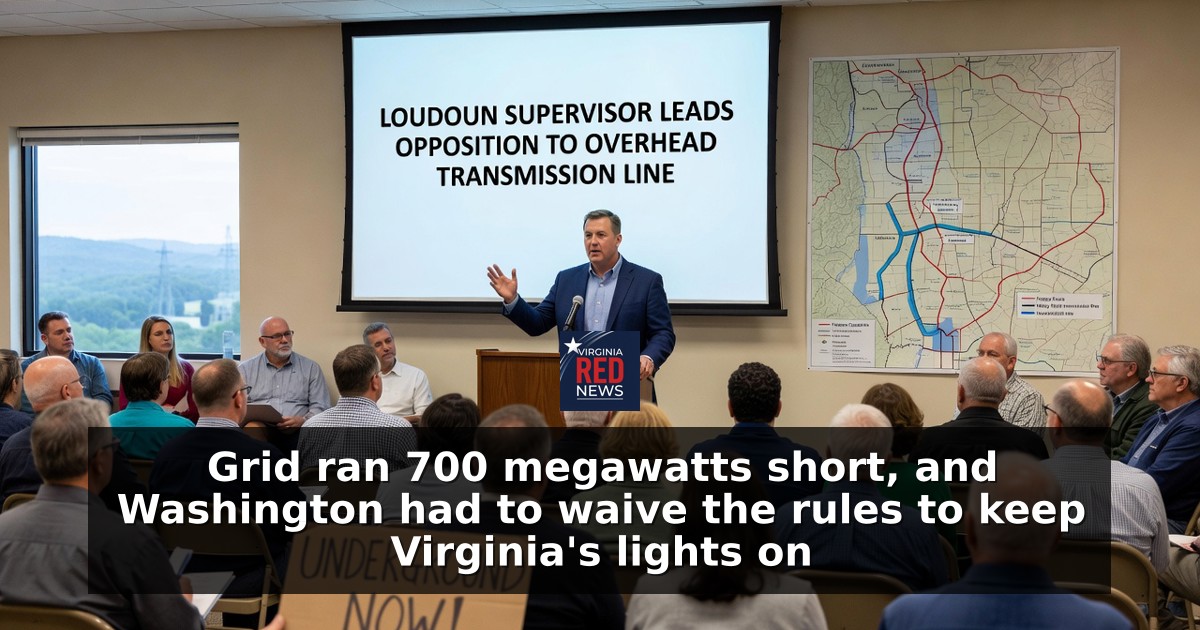
RICHMOND, Va. - Virginia families didn't lose power on Sept. 17. Federal records show how narrow the margin was, and what it took to keep the lights on.
The day before, PJM Interconnection, the grid operator for Virginia and 12 other states, asked the U.S. Department of Energy for emergency powers. It forecast demand "at or around 133,285 MW (or higher)" and told Washington it was "forecasted to be approximately 700 MW below its reserve margin." The trouble was "experienced most acutely in BGE, PEPCO, and Dominion zones," PJM wrote. The Dominion zone is the one serving most Virginians.
Energy Secretary Chris Wright signed Order No. 202-26-45 on Sept. 17, finding that "a statutory emergency exists" and that the risk included "the potential loss of power to homes and local businesses."
What it took
The order did two things. It let PJM run listed power plants past limits in their environmental permits on sulfur dioxide, nitrogen oxides, carbon monoxide, wastewater, ammonia and fuel use. And it let PJM direct backup generators at large power users to run "as a last resort before declaring an EEA 3 (i.e., before firm load interruption)." Before firm load interruption means before rolling blackouts.
PJM said it had already "committed all available generation resources across its footprint." It warned that without the order, "residences, hospitals, military facilities, water treatment plants, and other critical facilities may lose electric service."
Then things got worse. On the morning of Sept. 17, PJM told DOE that "a critical generation facility that supports the affected Zones" had "unexpectedly gone offline." PJM still hasn't named it.
What kept the power on
PJM's compliance report for Sept. 17 shows what ran under the order's allowances. Dominion's Mount Storm coal station in West Virginia ran unit 3 for 12 hours and unit 1 for one hour. Six diesel backup units in Ashburn ran 8 to 10 hours each. PJM also called emergency demand response, paying customers to cut usage, in the BGE, Pepco and Dominion zones.
That is coal and diesel, the fuels Virginia's energy policy has been trying to phase out.
The policy question
The emergency was not caused by a single law, and DOE's order doesn't blame one. PJM cited heat, about 33,191 megawatts of generation offline during fall maintenance, transmission limits and export obligations. But the episode puts a hard number on a debate Richmond has had since 2020.
That year, the Democratic-controlled General Assembly passed the Virginia Clean Economy Act. Under the law, Dominion Energy Virginia and Appalachian Power must produce electricity from 100% renewable sources by 2045 and 2050, respectively, under a mandatory renewable portfolio standard. The law also sets a schedule for retiring carbon-emitting plants located in Virginia, according to the Legislative Information System summary of HB 1526.
Critics have long argued that retiring dispatchable plants before replacements are proven on the grid invites shortfalls. In September, the grid serving Virginia leaned on a West Virginia coal plant and diesel generators, and needed a federal waiver to do it. Dominion has said the law's reliability provisions let fossil plants stay online past 2045 if the State Corporation Commission finds it necessary.
Who answers for it
The State Corporation Commission's three commissioners were copied on Wright's order. No public SCC statement on it was found. The order says rate recovery for the emergency "is available" through federal tariff filings. No cost figure has been published.
Dominion's political giving
Dominion is among the largest political donors in Richmond, and Virginia does not cap corporate contributions. Records compiled by the Virginia Public Access Project (VPAP) show Dominion's 20 largest Democratic recipients in the 2025-26 cycle took at least $8.42 million. That list includes Shannon Taylor's attorney general campaign ($775,000), Del. Charniele Herring ($625,000), Speaker Don Scott ($600,409), Senate Majority Leader Scott Surovell ($600,000) and Sen. Mamie Locke ($600,000). In 2023-24, VPAP shows the top 20 Democratic recipients took at least $7.15 million. Dominion's top 20 Republican recipients took about $5.58 million in 2025-26 and $5.06 million in 2023-24, led by Attorney General Jason Miyares at $1.42 million, according to VPAP. Virginia Scope, using VPAP data, reports Dominion has given nearly $18 million to Democrats and more than $15 million to Republicans since 2018. At the federal level, Dominion Energy PAC gave $117,800 to Democratic candidates in 2023-24 and $162,500 to Democratic PACs and party committees, according to OpenSecrets. These figures come from VPAP and OpenSecrets compilations and have not been independently re-verified against state filings.
Those same legislators will decide whether Virginia's energy laws change. The question for them is simple: how many more Sept. 17s does the grid have in it?
Documents
The order, PJM's application, its supplemental letter and Exhibit A are posted on the Department of Energy's 202(c) page for Order No. 202-26-45 at energy.gov. PJM's daily compliance report for Sept. 17 is posted at pjm.com.
Chris Wright DOE Order 202-26-45 Dominion Energy grid emergency PJM reliability Virginia Virginia Clean Economy Act