Fairfax County Public Schools tells registrars to destroy student identification documents
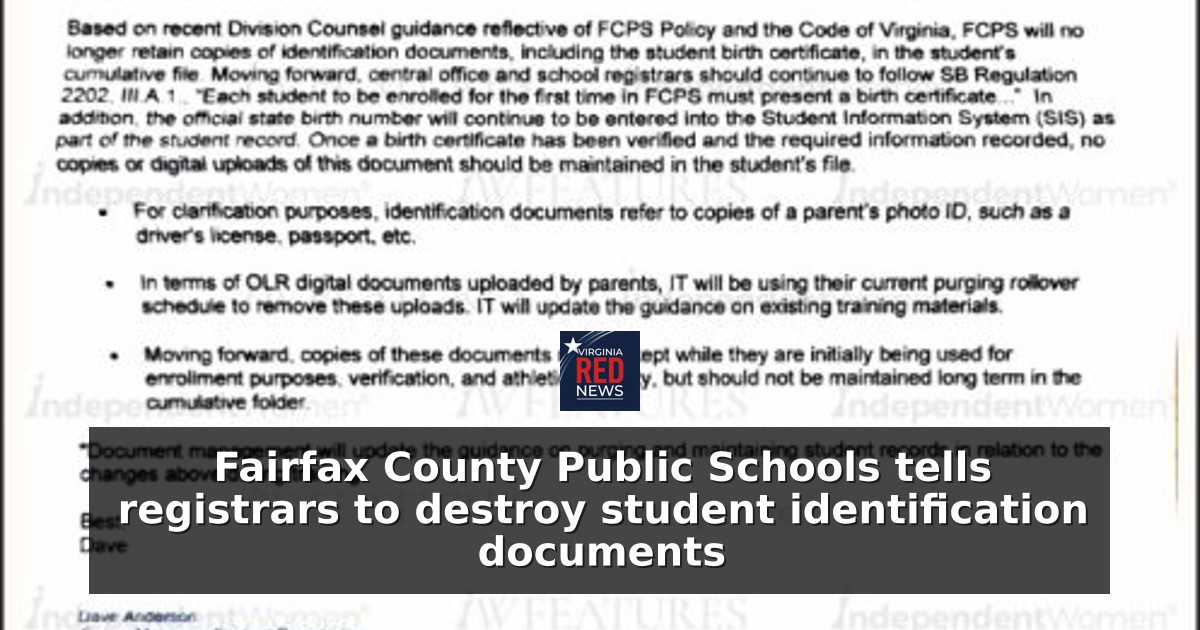
Fairfax County Public Schools has instructed school registrars to stop keeping copies of personal identification and residency documents in student cumulative files, a shift that critics say weakens verification of who a student is, where the family lives, and who holds legal parental authority.
According to reporting republished with permission from IW Features and bylined by Stephanie Lundquist-Arora, Dave Anderson—described as FCPS’s senior district manager for registration—emailed registrars on July 1 outlining that the division would no longer retain copies of identification documents in cumulative records. For years, schools have commonly kept scans or photocopies of items such as birth certificates, custody orders, and proof of address to establish enrollment eligibility and emergency contacts. The new guidance directs staff to remove copies of personal documents and digital uploads from those records.
FCPS is Virginia’s largest school division. Registration is not a clerical sideshow: it determines which school a child attends, whether tuition rules for non-residents apply, and whether the adults listed for pickup and medical consent are the right people. When copies disappear from the cumulative file, front-office staff facing a dispute may have less immediate paper to consult, even if central systems retain some data. Privacy advocates welcome less retention of sensitive IDs; parent advocates worry about custody conflicts, enrollment fraud, and situations where a student’s name or guardian information is challenged mid-year.
Anderson’s role and approximate $150,000 salary have been cited in coverage to underline that the change came from central registration management rather than a casual school-level experiment. The email’s practical effect is what school secretaries and registrars must do when a new family arrives with a lease, a utility bill, and a birth certificate: verify, then destroy or decline to keep the copies that previous practice treated as routine.
Supporters of the change argue schools are not immigration offices and that storing high-value identity documents creates breach risk. Opponents note that public schools already handle sensitive records under FERPA and that residency enforcement collapses without durable documentation when addresses change frequently in a high-cost county. Foster care, shared custody, and kinship care cases especially rely on clear paper trails when adults disagree at the front desk.
The policy also lands in a broader Fairfax debate about transparency and parental rights. Parents who already distrust central office directives see document destruction as one more instance of local practice shifting without a loud public board vote. Division leaders, if they defend the memo, will likely stress compliance with privacy norms and reduced liability from storing Social Security cards or driver’s licenses in filing cabinets.
What parents should ask now is operational: What, exactly, is verified at enrollment if copies are not kept? How are disputes resolved six months later? Are digital uploads purged from every system or only from the cumulative folder language in the email? Until FCPS publishes a plain-language FAQ, registrars will improvise, and improvisation in a 180,000-student system is how uneven practice becomes the story.
Identity and residency rules exist to put the right child in the right seat with the right adults responsible. Changing how evidence is retained is not a small clerical tweak. It is a governance choice—and Fairfax should explain it in public, with the same clarity it used in the July 1 email to staff.
State lawmakers could clarify minimum retention rules so the largest division is not inventing privacy policy in an email. A short statute or VDOE guidance listing which documents may be viewed, which must be copied, and how long copies last would protect both privacy and enrollment integrity. Without that, each registrar becomes a policy shop of one.
Immigrant and mixed-status families add another layer. Advocates fear document demands become proxies for immigration enforcement; other parents fear the opposite—that weak documentation invites residency fraud that overcrowds already strained schools. The answer is not maximal retention of every ID for eternity, nor maximal deletion that leaves schools guessing. It is a defined checklist, audited evenly, explained in multiple languages at the registration counter.
Email the Fairfax County Board of Supervisors:
Jeffrey C. McKay, chairman@fairfaxcounty.gov,
Kathy L. Smith, sully@fairfaxcounty.gov,
Rachna Sizemore Heizer, braddock@fairfaxcounty.gov,
James N. Bierman Jr., dranesville@fairfaxcounty.gov,
Rodney L. Lusk, franconia@fairfaxcounty.gov,
Walter L. Alcorn, huntermill@fairfaxcounty.gov,
Andres F. Jimenez, mason@fairfaxcounty.gov,
Daniel G. Storck, mtvernon@fairfaxcounty.gov,
Dalia A. Palchik, providence@fairfaxcounty.gov,
Pat Herrity, springfield@fairfaxcounty.gov,
Email the Fairfax County School Board:
Tom Dannan, tfdannan@fcps.edu,
Robyn Lady, ralady1@fcps.edu,
Marcia St. John-Cunning, mstjohncunni@fcps.edu,
Melanie Meren,
Ricardy Anderson, randerson@fcps.edu,
Mateo Dunne, mdunne@fcps.edu,
Karl Frisch, kvfrisch@fcps.edu,
Sandy Anderson, sanderson@fcps.edu,
Seema Dixit, sdixit@fcps.edu,
Kyle McDaniel, kmcdaniel@fcps.edu,
Ryan McElveen, rlmcelveen@fcps.edu,
Ilryong Moon, imoon@fcps.edu,
Fairfax County Andres F. Jimenez Bacons Rebellion bill Children Dalia A. Palchik Daniel G. Storck Drugs Education Environment Fairfax County Fairfax County Board of Supervisors Fairfax County Public Schools Fairfax County School Board Fraud Gangs Illegal immigration Ilryong Moon Immigration James N. Bierman Jr. Jeffrey C. McKay Karl Frisch Kathy L. Smith Kyle McDaniel Marcia St. John-Cunning Mateo Dunne Melanie Meren Parental Rights Parents Pat Herrity practice Public Schools Rachna Sizemore Heizer Ricardy Anderson Robyn Lady Rodney L. Lusk Ryan McElveen Safety Sandy Anderson School Board Schools Seema Dixit Sex Tom Dannan transparency Tren de Aragua Virginia Walter L. Alcorn