Delegate Price Criticizes Operation Ceasefire as Ineffective Slush Fund
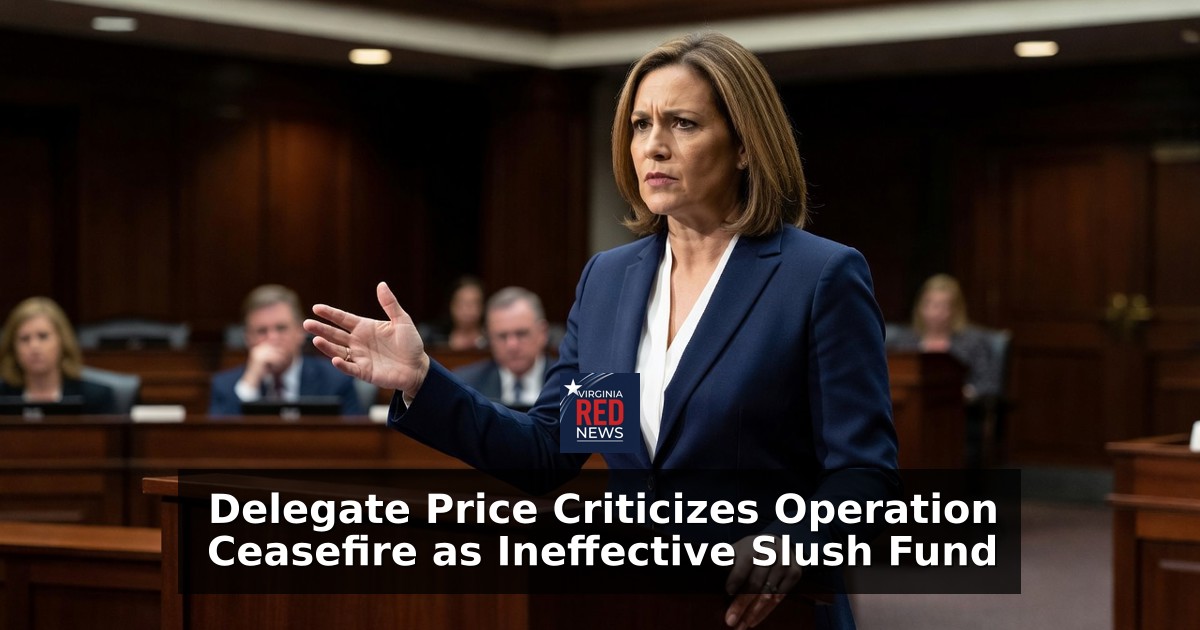
Delegate Cia Price of the Virginia House of Delegates delivered a direct rebuttal during a public safety discussion in the General Assembly. She responded to concerns raised by Delegate Wells about her proposed violence prevention initiative. Price centered her remarks on the record of a previous program called Operation Ceasefire. She told the chair that the effort existed in name only and failed to deliver meaningful public safety gains.
Price described Operation Ceasefire as a slush fund for the previous attorney general. She said the money supported billboards and commercials rather than concrete crime-fighting work. According to Price, those promotional activities solved no crime. She contrasted that approach with the need for programs that actually reduce violence in Virginia communities.
The previous attorney general in question is Jason Miyares. Miyares, a Republican, has held the office and advanced multiple law-enforcement and awareness campaigns. His office has used public messaging tools common to attorneys general nationwide, including outdoor advertising and broadcast spots. Price maintained that the specific Ceasefire expenditures produced no measurable drop in criminal activity.
Price outlined the categories of harm her alternative initiative would target. She listed mass shootings as one priority requiring focused prevention. She also named suicide by firearm, a leading cause of gun-related death in Virginia and across the United States. Domestic violence involving firearms rounded out the set of problems she said demand results rather than publicity.
Virginia lawmakers have long debated the proper mix of enforcement and prevention in addressing gun violence. Republicans in the General Assembly typically stress support for police, swift prosecution, and protection of Second Amendment rights. Democrats more often highlight early intervention, mental-health resources, and community programs. Price’s comments placed her firmly on the prevention side of that divide.
Public data show firearm suicides account for the large majority of gun deaths in the Commonwealth. Mass public shootings remain statistically rare yet generate intense legislative attention after each incident. Domestic-violence homicides rise sharply when a firearm is present in the home. Price argued that directing resources at these patterns would yield tangible improvements for residents.
Critics of heavy prevention spending sometimes contend that awareness campaigns themselves deter crime and encourage reporting. Price rejected that view in the case of Operation Ceasefire. She insisted the billboards and commercials had no effect on actual offense rates. Her proposed shift would move dollars toward interventions she believes can be measured by fewer shootings, fewer suicides, and fewer domestic fatalities.
The exchange occurred in a formal legislative setting with Price addressing the chair. Her language was sharp and left little room for ambiguity about her assessment of the prior program. She framed the choice as one between empty branding and real community outcomes. Colleagues on both sides of the aisle heard a clear call to evaluate past spending against results.
Attorney General Jason Miyares has overseen a range of public-safety efforts during his tenure. Those efforts include initiatives against violent crime, gangs, and other threats. Media outreach forms a standard part of such offices’ work to inform citizens and deter offenders. Price’s slush-fund characterization nonetheless raised questions about accountability and the proper use of appropriated funds.
Budget writers in the General Assembly must weigh competing claims whenever public-safety dollars are allocated. Programs labeled as prevention require clear metrics if they are to survive scrutiny. Price’s insistence on results supplies one standard by which future proposals may be judged. Whether her initiative advances will depend on committee votes, floor support, and ultimate agreement with the executive branch.
Community prevention strategies often involve local partnerships. Schools, faith groups, mental-health providers, and law-enforcement agencies can share roles in identifying risk and intervening early. Safe storage education, crisis counseling, and domestic-violence services appear in many such models. Price presented her plan as a vehicle for delivering those services with an expectation of documented success.
Urban and rural Virginia face distinct gun-violence profiles. Cities contend more frequently with interpersonal shootings, while rural localities record higher rates of firearm suicide. Any statewide approach must account for both patterns. Price’s list of priorities—mass shootings, suicide, and domestic violence—attempts to cover the major categories observed in state data.
Legislative debates over gun policy routinely invoke constitutional protections alongside public-health statistics. Price did not dwell on regulatory details in the recorded remarks. She concentrated instead on the failure of promotional spending and the promise of prevention that produces numbers. That focus keeps the discussion on efficacy rather than on broader cultural arguments.
Delegate Wells had expressed reservations about the new proposal, prompting Price’s reply. The back-and-forth illustrates how individual delegates press one another on the details of crime-reduction theory. Such exchanges help surface assumptions about what works and what merely looks active. Price used the moment to draw a bright line between past practice and her preferred path.
Independent audits and performance reviews remain the surest way to test competing claims. If Operation Ceasefire funds indeed supported only advertising, fiscal overseers could confirm or refute the assertion. Price’s public statement invites that examination. Transparency of that kind strengthens confidence in whatever programs ultimately receive funding.
As the session continues, public-safety bills will move through subcommittees and the full chamber. Price’s critique of Operation Ceasefire supplies a reference point for members evaluating similar line items. Her demand for prevention that stops mass shootings, firearm suicides, and gun-related domestic violence sets a concrete benchmark. Lawmakers now face the task of translating that benchmark into statute and appropriation language that can be monitored over time.
Virginia residents expect both security and responsible stewardship of tax dollars. Price positioned her initiative as meeting both expectations by discarding ineffective promotion in favor of measurable protection. The coming weeks of legislative work will reveal how many of her colleagues share that assessment and are prepared to act on it.