Delegate Price Defends Prevention Bill After Wells Criticizes Record on Gun Violence Programs
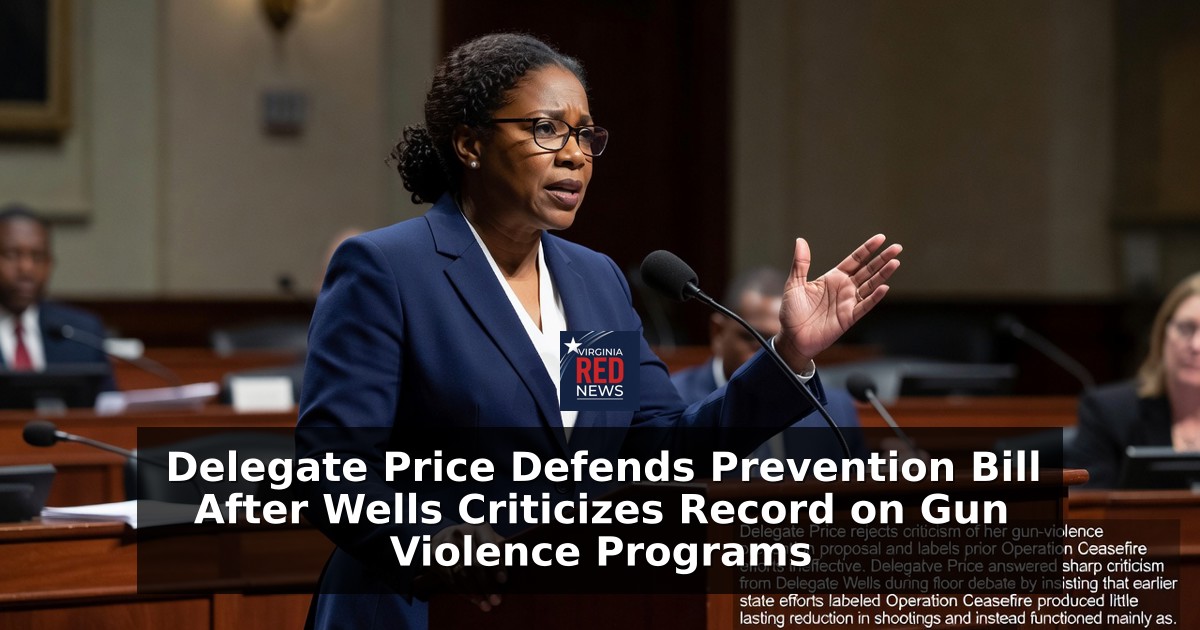
Delegate Price answered sharp criticism from Delegate Wells during floor debate by insisting that earlier state efforts labeled Operation Ceasefire produced little lasting reduction in shootings and instead functioned mainly as a promotional vehicle. Price told colleagues the program operated as a slush fund that advanced the public profile of then-Attorney General Jason Miyares more than it delivered measurable safety gains in high-crime neighborhoods. She maintained that communities still face unacceptable levels of gun violence and that a new prevention-focused initiative is required to produce concrete results rather than press releases. Price framed her legislation as a necessary course correction that prioritizes intervention, data-driven targeting, and local partnerships over what she called symbolic spending. The exchange underscored deep divisions inside the Virginia House of Delegates over how best to allocate limited public-safety dollars.
Virginia has long struggled with concentrated firearm violence in several urban centers even while overall statewide crime rates have fluctuated. Lawmakers on both sides routinely cite Richmond, Norfolk, and parts of Northern Virginia as areas where retaliatory shootings and illegal gun trafficking continue to claim lives. Operation Ceasefire, modeled on focused-deterrence strategies first tested in other states, was promoted during the Miyares tenure as a way to identify chronic offenders, deliver clear consequences, and offer social services as an off-ramp. Supporters of that approach argued it combined enforcement with prevention and avoided broad new restrictions on lawful gun owners. Price rejected that characterization, telling the chamber the results never matched the rhetoric and that funds were diverted toward visibility events rather than sustained street-level work.
Delegate Wells had pressed Price on whether another layer of programming would simply repeat past shortcomings and whether the new proposal contained adequate accountability metrics. Price responded that her bill deliberately avoids the pitfalls she associated with the earlier effort by tying dollars to verified reductions in shootings, hospital admissions, and illegal firearm recoveries. She said prevention must address multiple pathways into violence, including group conflicts, domestic disputes, and youth recruitment into crews that traffic guns. Price argued that without a dedicated, results-oriented structure the commonwealth would continue cycling through temporary grants that expire before neighborhoods stabilize. She called on colleagues to judge the proposal by the outcomes it is designed to produce rather than by partisan association with prior administrations.
Public-safety analysts note that focused-deterrence models can succeed when police, prosecutors, and community organizations maintain consistent follow-through, yet they can also stall when leadership changes or when funding becomes unpredictable. In Virginia the debate has repeatedly returned to whether limited resources should emphasize prosecution and incarceration of repeat shooters or expand upstream social programs. Price positioned her initiative firmly in the prevention camp while insisting it would not neglect enforcement. She told the House that tangible community results, not branding exercises, must become the standard for every dollar spent. Critics counter that vague prevention language often masks open-ended spending with weak oversight, a concern Wells appeared to raise in the exchange.
Attorney General Jason Miyares had previously defended Operation Ceasefire as a practical tool that paired clear warnings to violent actors with genuine offers of help, arguing it respected both public safety and constitutional rights. Price’s floor remarks directly challenged that record, asserting the program failed to bend the curve on gun deaths and instead served political communication goals. The clash reflects larger philosophical differences inside the General Assembly about the proper role of state government in local crime fighting. Republican members have generally preferred strengthening penalties for illegal gun possession and straw purchasing, while many Democratic members have sought expanded intervention and community-based grants. Price’s proposal sits at the center of that unresolved tension.
Local officials in affected cities have voiced frustration that state initiatives sometimes arrive with heavy publicity and then fade when attention shifts. Neighborhood leaders frequently request longer funding horizons, better data sharing between agencies, and programs that survive election cycles. Price claimed her legislation incorporates those lessons by requiring regular public reporting and by concentrating resources where shootings actually cluster. She rejected the suggestion that another program would become a new slush fund, insisting transparency provisions would prevent the very problems she attributed to the prior effort. Whether those safeguards prove sufficient will depend on final bill language and subsequent implementation.
Gun-violence trends in Virginia remain uneven. Some jurisdictions have recorded declines in homicides after intensified federal-state task-force work, while others continue to see spikes tied to specific feuds or drug markets. Medical examiners and trauma centers still treat large numbers of gunshot victims each year, imposing heavy costs on public hospitals. Price argued that waiting for enforcement alone to solve the problem has already been tried and found wanting, making structured prevention an urgent complement. Opponents reply that the most reliable prevention is swift and certain punishment of those who already carry and fire guns illegally. The floor debate captured both perspectives without resolving them.
As the session continues, Price’s measure will face committee scrutiny over cost estimates, performance benchmarks, and possible overlap with existing local and federal grants. Fiscal analysts will examine whether the proposal creates new bureaucracy or merely re-labels current activities. Second Amendment advocates will watch for any language that could expand registration or reporting requirements on lawful owners. Public-health voices will press for inclusion of hospital-based intervention and youth mentoring components. Price has signaled she is prepared to negotiate details so long as the core commitment to measurable prevention remains intact.
The sharper tone of her reply to Wells indicates that gun-violence policy retains the capacity to polarize even routine budget and public-safety discussions. Lawmakers must still reconcile competing claims about what worked, what failed, and what taxpayers should fund next. Price’s insistence that Operation Ceasefire was ineffective sets a clear marker for the debate ahead and places the burden on her legislation to demonstrate a different trajectory. Communities dealing with the daily consequences of gunfire will ultimately measure success by fewer funerals and safer streets rather than by the labels attached to any given program. The House now faces the practical task of translating those competing diagnoses into statutes that can survive both political cycles and real-world conditions on the ground.