Griffin Stands Firm Against HB-1295 Assault on Virginia Police
Updated
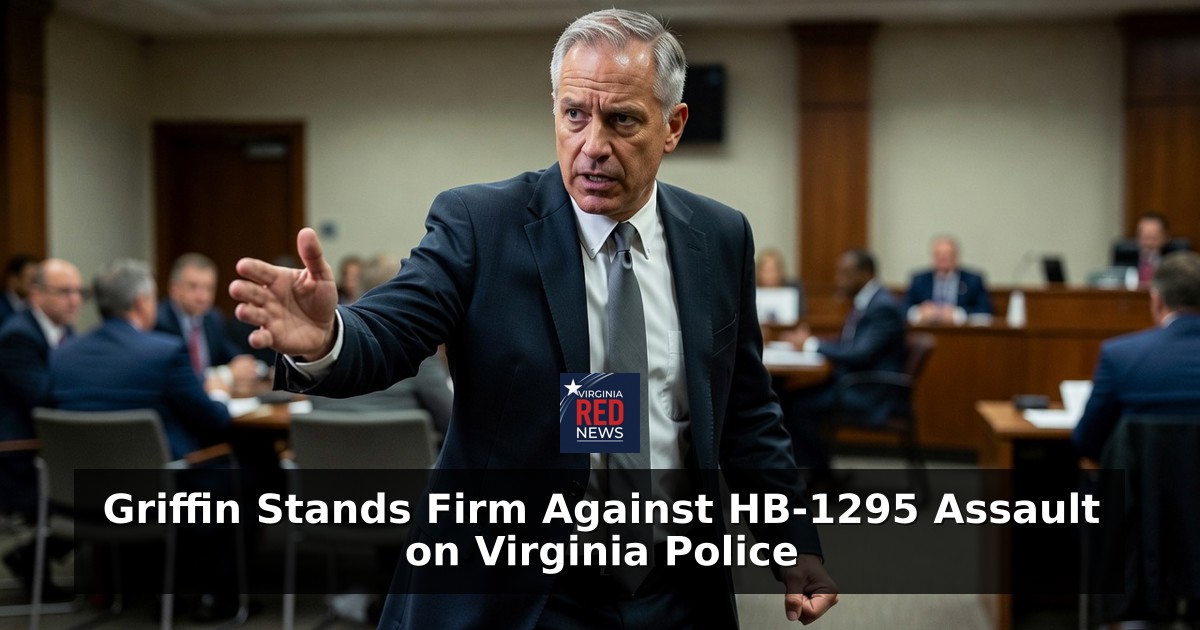
Delegate Griffin delivered a clear and forceful critique of House Bill 1295 during a recent Communications Subcommittee meeting, warning that the measure would fundamentally damage the relationship between state officials and the men and women who protect Virginia communities every day. The legislation authorizes the attorney general to investigate and file civil actions directly against law enforcement agencies, a sharp departure from the office’s historic role of assisting local police and sheriffs. Griffin emphasized that this change places the attorney general in an adversarial position rather than a supportive one. Such a shift risks eroding the trust and cooperation essential to effective crime fighting across the Commonwealth. Conservatives who value ordered liberty recognize that strong local policing forms the backbone of safe neighborhoods and secure families.
The bill’s provisions extend even further by allowing virtually any resident within a jurisdiction to initiate civil lawsuits against law enforcement agencies. Successful plaintiffs would then be entitled to recover attorney’s fees and costs from the very agencies tasked with upholding the law. Griffin noted that while the language refers to a “plaintiff,” the practical reality is that defendants facing criminal charges would most likely exploit this new avenue for retaliation. This creates a dangerous incentive structure that rewards those who seek to harass officers rather than those who respect the rule of law. Virginia families deserve protection from crime, not a legal framework that tilts the scales against the thin blue line.
Undermining Traditional Roles and Public Safety
For generations the attorney general’s office has stood alongside local law enforcement, providing legal guidance, resources, and a unified front against criminal activity. HB-1295 reverses that partnership by casting the state’s top lawyer as a potential prosecutor of the police themselves. Griffin correctly identified this inversion as contrary to sound governance and common sense. When state power turns inward against the agencies that maintain order, criminals gain breathing room and communities suffer the consequences. Conservative principles hold that government exists first to secure the rights of law-abiding citizens, not to second-guess every decision made by officers in the field.
Local law enforcement agencies already operate under extensive oversight, internal affairs processes, and existing civil remedies for genuine misconduct. Adding a new layer of attorney general investigations and open-ended resident lawsuits multiplies the burden without clear evidence of systemic failure. Officers who must constantly look over their shoulders for the next civil filing become less effective at proactive policing. The result is hesitation in high-crime areas, delayed responses, and ultimately higher victimization rates for the very residents the bill claims to empower. Virginia’s conservative tradition rejects such counterproductive experiments in favor of proven support for those who wear the badge.
Financial and Operational Burdens on Agencies
The fee-shifting provision in HB-1295 poses a direct fiscal threat to sheriffs’ offices and police departments already stretched thin by recruitment challenges and rising operational costs. Every successful lawsuit, even one brought by a disgruntled defendant seeking leverage, could drain taxpayer dollars that would otherwise fund patrols, equipment, and training. Griffin highlighted the real-world likelihood that charged individuals would weaponize the statute, turning criminal proceedings into dual civil battles. This dual exposure forces agencies to divert scarce resources toward defensive litigation rather than community protection. Responsible stewardship of public funds demands rejection of measures that invite endless legal fishing expeditions.
Smaller departments in rural Virginia counties would feel the pressure most acutely, lacking the deep legal budgets of larger urban forces. A single adverse judgment or settlement could cripple their ability to maintain adequate staffing levels. Conservatives understand that fiscal responsibility and public safety are inseparable; one cannot be sacrificed for the other without lasting harm. By empowering private litigants with the promise of recovered fees, the bill effectively subsidizes activism against police at the expense of every Virginia taxpayer. Such an arrangement offends basic notions of fairness and accountability.
Protecting Officers Who Protect Communities
Law enforcement professionals already face elevated risks, from physical danger on the street to the emotional toll of confronting society’s darkest elements. Legislation that invites additional civil harassment compounds those stresses and accelerates burnout and early retirements. Griffin’s straightforward assessment that HB-1295 is simply “a bad idea” resonates with citizens who still believe officers deserve the benefit of the doubt when performing difficult duties in good faith. The conservative commitment to moral clarity insists that society back those who enforce just laws rather than erect new obstacles in their path. Weakening police morale through constant legal threat serves no legitimate public interest.
Virginia has long prided itself on a culture that respects authority properly exercised and demands personal responsibility from every resident. Opening the courthouse doors to essentially any local resident for fee-recoverable suits against agencies inverts that culture. It signals that the default posture toward police should be suspicion rather than gratitude. Experience across the nation shows that jurisdictions embracing similar anti-police legal frameworks have watched crime rates climb while officer recruitment collapses. The Commonwealth need not repeat those failures. Sound policy begins with supporting the thin blue line, not litigating against it.
A Call for Balanced Oversight Rooted in Principle
Genuine accountability remains essential, and existing mechanisms already provide avenues for addressing misconduct without the sweeping new powers contained in HB-1295. Conservatives favor targeted reforms that strengthen training, transparency, and internal discipline while preserving the operational independence officers require. The attorney general should continue serving as a partner who bolsters local efforts against gangs, drugs, and violent offenders, not as an overseer primed for civil confrontation. Griffin’s objections correctly frame the choice before lawmakers: stand with the men and women who keep communities safe, or hand new weapons to those who would undermine them.
Public safety is not a partisan slogan but a foundational duty of government. When legislation prioritizes novel lawsuit rights over the practical needs of law enforcement, it abandons that duty. Virginia voters who cherish secure streets, intact families, and respect for lawful authority expect their delegates to reject bills that tilt the field against police. Delegate Griffin has articulated the stakes with clarity and conviction. The subcommittee and the full General Assembly now face a straightforward test of whether they will defend traditional support for law enforcement or experiment with measures that place officers and agencies in perpetual legal jeopardy. The conservative answer remains unambiguous: protect those who protect us.
attorney fees attorney general bill criticism civil actions civil lawsuit costs criminal issues defendants Delegate Griffin frivolous lawsuits HB-1295 jurisdiction Law Enforcement legal implications local police oversight plaintiff public safety state police subcommittee Virginia Virginia legislature