Kilgore Presses House to Deliver Car Tax Relief Without Further Delay
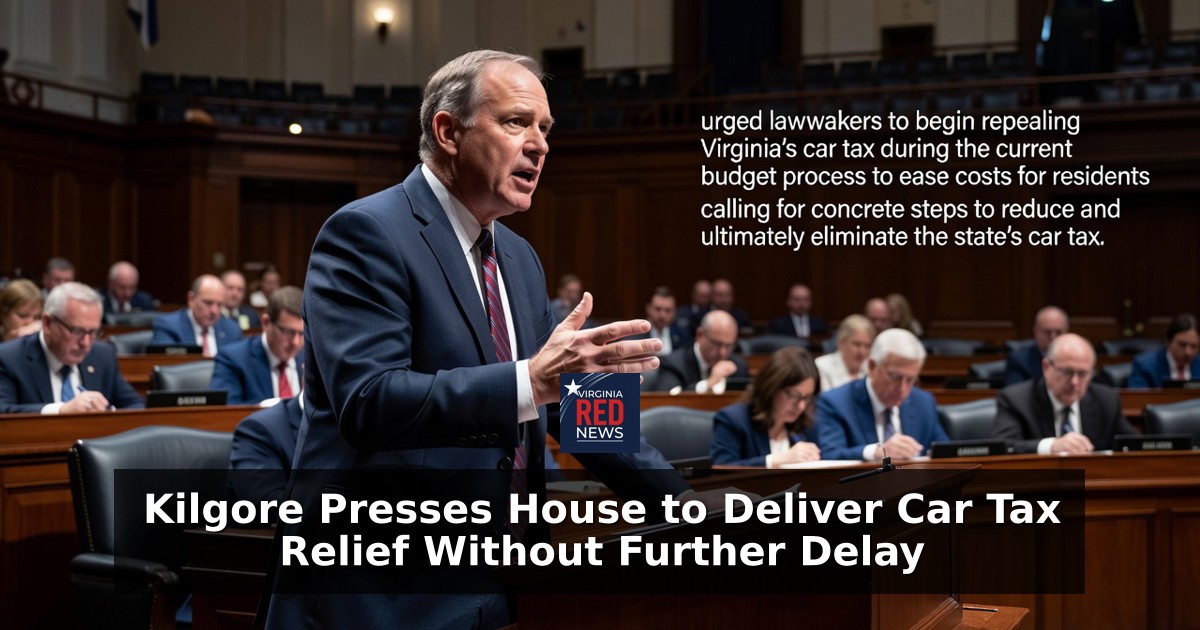
Delegate Terry Kilgore of Scott County addressed the Virginia House of Delegates during the regular session on January 30, 2026, calling for concrete steps to reduce and ultimately eliminate the state’s car tax. Speaking on the House floor, Kilgore framed the issue as central to the session’s stated focus on affordability for ordinary Virginians. He argued that continuous studies of the tax’s cost are unnecessary because the financial burden on vehicle owners is already well understood by legislators and the public alike.
Kilgore told colleagues that meaningful relief could begin immediately by exempting the first five thousand dollars of a vehicle’s value, referencing a measure previously advanced by the delegate from Salem. Such an incremental approach, he said, would start delivering tangible savings to families without requiring a complete overhaul in a single stroke. He stressed that lawmakers already possess sufficient information on the revenue impact and that further delays amount to kicking the can down the road rather than solving a problem that affects household budgets across the Commonwealth.
The car tax, formally a local personal property tax levied on motor vehicles, has long been a point of contention in Virginia politics. Residents routinely cite the annual assessment as one of the more visible and frustrating costs of vehicle ownership, especially as car prices and local rates have fluctuated. Past efforts to curb or replace the tax have produced partial reimbursements and study commissions, yet full repeal has remained elusive. Kilgore positioned the current budget negotiations as the practical venue for action, urging the majority party to incorporate relief language rather than consign the matter to another round of analysis.
Kilgore reminded the chamber that the governor had publicly supported car-tax relief during the recent campaign. He expressed hope that both parties could set aside differences and work in a bipartisan spirit to enact legislation this year. The delegate emphasized civility in the process while insisting that affordability rhetoric must be matched by policy results. In his view, starting with a modest exemption would demonstrate good faith to taxpayers and create momentum for broader reductions in subsequent sessions.
Public discussion of the car tax often centers on its regressive character for working families who rely on older vehicles yet still face yearly bills. Local governments depend on the revenue for schools, public safety, and infrastructure, which complicates outright elimination. Kilgore’s proposal of a phased reduction acknowledges that fiscal reality while rejecting indefinite postponement. By tying the issue to the budget process already underway, he sought to move the conversation from abstract study to line-item decisions that affect real people.
Supporters of tax relief argue that Virginia households face cumulative pressures from housing, energy, and transportation costs, making any reduction in mandatory vehicle taxes a direct boost to disposable income. Critics of rapid repeal typically warn of gaps in local budgets and the need for replacement revenue sources. Kilgore countered that the known cost of the tax itself removes the justification for endless review and that incremental steps can be calibrated to available resources. He called on colleagues to honor campaign commitments and deliver measurable help before the session concludes.
The House debate reflected broader tensions over how best to translate affordability promises into statute. Kilgore’s remarks underscored a preference for action over process, asserting that citizens expect results rather than additional reports. He closed by reiterating the invitation for bipartisan cooperation and the opportunity to pass car-tax legislation in the present year. Whether the budget ultimately includes the five-thousand-dollar threshold or similar language will determine if the speech marks the start of concrete relief or another chapter in a long-running discussion.
Observers note that vehicle personal property taxes vary widely by locality, creating uneven burdens that statewide policy must address carefully. An initial exemption could standardize a baseline of relief while preserving local flexibility above that floor. Kilgore’s emphasis on starting small yet starting now aligns with incremental strategies that have succeeded in other tax reforms. The delegate’s appeal to shared campaign language and mutual courtesy sought to lower the temperature while raising the urgency of the underlying pocketbook issue.
As the session continues, the car-tax question remains a test of whether affordability remains a governing priority or recedes into procedural delay. Kilgore’s floor statement placed the onus on the budget writers to produce language that begins phasing out the levy. Virginians who track their annual vehicle assessments will be watching to see whether the incremental path he outlined advances beyond rhetoric. The coming weeks of budget negotiation will reveal if the House can convert the delegate’s call into statutory change that lightens the load on car owners across the Commonwealth.
Historical attempts at car-tax reform in Virginia have shown both the popularity of relief and the difficulty of replacing local revenue. Kilgore’s approach of acknowledging those constraints while refusing further study reflects a pragmatic conservatism that prioritizes taxpayer benefit within existing fiscal frameworks. By invoking the governor’s campaign stance and inviting cross-aisle partnership, he framed repeal not as a partisan trophy but as a shared obligation to make daily life more affordable. The measure of success will be whether the final budget contains the first concrete reduction he advocated on the House floor.