Cost of Democrat Supported Carbon Tax Exceeds $500 Million per Year
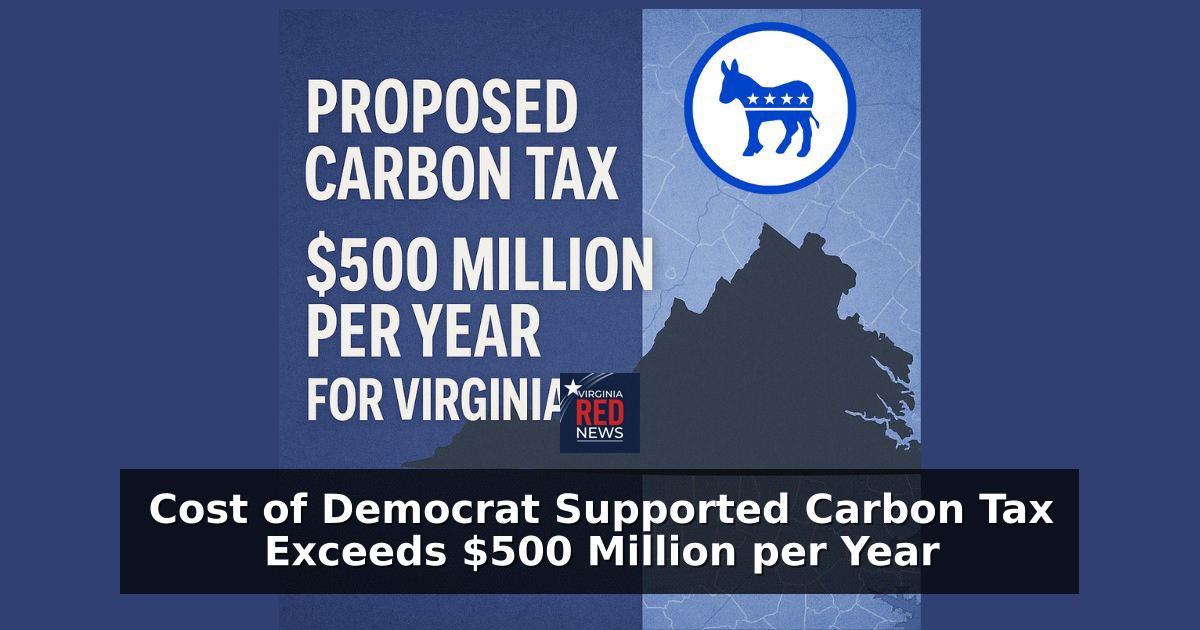
RICHMOND — Virginians would pay roughly half a billion dollars more per year on electricity if the Commonwealth rejoined the Regional Greenhouse Gas Initiative at today’s allowance prices, according to an analysis circulating among energy-policy critics — a figure that has become a central wedge in the governor’s race between Democrat Abigail Spanberger and Republican Winsome Earle Sears.
RGGI is a multistate carbon-allowance compact. Power plants that burn coal or oil must buy allowances for each ton of carbon dioxide they emit. Those costs do not stay on utility balance sheets; they are passed through to ratepayers. When Virginia participated, Dominion Energy Virginia recovered RGGI costs through a special charge on customer bills. Gov. Glenn Youngkin withdrew the state from the program, a move his allies still call one of his clearest wins on electricity prices. A lawsuit challenging that withdrawal remains pending.
Spanberger has pledged to put Virginia back into RGGI and restore the carbon pricing mechanism. Sears has pledged to keep Youngkin’s exit in place. That contrast gives voters a measurable utility-bill question alongside the usual education and crime themes. Critics of rejoining note that RGGI’s third 2025 allowance auction cleared at $22.25 per ton — well above the $5.65-per-ton level when Virginia’s participation statute passed in early 2021, and higher than the $14.88 price at Virginia’s final auction in December 2023. A jump from roughly $5.65 to $22.25 is about a fourfold increase in five years.
If Virginia had remained in the compact through 2024–2025, the state would have collected nearly $1 billion more in carbon-allowance revenue, according to the same critique. Democratic lawmakers historically steered those dollars toward flooding projects and home energy-efficiency grants. Advocates celebrate the program spending; opponents answer that the money is not free — customers pay it whenever they turn on the lights. “It is not the utilities and their shareholders who pay for it. It is ultimately customers,” writes Steve Haner, senior fellow in environment and energy policy at the Thomas Jefferson Institute, whose Bacon’s Rebellion analysis underpins much of the $500 million estimate.
Allowance markets have a speculative side that rarely appears in campaign talking points. Beyond quarterly auctions, a secondary market lets investors buy, hold, and trade unused allowances. Utilities that need credits quickly can pay secondary prices; options trading on RGGI futures has seen sharp swings in implied volatility. Secondary-market reports show prices sliding from the low twenties toward the mid-teens around federal executive actions aimed at state carbon penalties, then rebounding toward $22–$23 ahead of later auctions. A Cost Containment Reserve trigger near $18.22 is another technical detail that can inject supply — and mute prices — when markets run hot.
For households and manufacturers, the politics reduce to a simpler ledger. Rejoining RGGI at current clearing prices means a renewed carbon surcharge layered onto rates already pressured by data-center load and transmission buildout. Staying out means forgoing a revenue stream Democrats want for climate and resilience programs, but also forgoing the tax that funds them. Youngkin’s team argues exit was the cleanest way to shave bills; Spanberger’s team argues reentry is climate leadership and flood-protection funding. Sears is betting voters feel the difference on their Dominion or co-op statements more than they feel the grant programs.
Election Day is the practical referendum. The pending lawsuit over Youngkin’s withdrawal could complicate a clean handoff either way, but the candidates’ pledges leave little ambiguity about intent. If Spanberger wins and follows through, RGGI allowance purchases return to Virginia generators and, shortly afterward, to customer bills. If Sears wins, the Commonwealth stays outside the compact while other northeastern states continue auctioning carbon tons among themselves.
Haner’s warning is blunt: carbon cap-and-tax systems transfer money from ratepayers to state treasuries and to market traders. Whether that trade is worth $500 million a year is now a ballot question as much as a regulatory one. Virginians who want the programs can vote for rejoining. Virginians who want the lower power bills Youngkin advertised can vote to keep RGGI on the other side of the Potomac.
Richmond is an independent city in the Richmond region.
Richmond Abigail Spanberger Abigail Spanberger bill Candidates challenges City of Richmond Crime Democrats Dominion Dominion Energy Education Electric Energy Environment Glenn Youngkin Grants held RGGI Taxes Thomas Jeffersoninst Virginia Voting Winsome Earle-Sears