Farm Bureau Stands Firm Against Leaf Blower Restrictions Threatening Rural Virginia
Updated
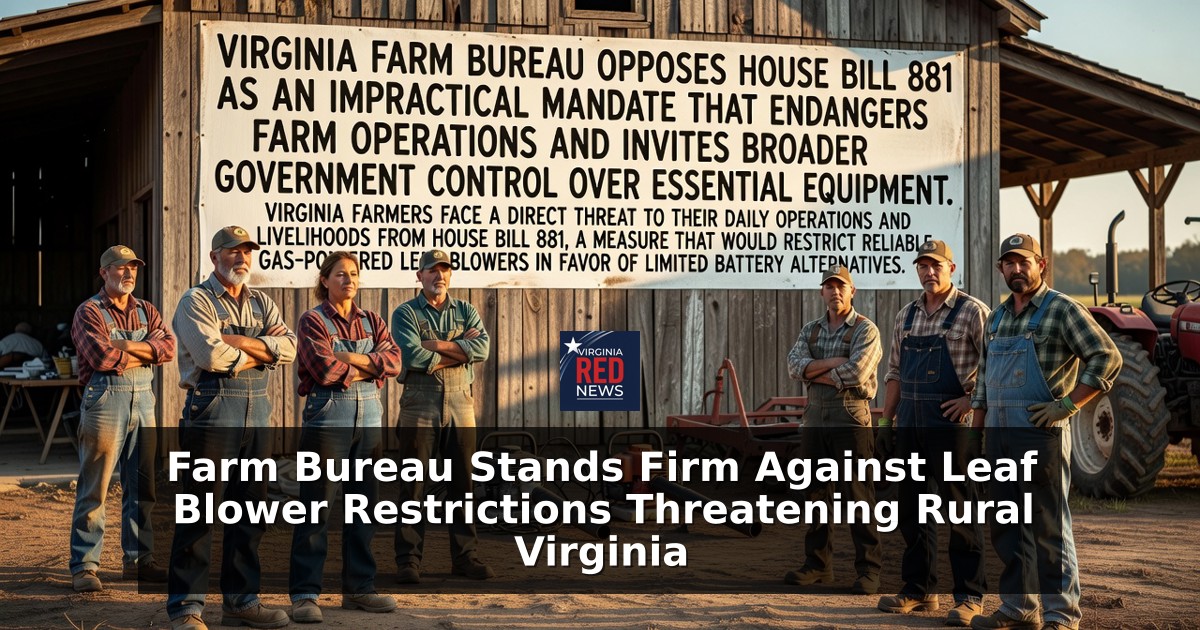
Virginia farmers face a direct threat to their daily operations and livelihoods from House Bill 881, a measure that would restrict reliable gas-powered leaf blowers in favor of limited battery alternatives. Caitlin Jordan of the Virginia Farm Bureau delivered clear testimony before a legislative subcommittee, speaking for more than 30,000 farm families who depend on gas and diesel equipment to complete time-sensitive work. These families operate under tight schedules dictated by weather, daylight, and crop cycles that leave no room for equipment failures or repeated interruptions. Conservative principles of limited government and individual responsibility demand that lawmakers reject such overreach and preserve the right of producers to select the tools that actually work. Forcing unproven technology onto working Virginians undermines free enterprise and places ideology ahead of practical results.
The bill would strike hardest at industrial and agricultural users who cannot afford downtime when chores must be finished before storms arrive or the sun sets. Jordan warned that the proposal represents the camel's nose under the tent, opening the door for future state restrictions on other gas-powered machinery that rural communities rely upon every day. Local agencies, including departments of public works, would also face costly fleet overhauls if the measure applied retroactively, hampering their ability to clear roads after snow events and keep communities safe. Such mandates ignore the hard-won experience of those who feed the Commonwealth and maintain its infrastructure. True stewardship of the land requires equipment that performs under real conditions, not experimental substitutes pushed by distant regulators.
Reliability Gaps Expose the Flaws in Electric Mandates
A standard high-powered gas leaf blower can clear leaves from an acre in roughly 30 to 60 minutes under normal conditions, allowing crews to move efficiently across large properties. Battery-powered versions, by contrast, deliver only 15 to 45 minutes of runtime and would demand two to four battery swaps to cover the same ground. During urgent farm tasks or adverse weather, charging stations often prove unavailable, forcing operators to haul gas-powered generators simply to keep electric tools running. This circular dependency defeats the stated purpose of the bill and adds expense, weight, and complexity that working families cannot absorb. Conservative values prize self-reliance and common sense; they reject policies that create new problems while solving none.
Farmers already stretch every hour of daylight and every gallon of fuel to meet market demands and weather windows. Replacing proven gas blowers with short-lived batteries would slow operations, raise labor costs, and risk unfinished work that invites crop damage or safety hazards. Public works crews that recently battled snowstorms would confront the same limitations when clearing debris or preparing roads. The Virginia Farm Bureau correctly identifies these realities as reasons to oppose the legislation outright. Lawmakers who value rural communities must listen to the people who actually perform the labor rather than impose untested rules from Richmond.
Protecting Free Choice and Economic Freedom for Rural Families
House Bill 881 threatens more than leaf blowers; it signals a broader willingness to dictate equipment choices across agriculture, landscaping, and municipal services. Once the state claims authority to ban one category of gas tool, pressure will mount to extend similar limits to chainsaws, trimmers, generators, and tractors that keep farms productive. Thousands of multi-generational farm families have built their operations around durable, refillable power sources that function far from electrical outlets. Stripping away that flexibility violates the moral principle that citizens closest to the work know best how to complete it. Limited government exists precisely to prevent such top-down experiments that ignore local knowledge and economic consequences.
The measure also raises legitimate concerns about fairness and cost. Retroactive application would compel private businesses and public agencies to scrap functional equipment and purchase expensive battery systems that still require fossil-fuel backup. Rural electric grids already face strain during peak seasons; adding widespread charging demand would only compound reliability challenges. Conservative Republicans have long defended property rights and the freedom to earn a living without bureaucratic interference. Supporting the Farm Bureau's position upholds those traditions and shields hardworking Virginians from policies that sound appealing in committee rooms yet fail in the field.
Standing with Farmers Against Regulatory Creep
Jordan's testimony underscored that potential restrictions reach far beyond residential yards and into the heart of Virginia agriculture. Farm chores wait for no one, and crews must finish before darkness or storms halt progress. Electric alternatives simply cannot match the sustained power and quick refueling of gas models when minutes matter. By opposing House Bill 881, the Virginia Farm Bureau defends not only current tools but the principle that government should not experiment with the livelihoods of 30,000 farm families. Lawmakers committed to conservative morals will reject the bill and affirm that practical results, not political fashion, must guide equipment standards.
Virginia's rural heritage thrives when producers retain the liberty to choose reliable machinery suited to their land and climate. Mandates that force battery swaps in the middle of a job or require generators to charge so-called clean tools reveal the emptiness of one-size-fits-all regulation. Public safety agencies that clear snow and debris deserve the same dependable equipment that farmers use. Preserving access to gas and diesel power protects jobs, food production, and community resilience. The subcommittee heard a clear message rooted in experience and common sense: House Bill 881 must not advance.
A Call for Common-Sense Governance
The debate over leaf blowers ultimately tests whether Virginia will honor the wisdom of its farmers or surrender to expanding state control. Conservative values elevate personal responsibility, free markets, and respect for those who work the soil. House Bill 881 fails every one of those tests by substituting short battery life and charging headaches for proven performance. Caitlin Jordan and the Virginia Farm Bureau have performed a public service by documenting the real-world costs and by warning of future restrictions that would follow. Citizens who cherish limited government and strong rural communities should expect their representatives to stand with the Farm Bureau and defeat this unnecessary measure.
Continued vigilance remains essential because regulatory pressure rarely stops at a single tool. Once the precedent of banning gas leaf blowers takes hold, advocates will target additional equipment that underpins agriculture and public works. Virginia can choose a better path by trusting farmers, landscapers, and local crews to select the machines that keep the Commonwealth productive and safe. The facts presented in subcommittee testimony leave no doubt that electric mandates create more problems than they solve. Responsible governance demands rejection of House Bill 881 and a renewed commitment to the practical freedoms that sustain rural life.
adverse weather battery life charging issues diesel equipment efficiency concerns electric leaf blowers equipment restrictions farm chores farmer families fleet changes gas powered equipment heavy duty tasks House Bill 881 industrial use local agencies opposition testimony public works rural Virginia snow removal time constraints Virginia Farm Bureau Virginia farmers