CCA Draft Cannabis Fees and Lotteries Demand Hard Public Scrutiny Before 2027
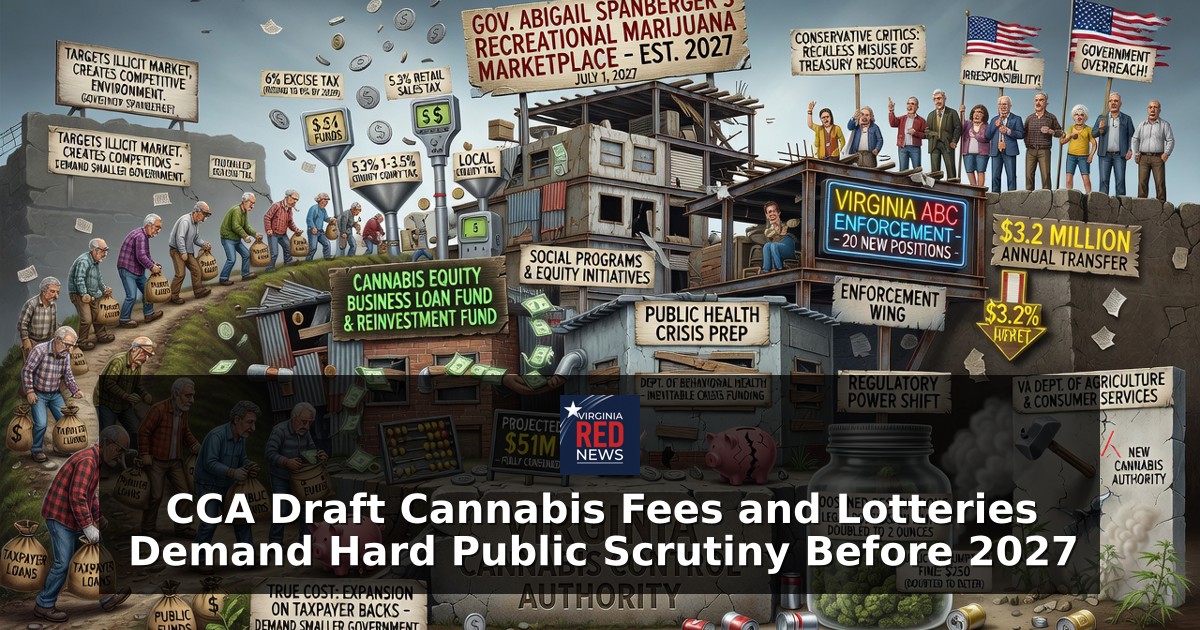
The Cannabis Control Authority’s draft recreational-market rules — fees, license caps and a Feb. 1 application start for a July 1, 2027 market open — deserve hard scrutiny from taxpayers who will live with the enforcement and social costs long after the ribbon cuttings.
Richmond BizSense detailed the fee stack: retail stores face a $4,000 application fee, $20,000 first-year operating fee and $15,000 annual renewals, with a statewide ceiling of 350 retail licenses. Microbusiness vertical licenses are cheaper ($1,000 apply, $2,500 initial, $6,000 renew) and pitched as a small-operator on-ramp. Cultivation tiers climb to a 35,000-square-foot Tier V canopy with only five licenses at first.
CCA acting head Jamie Patten says microbusiness pricing aims to help Virginia operators compete with multistate firms. Accountability question: will fee discounts and “impact” licenses — for owners tied to disproportionately policed or disadvantaged areas from 1999–2025 — be audited for true control, or become a loophole for well-capitalized pass-through ownership?
Lotteries for oversubscribed retail and cultivation licenses raise classic fairness concerns. Lotteries can prevent insider stacking, but they also invite ticket-farming and secondary-market pressure unless beneficial-ownership disclosures are strict. Testing-lab licenses may skip lotteries if demand is low — another place to watch for concentration.
The 18-month clock to become operational, with revocation for failure, is a meaningful accountability tool if enforced. Soft extensions under political pressure would recreate the worst of alcohol and gaming licensing: scarcity rents without service. Home-based businesses are barred, which closes an obvious enforcement nightmare but will push activity into commercial zones localities must police for odor, parking and youth access.
Phasing matters. Retail licenses are not expected in the first February batch, which prioritizes microbusiness, hemp processors, cultivators and labs. That sequence may strand would-be storefronts or, conversely, let medical incumbents line up supply before new retailers clear local zoning. Either way, the public should see clear timelines and denial reasons.
Reinspection fees after violations or expansions are appropriate if they recover costs rather than become a quiet tax. Virginians should ask the CCA to publish aggregate violation data by license type once the market opens. Transparency on enforcement is how regulated markets earn legitimacy — or expose capture.
Metrc seed-to-sale tracking and an OpenGov portal are necessary plumbing. They are not sufficient. Accountability also requires local law-enforcement training budgets, toxicology capacity for impaired driving, and honest metrics on ER visits, youth use and black-market prices after launch. States that sold legalization as a panacea often underbuilt those measurements.
The CCA board aims to finalize regs in December after stakeholder tweaks. That is the moment for localities, sheriffs, school boards and substance-use providers to put comments on the record — not six months after stores open. Draft status is not an excuse for silence; it is the last easy chance to fix fee, lottery and equity definitions.
Fiscal conservatives should model net revenue after regulatory costs, local enforcement and public-health offsets, not just gross excise projections. Social conservatives should focus on specific rule text: age verification, advertising near schools, serving sizes and sanctions for diversion. Both groups lose if debate stays at slogan level while the fee schedule quietly locks in.
Impact-license fee waivers need bright-line residency and ownership tests with audits. Without them, the equity program becomes a marketing brochure. With them, it can be evaluated on whether ownership actually broadens or simply relabels capital.
For existing medical dispensaries, dual-permit complexity will be a compliance minefield. Regulators should publish plain-language guides before February. Ambiguity at launch produces selective enforcement narratives that corrode trust across party lines.
Red Virginia News will watch whether the CCA’s lottery, fee and revocation rules are applied evenly — including to politically connected applicants. A regulated market that privileges insiders while advertising small-business opportunity would confirm critics’ worst expectations.
Bottom line: Virginia is building a recreational cannabis bureaucracy with real money at the door and a hard 2027 open date. The draft regs are the blueprint; accountability now means commenting, auditing ownership rules and insisting on enforcement metrics before the first legal adult-use sale.
Transparency Ali Faruk Andrew Breton Anne Holton Cheryl Burke Cynthia Newbille Ellen Robertson Emmett Jafari Equity Fees Katherine Jordan Kathryn Ricard Kenya Gibson Law Lottery Matthew Percival Nicole Jones Police Reva Trammell Richmond City Council Richmond School Board Sarah Abubaker Schools Shavonda Fernandez Stephanie Lynch Stephanie Rizzi Taxpayers Virginia Wesley Hedgepeth