Rural Virginians Stand to Lose Vital Voice on Medical Board
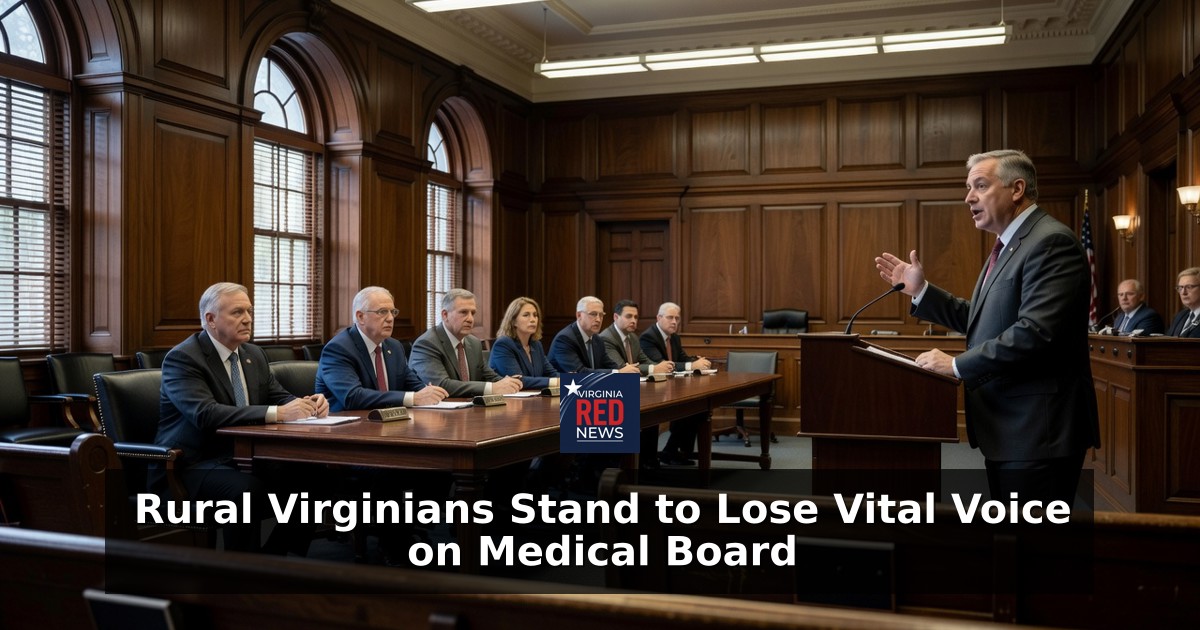
Legislation advancing in Richmond would eliminate the longstanding requirement that every congressional district hold a seat on the Virginia Board of Medicine, stripping rural communities of their only structural guarantee of representation on the panel that decides who may practice medicine and under what conditions. The board’s decisions on licensure, practice locations, and operating rules fall hardest on patients outside Northern Virginia, where the nearest specialist often sits an hour away and a nurse practitioner may serve as the sole provider in an entire county. Opponents argue the measure replaces balanced regional input with pure gubernatorial discretion, allowing any sitting governor to fill every seat without regard to geography or the distinct needs of rural patients. No evidence has been offered that any congressional district lacks qualified physicians willing to serve, leaving the true purpose of the change unexplained beyond the removal of the existing representation rule.
Conservative lawmakers and rural advocates see the proposal as another example of centralized power overriding local voices that have long protected traditional communities. Virginia’s rural counties depend on physicians who understand the realities of long travel distances, limited hospital resources, and workforce shortages that urban centers rarely face. Removing guaranteed seats from every district risks stacking the board with appointees drawn disproportionately from the densely populated corridors around Washington and Richmond. Such an imbalance would undermine the practical knowledge needed to craft rules that keep doctors practicing in small towns rather than driving them toward already well-served markets. The principle of fair representation remains essential to preserving access for families who cannot simply drive across the state for routine or emergency care.
Why Regional Balance Matters for Patient Care
The Board of Medicine sets the standards that determine whether a physician may open a practice, under what supervision nurse practitioners may operate, and how specialty services reach underserved areas. In many rural Virginia counties the nearest cardiologist, obstetrician, or orthopedic surgeon already requires a lengthy drive that becomes impossible for elderly patients or working parents without reliable transportation. When rules are written without input from doctors who live and work in those same communities, the resulting regulations often favor high-volume urban models that simply do not translate to sparse populations. Maintaining one seat per congressional district has ensured that physicians familiar with these challenges sit at the table when standards are debated and adopted. Eliminating that guarantee invites policies crafted by those who have never waited an hour for an ambulance or watched a clinic close because no replacement doctor could be recruited.
Supporters of the bill have labeled the change a modernization effort, yet they have failed to identify a single district unable to produce a competent physician ready to serve. That absence of justification raises legitimate questions about motives. Handing a governor unchecked authority to appoint every member concentrates power in a single office and removes the structural check that once forced geographic diversity. Future governors of either party would inherit the same open-ended discretion, creating permanent uncertainty for rural patients whose access to care already hangs by a thread. Conservatives have long defended the idea that government closest to the people governs best; this legislation moves in the opposite direction by silencing the very regions that most need a voice.
Protecting Rural Values and Practical Medicine
Rural Virginia embodies enduring values of self-reliance, neighborly responsibility, and skepticism toward distant bureaucracies that claim to know better than local practitioners. Families in these communities expect their elected officials to defend the institutions that keep doctors in town and clinics open. The current district-based requirement on the Board of Medicine reflects that expectation by ensuring every corner of the Commonwealth shares in the authority to set medical standards. Stripping away that requirement signals that rural concerns are expendable whenever convenience or political control becomes the priority in Richmond. Lawmakers who represent these areas have rightly warned that the heaviest consequences will land on the same voters who already struggle with workforce shortages and hospital closures.
The practical stakes extend beyond abstract governance. When the board debates scope-of-practice rules or continuing-education mandates, rural physicians bring firsthand knowledge of how those rules affect solo practitioners who cannot afford large compliance staffs. Without their presence, urban-centric perspectives dominate and produce regulations that accelerate the exodus of doctors from small towns. Patients then face longer waits, higher travel costs, and in some cases the complete loss of local services. Conservative principles hold that government should expand opportunity rather than erect new barriers; guaranteeing regional seats has been one modest way to keep opportunity alive for rural patients and the physicians who serve them.
A Call for Accountability and Common Sense
Virginia deserves a Board of Medicine that reflects the full geographic and cultural diversity of the Commonwealth rather than the preferences of whichever governor holds office. The existing requirement of one representative per congressional district has provided that reflection without any demonstrated hardship in finding qualified candidates. Repealing it serves no public-health purpose that has been publicly articulated and instead concentrates appointment power in a manner inconsistent with limited-government ideals. Rural delegates and senators who rose in opposition have underscored that communities outside Northern Virginia cannot afford to lose their seat at the table. Their warning deserves serious attention from colleagues who claim to value fairness and practical results over partisan convenience.
Preserving the district-based structure would reaffirm that every Virginian, regardless of zip code, retains a voice in the rules governing medical practice. It would also honor the conservative conviction that durable institutions protect ordinary citizens from the shifting winds of political fashion. Lawmakers still have the opportunity to reject this unnecessary centralization and keep the Board of Medicine accountable to the entire state. Rural families watching the debate expect nothing less than a clear defense of the representation that has long safeguarded their access to care. The choice before the General Assembly is whether to uphold that safeguard or surrender it to unchecked executive discretion.
Board of Medicine congressional districts district mandates February session governor appointments healthcare access legislative session Medical Board medical licensing medical practice rules NOVA nurse practitioners opposition bill physician requirements rural healthcare rural representation rural Virginians specialist access state government unchecked power Virginia Virginia politics