Virginia Lawmakers Urged to End Driver Privilege Cards Amid Resource and Safety Concerns
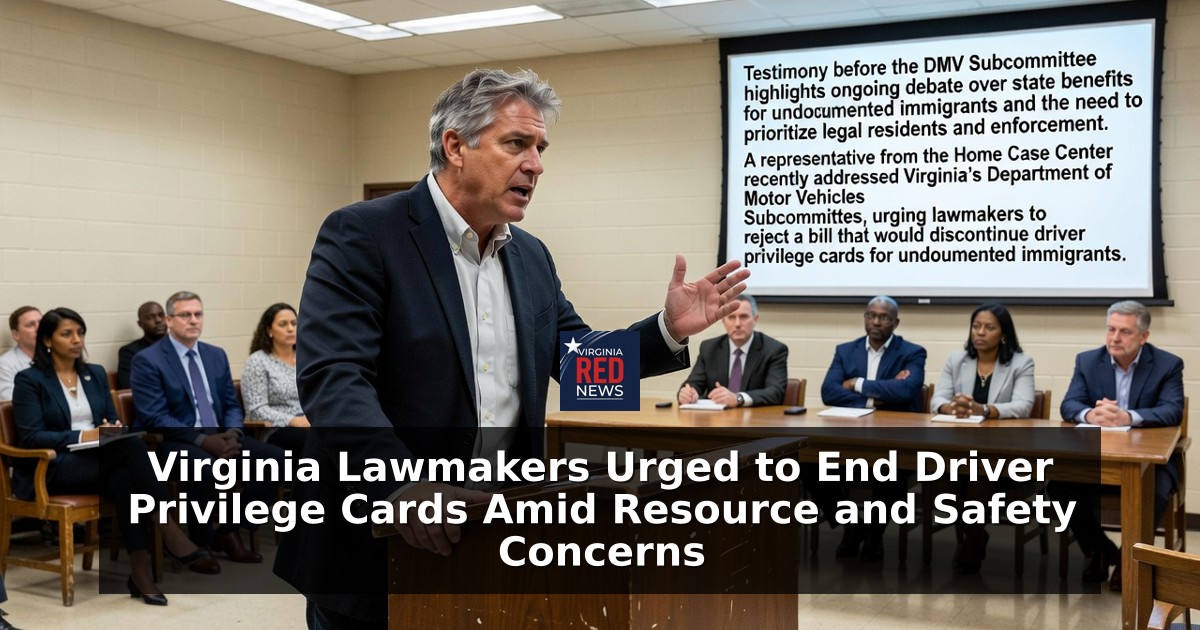
A representative from the Home Case Center recently addressed Virginia's Department of Motor Vehicles Subcommittee, urging lawmakers to reject a bill that would discontinue driver privilege cards for undocumented immigrants. Ashley Elstad recalled the 2020 introduction of these cards and described the relief they supposedly brought by allowing individuals without legal status to drive without immediate fear of deportation stops. Elstad argued that current fears in immigrant communities are already elevated and that ending the cards would add unnecessary pressure on daily activities. Conservative voices across the Commonwealth view this testimony as a clear call to reexamine whether limited state resources should continue supporting those who entered or remained in the country unlawfully.
The core issue centers on fundamental questions of fairness, public safety, and the proper role of state government. Driver privilege cards, first secured in 2020, grant driving privileges to people who cannot demonstrate legal presence in the United States. From a conservative standpoint rooted in respect for the rule of law, such programs undermine the principle that benefits and privileges should flow first to citizens and legal residents who follow the established immigration process. Continuing these cards signals that Virginia will accommodate illegal presence rather than enforce existing statutes, which erodes trust in government institutions among law-abiding taxpayers.
Fiscal responsibility demands careful scrutiny of every program that draws on state funds and administrative capacity. Issuing and maintaining driver privilege cards requires DMV staff time, technology systems, and verification processes that could otherwise serve Virginia citizens waiting for standard licenses or identification. Conservatives maintain that every dollar and every hour spent on services for undocumented immigrants is a dollar and hour diverted from roads, schools, and public safety needs that directly benefit legal residents. In an era of tight budgets and competing priorities, lawmakers have a duty to ask whether this particular benefit aligns with the values of self-reliance and ordered liberty that built the Commonwealth.
Public safety considerations further strengthen the case for ending the cards. Allowing individuals who lack legal status to obtain official driving credentials can complicate law enforcement efforts when officers encounter drivers during routine stops or investigations. Conservative principles emphasize that secure communities depend on clear distinctions between those who respect the law and those who do not. Heightened concerns about immigration enforcement, as noted in the testimony itself, actually underscore the need for consistent state policies that do not create safe harbors or reduce incentives for compliance with federal immigration requirements.
Community engagement arguments raised by supporters of the cards fail to outweigh the deeper moral obligation to uphold legal immigration pathways. Legal immigrants who waited their turn, learned English, and contributed through proper channels often express frustration when special privileges appear available to those who bypassed the system. Virginia families who play by the rules deserve a government that rewards their patience and integrity rather than diluting standards. Ending driver privilege cards would reaffirm that the Commonwealth values lawful conduct and refuses to normalize unlawful presence through official documentation.
The testimony before the DMV Subcommittee also invites broader reflection on how Virginia balances compassion with accountability. True compassion includes protecting the integrity of citizenship and ensuring that state services remain sustainable for future generations. Conservatives reject the notion that discontinuing a 2020 program equates to cruelty; instead, it represents a return to first principles where government does not subsidize or facilitate violations of immigration law. Lawmakers listening to such appeals should weigh the long-term cultural message sent when official state credentials are extended without regard to legal status.
Enforcement priorities must remain front and center in any serious policy discussion. Virginia cannot effectively partner with federal authorities on immigration matters if state agencies simultaneously issue documents that ease daily life for those subject to removal. The Home Case Center speaker's own reference to fear of deportation illustrates the reality that undocumented status carries inherent legal consequences. State policy should not attempt to erase those consequences by creating parallel systems of privilege. Doing so confuses residents, burdens local police, and weakens the deterrent effect that clear rules provide.
Looking ahead, the subcommittee faces a straightforward choice grounded in conservative values of limited government, personal responsibility, and equal application of the law. Opposing the bill to keep the cards, as urged in the testimony, would perpetuate a program that many Virginians already see as an unjust allocation of resources. Supporting the measure to discontinue the cards would restore proper boundaries, free DMV capacity for citizens, and send an unambiguous signal that Virginia stands with legal immigration and against open-ended benefits for unlawful presence. The facts presented make plain that the cards originated as a relief measure for undocumented immigrants; continuing them now only deepens the original policy error.
Virginia's strength has always rested on ordered liberty and respect for the laws that protect its people. Driver privilege cards introduced in 2020 represent a departure from that tradition by treating legal status as optional for access to official driving credentials. Conservative Republicans across the state recognize that reversing course is not punitive but restorative. It protects taxpayers, supports law enforcement, and honors the millions of legal residents who built their lives the right way. The DMV Subcommittee should therefore advance the bill and reject calls to preserve a flawed program that places undocumented interests ahead of the Commonwealth's foundational commitments.
community safety daily life impacts deportation concerns DMV Subcommittee driver privilege cards driving privileges engagement in communities fear of enforcement Home Case Center immigrant community oppose the bill policy change public resources state offered resources state services testimony hearing undocumented immigrants Virginia Virginia bill Virginia DMV